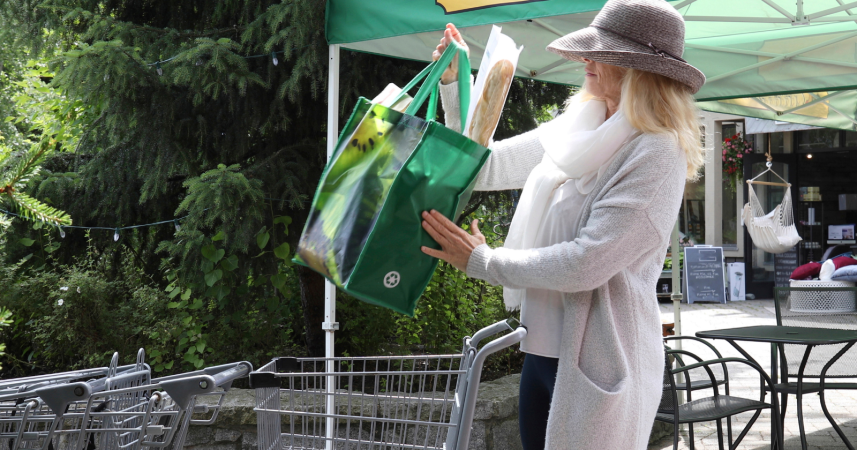
It’s the smallest actions, taken when no one is paying attention, that quietly shape our identity over time.

Add VegOut to your Google News feed. 
We all know the moment.
You have finished your grocery run. Your phone is buzzing. The car is parked far away.
The cart corral might as well be in another zip code.
And there it is. That tiny internal debate.
Do you leave the cart next to your car and move on with your life?
Or do you walk it back, even though no one would blame you for not doing it?
It sounds small.
Almost stupidly small.
But psychology suggests this moment says a lot about who someone is.
In fact, researchers and behavioral psychologists often point to these low-stakes situations as some of the most revealing indicators of character.
Not the moments where rewards are big or consequences are obvious.
The moments where doing the right thing costs you a bit of effort and gives you nothing in return.
As someone who spent years in luxury hospitality, I can tell you this tracks.
The best people I worked with were never the ones performing when managers were watching.
They were the ones who quietly reset a table properly after a long shift, or stayed an extra minute to help a teammate, even when no one was counting.
So what does psychology say about the people who return their carts anyway.
Here are eight integrity traits they tend to display and why those traits show up everywhere else in their lives too.
1) They take responsibility without needing supervision
Returning a shopping cart is a responsibility that no one enforces.
There is no fine.
No security guard.
No angry email waiting for you later.
Psychologically, this taps into something called internalized responsibility.
People with this trait do the right thing because they see it as their role, not because someone is watching or rewarding them.
I saw this constantly in restaurants.
The strongest servers were not the ones who only polished glasses when a manager walked by.
They did it because they believed it was part of the job, part of their identity.
People who return carts tend to carry this mindset everywhere.
At work, they follow through without reminders.
In relationships, they own their mistakes.
In life, they do not outsource accountability.
They act like adults even when no one forces them to.
2) They respect shared spaces
A parking lot is a shared environment.
So is an office kitchen. A gym. A sidewalk. A dining room.
When someone takes the extra step to return their cart, they are signaling something subtle but powerful.
They care about how their actions affect people they will never meet.
Psychologists often link this to prosocial behavior, actions that benefit others even at a personal cost.
In food and hospitality, this trait is gold.
The chefs who clean as they go, even when service is chaotic, are thinking about the next person who has to use that space.
The cooks who leave their station better than they found it are thinking beyond themselves.
People who respect shared spaces tend to be better coworkers, better neighbors, and frankly, better humans.
3) They have a strong internal moral compass
Some people need rules to tell them what is right.
Others already know.
Returning a shopping cart is not about rule-following.
It is about values.
You either believe leaving it out is wrong, or you do not.
Psychologists call this an internal moral compass.
It guides behavior even in morally neutral situations where the stakes are low.
I remember working with a sommelier early in my career who always rechecked inventory after closing.
No one asked him to.
No one audited him.
He just believed accuracy mattered.
That same belief showed up in how he treated guests, how he trained juniors, and how he handled conflict.
Cart returners tend to operate the same way.
Their ethics are portable.
They do not change depending on who is watching.
4) They delay gratification easily
Walking a cart back is inconvenient.
It costs time.
It costs effort.
It delays the reward of getting into your car and moving on.
Psychology has long linked small acts like this to delayed gratification, the ability to tolerate minor discomfort now for a better outcome later.
This trait shows up everywhere.
In people who cook at home instead of defaulting to fast food.
In people who train consistently instead of chasing shortcuts.
In people who invest patiently rather than gambling impulsively.
In my own life, I have noticed that the more disciplined I am in small, annoying moments, the easier big discipline becomes.
Returning the cart is like a micro-rep for self-control.
You either train it, or you do not.
5) They think long-term, not just in the moment
 Leaving a cart loose might save you thirty seconds.
But it creates a future problem.
For someone else.
Or for you later when a cart dents your door.
People who return carts tend to think a step ahead.
They consider downstream effects, even when those effects are abstract.
This is the same mindset that leads someone to clean up their diet before health issues appear, or to save money before an emergency hits.
In kitchens, the best operators think this way constantly.
They prep early.
They organize storage.
They anticipate bottlenecks before service explodes.
Psychology links this to future-oriented thinking, a trait associated with better career outcomes, healthier habits, and stronger relationships.
Cart returners are not just polite.
They are strategic.
6) They do not need praise to behave well
Here is the thing about returning a shopping cart.
No one claps.
No one says thank you.
No one gives you a gold star.
And that is exactly the point.
People who do it anyway tend to be intrinsically motivated.
Their reward comes from knowing they acted in alignment with their values, not from external validation.
This is huge.
In my experience, the most grounded people I know do not post every good deed online.
They do not fish for compliments.
They quietly do the work.
Psychologists consistently find that intrinsic motivation leads to more sustainable behavior.
When you rely on praise, you burn out the moment it disappears.
Cart returners behave well even in silence.
That silence does not scare them.
7) They experience less cognitive dissonance
Cognitive dissonance is the mental discomfort we feel when our actions conflict with our beliefs.
If you believe you are a considerate person but leave your cart in the middle of the lot, something has to give.
Either you change the behavior, or you change the story you tell yourself.
People who return carts reduce this friction.
Their actions match their self-image.
That alignment matters more than it sounds.
When your behavior consistently reflects your values, you waste less mental energy justifying yourself.
You make decisions faster.
You feel calmer.
You trust yourself more.
I noticed this shift when I started tightening up small habits like cleaning my kitchen before bed or prepping meals for the next day.
The external benefit was minor.
The internal peace was not.
Cart returners live with less internal noise because they do not constantly have to explain themselves to themselves.
8) They behave consistently even when no one is watching
Finally, this is the trait that ties everything together.
Consistency.
Psychology shows that character is not revealed in big, dramatic moments.
It is revealed in patterns of small, boring behavior.
Returning a shopping cart when the corral is far away is boring.
It is unsexy.
It is inconvenient.
And that is exactly why it matters.
People who do it tend to behave the same way across contexts.
They are not one person in public and another in private.
They do not need an audience to be decent.
In food, in business, in relationships, these are the people you want around.
They show up. They clean up. They follow through.
Not because they have to.
But because that is who they are.
The bottom line
It is tempting to dismiss the shopping cart test as internet psychology fluff.
But when you zoom out, it makes a lot of sense.
Low-stakes decisions strip away incentives and expose values.
They show us how someone behaves when effort is required and no reward is guaranteed.
Whether it is returning a cart, wiping down a counter, or choosing the harder but better option with your diet, these small choices compound.
They shape identity.
So next time you are standing in a parking lot, keys in hand, cart beside you, ask yourself a simple question.
Who am I when no one is watching.
The answer tends to show up in the smallest actions.
What’s Your Plant-Powered Archetype?
Ever wonder what your everyday habits say about your deeper purpose—and how they ripple out to impact the planet?
This 90-second quiz reveals the plant-powered role you’re here to play, and the tiny shift that makes it even more powerful.
12 fun questions. Instant results. Surprisingly accurate.