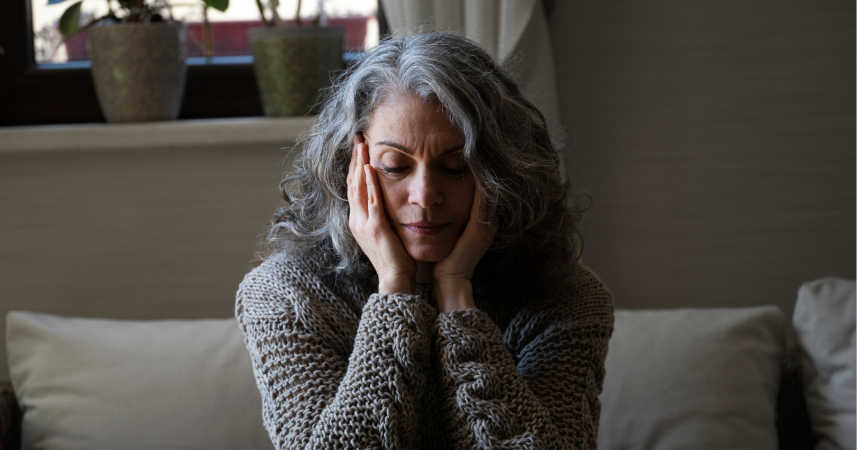
She thought she was tired from raising kids alone and working two jobs, but at 68, she discovered the real exhaustion came from decades of shrinking herself into the convenient version everyone needed her to be.

Add VegOut to your Google News feed. 
Last Tuesday, I found myself sitting in my car outside the grocery store, engine running, unable to move for twenty minutes. Not crying, not panicking, just sitting there with my hands on the wheel, staring at nothing.
At 68, I finally understood what had been building inside me for decades. The exhaustion that hits around 58 isn't from overwork or illness. It's from three decades of being the version of yourself that made everyone else's life easier.
You know the version I mean. The one who says "I'm fine" when your marriage is crumbling but you don't want to worry your aging parents.
The one who volunteers for the school fundraiser even though you're working two jobs, because good mothers do that. The one who smiles through family dinners where your opinions are dismissed with loving pats on the hand. That version of fine becomes so automatic that you forget you're performing it.
The weight of invisible labor
When I was raising my children alone for fifteen years, working two jobs to keep us afloat, people would marvel at how I "had it all together."
What they didn't see was me sitting in the bathroom at 2 AM, door locked, eating cereal straight from the box because it was the only moment I had to myself. I performed capable so well that nobody thought to ask if I needed help.
And honestly? I wouldn't have known how to accept it if they had.
The exhaustion I'm talking about isn't physical, though your body certainly keeps score. It's the bone-deep weariness that comes from translating your needs into something palatable for decades.
"I need a break" becomes "Maybe we could eat out tonight?" "I'm drowning" becomes "Things are a little hectic right now." "I don't recognize myself anymore" becomes silence, because who has time for an existential crisis when there's laundry to fold?
Women of my generation were taught that our value came from our usefulness to others. We learned to read rooms before we learned to read our own hearts.
We became emotional translators, shock absorbers, and peace keepers. We managed everyone's feelings while ours went unexamined, like old letters stuffed in a drawer.
When your body starts keeping score
The exhaustion often manifests physically first. Maybe it's the headaches that start in your mid-fifties, or the way your shoulders live somewhere near your ears.
For me, it was waking up one morning unable to turn my neck. The doctor said it was stress. I laughed and asked him whose life wasn't stressful. He didn't laugh back.
I started yoga at 58, partly for my aching back but mostly because my sister had just died of ovarian cancer at that same age, and suddenly time felt different. Finite. In that first class, lying in child's pose, the instructor said, "Let your body be heavy. Stop holding yourself up."
I started crying and couldn't stop. Thirty years of holding myself up, holding it all together, holding my tongue, and I'd forgotten what it felt like to just... stop.
Your body remembers every time you swallowed your anger instead of expressing it. Every time you smiled when you wanted to scream. Every time you said yes when your whole being was saying no.
By 58, you're carrying the physical weight of a thousand small betrayals against yourself.
The convenient fiction of "fine"
Here's what nobody tells you: everyone around you has a vested interest in you being fine. Your adult children need you to be fine because they're overwhelmed with their own lives. Your partner needs you to be fine because examining your unhappiness might mean examining their role in it. Your friends need you to be fine because your not-fineness might reflect something about their own lives they're not ready to see.
So you perfect the performance. You become so good at it that you fool yourself. You tell yourself that keeping the peace is noble, that sacrifice is love, that your needs can wait until... when? Retirement? When the kids are settled? When your parents no longer need care? There's always another reason to delay your reckoning with yourself.
I remember reading Virginia Woolf in college, something about women serving as looking glasses reflecting men at twice their natural size. At 22, I thought I understood it. At 58, I realized I'd spent decades being a looking glass for everyone, reflecting back what they needed to see while my own image grew smaller and fainter.
The awakening that comes with exhaustion
But here's the unexpected gift of this exhaustion: it forces you to stop. You literally cannot continue the performance. Your body rebels, your mind fogs, your spirit says enough. And in that stopping, something shifts.
Therapy at 56 felt like learning a new language. The language of boundaries, of authentic expression, of needs that didn't require justification. My therapist asked me to describe what I wanted without using the words "just" or "only" or explaining why I deserved it. I sat there for ten minutes, unable to speak. The woman who had taught high school English for 32 years couldn't form a simple sentence about her own desires without minimizing them.
The exhaustion is real, and it's valid, and it's not your fault. It's the natural consequence of a system that taught you to be endlessly flexible, endlessly giving, endlessly fine.
But recognizing it is the first step toward something else. Not recovery exactly, because you can't recover what was never fully yours to begin with. More like discovery. Of who you are when you stop performing. Of what you want when you stop translating. Of how much energy you have when you stop spending it on being convenient.
Final thoughts
That day in the grocery store parking lot, I finally went inside and bought flowers. Not for anyone's birthday or anniversary. Just because I wanted them. The cashier said, "Someone's lucky!" and I replied, "Yes, I am." She looked confused, but I didn't explain. Some truths don't need translation.
At 68, I'm learning that the exhaustion was never about doing too much. It was about being too little of myself for far too long.
What’s Your Plant-Powered Archetype?
Ever wonder what your everyday habits say about your deeper purpose—and how they ripple out to impact the planet?
This 90-second quiz reveals the plant-powered role you’re here to play, and the tiny shift that makes it even more powerful.
12 fun questions. Instant results. Surprisingly accurate.