
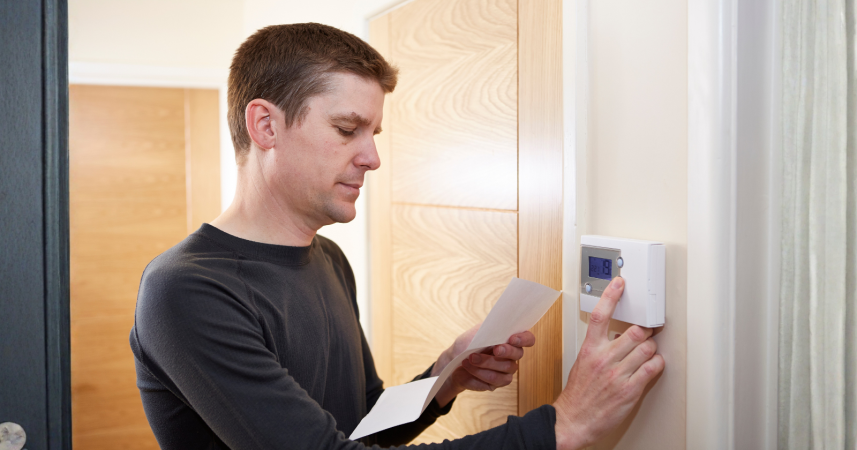
If your family argued about the thermostat every winter, you’ve been given a strange gift: You have a clear, memorable example of how class lives in everyday life.

Add VegOut to your Google News feed. 
There are a few sounds that instantly take me back to childhood.
A screen door slamming, a kitchen drawer full of tangled batteries and takeout menus, and someone yelling, “Who touched the thermostat?”
It’s funny how a small plastic box on the wall can hold so much history because the thermostat fight is almost never about the thermostat.
It’s about comfort, sure, but it’s also about fear, control, scarcity, pride, and the quiet rules you absorbed without realizing it.
It’s about what warmth meant in your house, what it cost, and who was allowed to decide.
If you grew up in a home where the heat was treated like a luxury item, you don’t need a sociologist to tell you what class you grew up in.
You feel it in your body, and you feel it when you reach for the dial, hesitate, and hear an old voice in your head.
Let’s talk about what those winter arguments were really teaching you, and how to loosen their grip now:
The thermostat is rarely the real issue
In my experience, most family fights have a “front door” and a “back room.”
The front door is the thing you’re technically arguing about.
The back room is what you’re actually protecting.
The thermostat is a perfect front door topic because it’s concrete.
You can point to a number, you can blame a person, or you can declare a rule.
However, the back room is usually something like: “Are we safe?” or “Do we have enough?” or “Will we be okay if something goes wrong?”
Heat is basic, survival, and the kind of need that makes people emotional fast.
If your household ran on tight margins, the furnace was a potential crisis.
One weird noise could mean a repair bill you didn’t have; one high utility statement could mean you had to juggle something else.
Even if no one said that out loud, your nervous system picked it up.
That’s why adults can still get weirdly intense about the temperature, even when they can afford it now.
Your brain files it under “threat” long before it files it under “comfort.”
What your “normal” temperature says about your childhood
Some families keep the house warm enough that you can walk around in a T-shirt in January, while other families treat layers like a moral value.
I’ve known people who grew up thinking it was normal to wear a hoodie indoors, to sleep under a mountain of blankets, to take quick showers because hot water “runs money,” to only heat the room you’re in.
Meanwhile, other people grew up in houses where the heat was just on, like the lights.
Neither is inherently better, but they create different default settings in your head.
If you grew up in a colder house, you may carry a subtle belief that comfort is something you earn.
You may be great at tolerating discomfort, you may pride yourself on being low maintenance, and you may even judge yourself when you want something simple, like warmth, because a part of you still associates it with waste.
If you grew up in a warmer house, you might carry a different assumption: That comfort is normal and expected, and that the environment should adapt to you.
Money stress turns small choices into moral battles
When money is tight, every decision starts to feel like character.
This is one of the sneakiest psychological effects of scarcity.
So, a thermostat adjustment becomes a story about responsibility:
- “Put on a sweater” can mean “We’re not made of money.”
- “Stop being dramatic” can mean “We have bigger problems than your cold feet.”
- “Don’t touch that” can mean “I’m trying to keep us afloat and you’re making it harder.”
If you had a parent who policed the thermostat, it may have been because they were carrying the entire weight of the household in their head, doing math you never saw.
I worked as a financial analyst for years, and I can tell you something that changed the way I look at these dynamics: The numbers live in people.
When your margin is thin, you experience them as a verdict.
You guard the dial and the kid who just wants to feel warm learns a lesson that follows them into adulthood: Wanting comfort can be dangerous.
The class lessons we internalize and don’t question

Class is also about the habits and beliefs you develop to survive your income.
Thermostat culture is one of those weirdly accurate signals because it reveals the household’s relationship to resources.
In some homes, you assume you can solve discomfort with spending; in other homes, you solve discomfort with endurance.
If your family argued about the heat, you may have learned things like: It’s risky to ask for more.
You should minimize your needs, and someone has to be the enforcer.
If you relax, something bad will happen.
Even if your adult life looks totally different now, those lessons can stick.
You might be the person who keeps their apartment colder than they want because “it’s fine,” or the person who panics when the utility bill is higher than expected, even if it’s still affordable.
Moreover, you might swing the other way, like you might blast the heat as a form of rebellion as if you’re proving something to your past.
I’ve seen both patterns: “I don’t deserve comfort” and “I will never be cold again” are two sides of the same childhood coin.
Why these fights can show up in relationships
Adult relationships are where our old class scripts get tested because now you’re dealing with someone else’s “normal,” too.
One person thinks 68 degrees is reasonable, while the other thinks it’s basically the Arctic; one person sees the heating bill as a manageable expense, while the other sees it as a flashing warning sign.
“I’m cold” might be heard as “You don’t care about me.”
“Turn it down” might be heard as “You’re irresponsible.”
If this is hitting close to home, try this experiment the next time you feel activated about the thermostat: Pause and ask yourself, What story am I telling right now?
Is it “We’ll run out,” “I’m not allowed,” “No one listens to me,” or “I always have to be the adult?”
That story is worth more attention than the temperature itself.
If you can say it out loud, gently, it changes everything.
“This is making me anxious because I grew up with money stress” lands very differently than “Why do you always do this?”
Rewriting the script without shaming your past
If you grew up with strict thermostat rules, that may have been genuinely necessary.
Your family might have been doing their best with what they had.
There’s no need to rewrite history into villains and victims, but there is a need to separate past survival from present reality.
Here’s a simple question I use when I catch myself in an old scarcity reflex: Is this a current problem or an inherited fear?
Sometimes the answer is “current problem,” and sometimes money really is tight and the responsible move is to keep the heat lower.
Aa lot of the time, the answer is “inherited fear,” and the fear deserves compassion, not obedience.
One way to work with this is to create a comfort budget.
A clear decision that says: “I’m allowed to spend X per month on being warm, because warmth supports my sleep, mood, and health.”
When you give comfort a legitimate place in your values, it stops feeling like a sneaky indulgence.
Another approach is to make comfort more efficient instead of more taboo.
If you grew up hearing “put on a sweater,” you can keep the spirit of that advice without the shame.
As a vegan who spends weekends around farmers’ markets and home gardens, I’m naturally interested in how small systems add up.
A house is a system, your body is a system, and you can make warmth a mindful choice.
The goal is to become the kind of adult who can meet a need without spiraling.
Turning a thermostat fight into self-knowledge
If your family argued about the thermostat every winter, you’ve been given a strange gift: You have a clear, memorable example of how class lives in everyday life.
Here’s the real self-development move: Use that memory as a mirror.
Adulthood is about updating your internal rules to match your current life.
You’re allowed to keep the strengths your upbringing gave you, like resourcefulness and awareness, and you’re also allowed to release the parts that keep you tense, like chronic guilt around basic comfort.
The next time you’re tempted to argue about the thermostat, try something radical.
Turn it into a check-in, not “Who touched it?” but “What’s coming up for me right now?”
Sometimes the warmest thing you can do in winter is lowering the defensiveness and giving yourself permission to live like you’re safe now.












