

Christmas morning traditions are the fingerprints of what a family has had to survive, stretch, and solve.

Add VegOut to your Google News feed. 
Christmas morning can look wildly different depending on what a family has lived through financially.
Money changes your nervous system; it changes what feels safe, what feels risky, and what feels like love.
I grew up around a lot of people who knew how to stretch things.
Later, when I worked as a financial analyst, I also saw the other side: Households where the numbers were so comfortable that certain worries never even made it onto the radar.
That gap shows up in tiny Christmas-morning habits that can feel totally normal to one family and totally baffling to another.
As you read, I want you to do one thing: Notice what you feel.
Pride? Tenderness? Embarrassment? Grief? Judgment?
Whatever comes up is information, it’s your story trying to be heard.
1) Checking the bank balance before the stockings
Have you ever watched someone try to “be present” while their brain is doing math in the background?
In a lot of working families, Christmas morning includes a quick, quiet moment with a phone screen because the bills do not pause for peppermint.
It can look like this: Coffee in hand, everyone still half-asleep, and a parent glancing at the account to make sure rent, utilities, and the next grocery run are still doable.
Sometimes they do it in the bathroom, and sometimes they do it with a smile on their face, because that’s what love looks like in a tight month.
Psychologically, this is scarcity management.
When resources are limited, your brain becomes hyper-alert to threats.
Even on a joyful morning, it’s scanning.
If you grew up with this, you might still do it now, even if you’re doing fine.
Your body remembers.
2) A full-on “wrap audit” before anyone opens anything
Some families do the slow, aesthetic gift-opening thing.
One present at a time, carefully, with photos and soft music.
In many lower-middle homes, Christmas morning has a different energy: An inventory vibe.
You see people scanning tags, counting gifts, sorting piles by person, making sure no one got “shorted,” and checking if the little one has enough to keep up with siblings because fairness is emotional safety.
When money is tight, gifts can accidentally become proof of worth.
No one wants a child to feel less loved because there were fewer boxes.
I’ve seen parents do quiet mental gymnastics like, “Okay, she has three bigger ones, he has five smaller ones, that’s roughly even.”
It’s sweet, it’s exhausting, and it’s also a sign that love has been forced to speak the language of objects.
Takeaway: If you’re a grown-up now, practice separating love from quantity.
Say it out loud, even just to yourself: “My value is not measured in wrapping paper.”
3) The “we’ll eat later” breakfast that turns into a snack scavenger hunt
When you don’t have a lot, you become creative with timing.
Christmas morning in a lot of households is fueled by whatever is easiest: Cinnamon toast, instant oatmeal, leftover pie, the last of the hot chocolate mix, maybe a handful of candy before noon.
Yes, it can become a little chaotic.
Kids tearing through gifts while adults are trying to keep everyone fed without launching a full sit-down breakfast that creates more dishes, more stress, and more expense.
Wealthier families might find this “messy” or “unstructured,” but it’s often strategic.
When your budget is tight, you keep things simple so the day stays manageable.
Also, food carries emotion.
If holidays were stressful, your body might crave quick sugar for comfort.
That’s your nervous system doing what it knows.
4) The immediate “save the bags, save the boxes” reflex
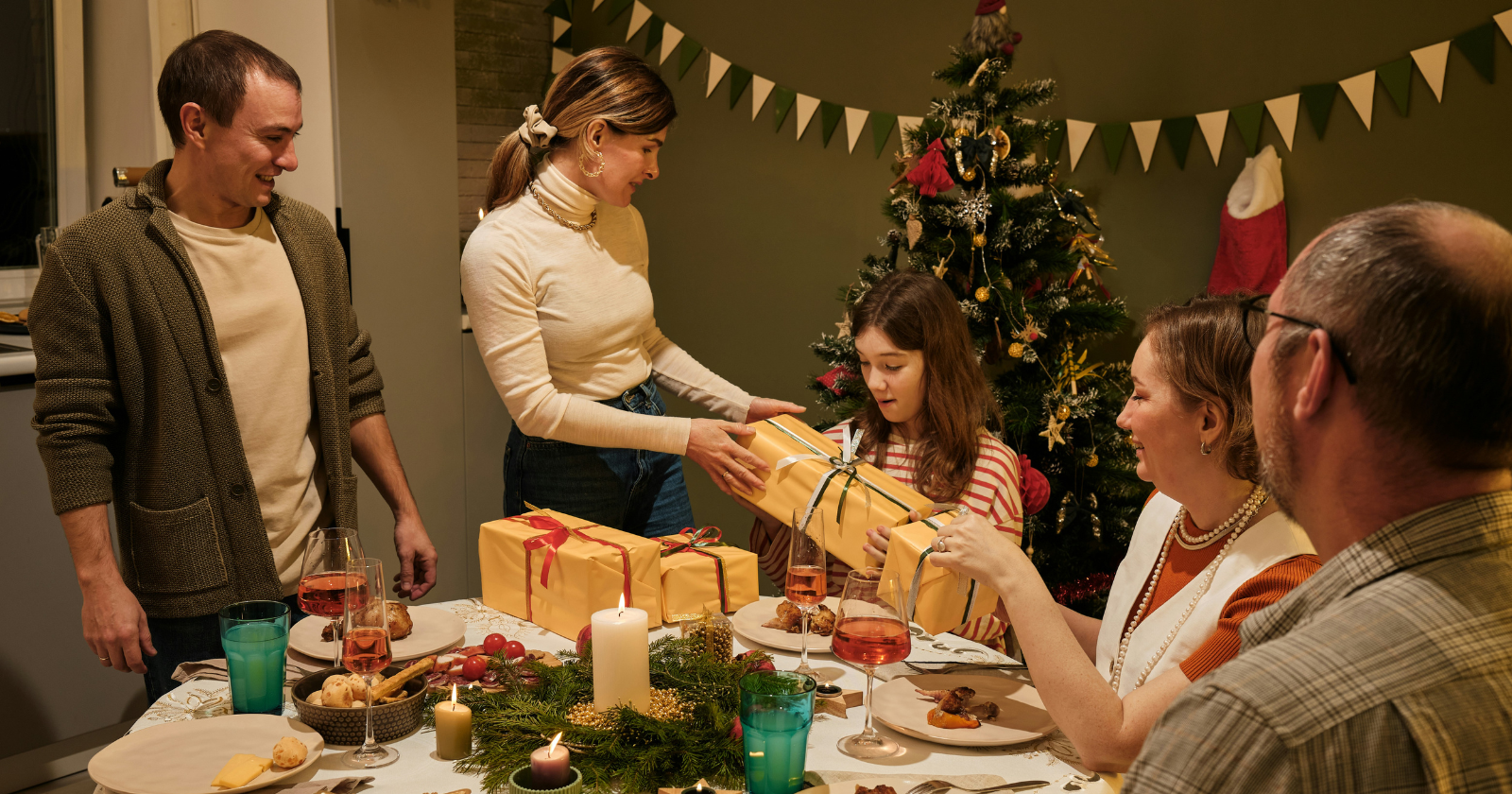
Some people finish opening gifts and immediately start breaking down packaging.
Others, especially families who’ve had to make things last, go into preservation mode.
Gift bags get folded perfectly and stored, tissue paper gets smoothed out, ribbons are wound around a hand like it’s a valuable resource (because it is), boxes are stacked in a closet “just in case,” batteries get saved, receipts get filed, and someone says, “Don’t rip it! We can reuse that!”
If you didn’t grow up like this, it might look like being overly serious about trash.
However, in a scarcity household, it’s future utility.
This habit is also about control: When you can’t control the economy, you control what you can: wrapping paper and storage bins.
5) The “one big gift” rule and the quiet pressure it creates
In lots of lower-middle families, there’s a common strategy: One big present plus a few small ones.
It’s practical, budget-friendly, and also concentrates a lot of emotional weight into one item.
That “big gift” can become the symbol of whether the holiday “worked.”
If it lands well, everyone relaxes; if it disappoints, it can feel like the whole morning is ruined, even if that’s not true.
I’ve watched adults hold their breath when a kid opens the main present because they’ve invested time, money, and hope into something that’s supposed to create joy.
When money is tight, you don’t get unlimited tries.
6) The “take a picture with it” moment that’s really about proof
In wealthier circles, photos can be about aesthetics or memory; in more budget-conscious families, photos can quietly become documentation.
A child holds up the new shoes and someone says, “Let me get a pic for your grandma.”
A parent snaps the toy still in the box; sometimes it’s for relatives, sometimes it’s for social media, and sometimes it’s for themselves.
When you’ve spent months making something happen, you want evidence it happened.
There’s also another layer: When money has been a source of shame, proof becomes protection.
A photo says, “We’re okay. We did it. The kids have something.”
It’s a way to soothe the part of you that worries you’re failing.
7) The post-gift “now we clean and prepare” sprint
Some households treat Christmas morning like the beginning of a lounge day.
In many working families, Christmas morning is followed by a fast transition into responsibility mode.
Cleaning up wrapping paper quickly because the living room is small, getting everyone dressed because you’re going to someone else’s house, packing food because bringing a dish is expected, and setting aside time for a shift later because holiday pay matters.
Wealthier families might find the urgency confusing but, when you have fewer resources, you rely more on planning, favors, and timing.
Community becomes the safety net, and community requires effort.
Final thoughts
If any of these made you laugh, wince, or tear up a little, you’re not alone.
Christmas morning traditions are the fingerprints of what a family has had to survive, stretch, and solve.
Here’s the part I really want you to take with you: You can honor where you came from without staying trapped in the stress patterns that came with it.
Ask yourself, “What do I want to keep? What do I want to soften? What do I want to stop passing down?”
Growth means choosing what you carry forward.












