
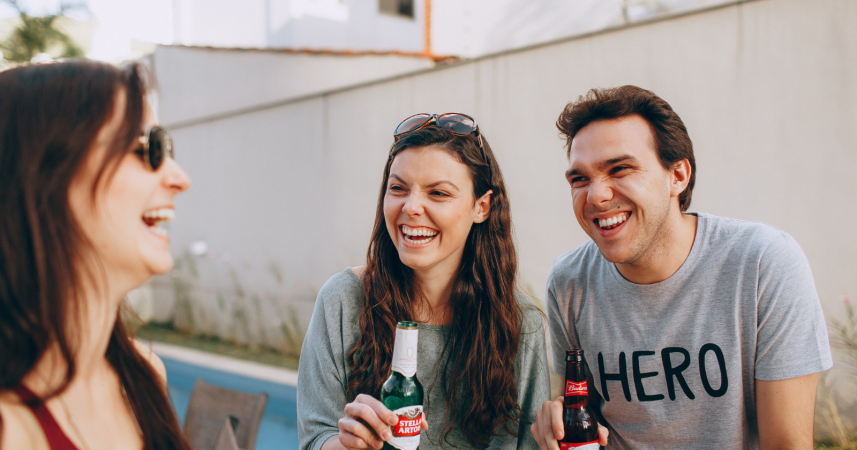
At any given party in America right now, someone is meticulously destroying a beer label. While their mouth says "totally fine, thanks for asking," their fingers are conducting a careful archaeology of adhesive, excavating a Stella Artois or a Topo Chico with the focus of someone defusing a bomb. By night's end, their spot at […]

Add VegOut to your Google News feed. 
At any given party in America right now, someone is meticulously destroying a beer label. While their mouth says "totally fine, thanks for asking," their fingers are conducting a careful archaeology of adhesive, excavating a Stella Artois or a Topo Chico with the focus of someone defusing a bomb. By night's end, their spot at the table looks like a craft store explosion—tiny paper casualties of social survival.
We all know these people. We are these people. In an era of $200 weighted blankets and breathing apps that send push notifications to remind you to inhale, the label peelers have found their own anxiety management system: free with purchase, biodegradable, and socially acceptable in a way that, say, screaming into the void typically isn't.
But here's what I've noticed after years of careful observation (conducted, yes, while peeling my own labels): This particular nervous habit isn't random. The people who systematically denude bottles at social gatherings share a specific constellation of traits that extends far beyond their adhesive destruction. They're not just fidgeters—they're a particular type of person trying to solve the puzzle of being simultaneously present and protected in an overwhelming world.
1. They need their hands to be doing something productive
Empty hands are to label peelers what silence is to podcasters: technically possible but deeply uncomfortable. These people experience stillness as a kind of psychological tinnitus. Their hands aren't just appendages; they're auxiliary processors that need to be running background programs at all times.
The genius of label peeling? It occupies exactly the right amount of physical bandwidth. Unlike doom-scrolling (rude) or nail-biting (socially alarming), it's the perfect cover. You can maintain eye contact while your fingers work. You can track conversation threads while systematically destroying corporate branding. It's multitasking for the anxious age.
Watch them in other contexts: They're the meeting doodlers, the pen clickers, the people who somehow manage to disassemble and reassemble their watches during performance reviews. One label peeler I know organized her entire spice rack during a particularly intense Zoom therapy session. "I process better when my hands are busy," she explained, which is exactly what someone who alphabetizes oregano during emotional breakthroughs would say.
2. They process information through texture
The modern world has largely given up on texture. Our phones are smooth glass, our keyboards are uniform plastic, our lives are increasingly lived through flat screens. Label peelers are staging a one-person resistance movement against this tactile dystopia.
For them, the label offers a complete sensory experience: glossy front, fibrous backing, that specific resistance when you find a good peeling angle, the faint stickiness left behind. It's practically ASMR in physical form. These are the people who were definitely that kid who peeled glue off their hands in elementary school, now grown up and finding socially acceptable ways to chase that same satisfaction.
3. They prefer incremental progress over grand gestures
You can tell a lot about someone by how they approach a stubborn label. The ambitious types go for one grand removal, inevitably leaving half the label behind in tragic strips. Label peelers? They understand that life is just a series of small negotiations with resistant adhesive.
They work in sections, patient as monks. When a piece tears (and it always tears), they simply find a new edge and begin again. No frustration, just recalibration. These are the people who actually read instruction manuals, who meal prep on Sundays, who have savings accounts that they contribute to regularly in small, unsexy amounts.
In a culture obsessed with disruption and transformation, label peelers are quietly living their truth: that most of life is just showing up and making tiny, consistent progress on things that don't particularly want to change.
4. They cultivate subtle forms of control
Here's the thing about modern social gatherings: You can't control the playlist (always too loud), the guest list (why is your ex here?), or the conversation topics (nobody needs to hear about cryptocurrency again). But you can absolutely control the fate of this bottle label.
This small dominion becomes crucial. Label peelers have discovered what therapists charge $150 an hour to teach: that you can't control everything, but you need to control something. It's anxiety management through micro-sovereignty.
5. They excel at partial presence
The beauty of label peeling is that it allows for what I call "social dimming"—you're there but not all the way there. It's the perfect activity for introverts who've learned to fake extroversion, for people who need periodic breaks from eye contact, for anyone who finds that full social engagement feels like staring directly into the sun.
They've mastered the art of being simultaneously engaged and buffered. They can track three conversations while working on a particularly stubborn corner of label. They can contribute a perfectly timed laugh while focused entirely on adhesive removal. It's presence without the full commitment—the social equivalent of keeping one foot out of the covers for temperature regulation.
6. They notice things others miss
Here's what people don't understand about label peelers: That downward focus isn't distraction—it's cover for hypervigilance. While seemingly absorbed in their destruction work, they're building a complete mental map of the social dynamics around them.
They know who's flirting, who's fighting, who's about to Irish goodbye their way out of here. They've catalogued every micro-expression, every shift in conversational energy. The label peeling provides plausible deniability for all this observation. They're not staring, they're just very focused on their beverage-based task.
These are the friends who later text you, "So what was going on with Sarah and that guy?" when you didn't even notice Sarah HAD a guy.
7. They transform anxiety into evidence
By the end of a difficult social event, label peelers have created an inadvertent art installation: a pile of removed labels that serves as physical proof of endured discomfort. It's anxiety made visible, a paper trail of social survival.
Some develop unconscious metrics. A three-label party was rough. A five-label event required deep breathing exercises in the bathroom. One friend refers to particularly stressful gatherings as "multi-bottle situations," which is both deeply specific and immediately understandable to anyone who's ever needed their hands to process what their brain couldn't.
8. They communicate through subtle actions
Label peelers have developed their own morse code. Rapid peeling = acute discomfort. Methodical, careful work = engaged but managing. Abandoning a half-peeled bottle = preparing for escape. It's a whole language written in adhesive and nervous energy.
They're showing you their feelings, just not in the way you might expect. Their emotional state runs through their hands more than their words—which, in an era of mandatory vulnerability and oversharing, feels almost refreshingly indirect.
Final words
So yes, we see you, label peelers. We see your careful work, your paper-covered tables, your bottles stripped bare as your nerves. We understand that you're not just fidgeting—you're practicing a highly specific form of social survival, one tiny piece of corporate branding at a time.
In a world that keeps demanding we choose between full presence or complete withdrawal, you've found a third way: there but buffered, engaged but processing, turning anxiety into confetti one careful peel at a time. And honestly? In the age of constant connectivity and inescapable group chats, methodically destroying beer labels might be the sanest response of all.
The next time you're at a party, look for us. We'll be the ones with the naked bottles and the focused expressions, turning our feelings into recyclable material. Come sit with us. We'll make room at our paper-covered table. Just bring your own bottle—we'll need something to do with our hands.
What’s Your Plant-Powered Archetype?
Ever wonder what your everyday habits say about your deeper purpose—and how they ripple out to impact the planet?
This 90-second quiz reveals the plant-powered role you’re here to play, and the tiny shift that makes it even more powerful.
12 fun questions. Instant results. Surprisingly accurate.












