
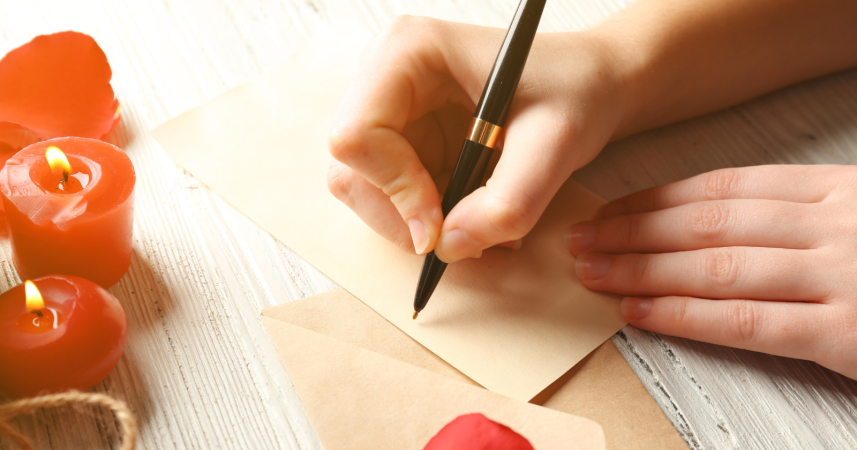
In an age of instant gratification, the handwritten note reveals character traits that are becoming cultural artifacts.

Add VegOut to your Google News feed. 
Last month, I received a handwritten thank-you note from a friend's 28-year-old daughter. Not an email, not a text with emoji hearts, but an actual card with her looping cursive across cream-colored paper. I held it like an archaeological find, turning it over in my hands, amazed that someone under 30 still did this. Later, showing it to friends sparked a conversation about who still writes by hand—and more interestingly, why. Turns out, those who maintain this practice aren't just nostalgic.
1. They demonstrate superior delay of gratification
People who write handwritten thank-you notes are essentially choosing the harder path when an easier one exists. This reflects what psychologists call delay of gratification—the ability to resist immediate rewards for better long-term outcomes. While texting provides instant completion, handwriting requires finding stationery, composing thoughts carefully, addressing an envelope, and getting to a mailbox. Those who consistently choose this delayed approach show the same self-control patterns that predict success in other life areas. They're the people who save for retirement, finish difficult projects, and stick with commitments even when quitting would be easier.
2. They possess heightened emotional intelligence
Writing by hand forces you to slow down and actually consider the recipient's emotional experience. Research shows that people who write gratitude letters demonstrate better understanding of how their words will impact others. Unlike firing off a quick "thanks!" text, handwriters must sit with their gratitude, articulate it precisely, and imagine how the recipient will feel reading it. This extended emotional processing builds what psychologists call "theory of mind"—the ability to understand that others have different thoughts and feelings than our own.
3. They value depth over efficiency in relationships
Handwritten note writers are making a statement about what matters to them. By choosing the inefficient option, they signal that some relationships deserve more than minimum effort. These are people who remember birthdays without Facebook reminders, who call instead of text for important conversations, who show up in person when they could send flowers. They understand that relationships aren't just about information exchange but about creating moments of genuine connection. In a world optimized for speed, they're optimizing for meaning.
4. They display conscientiousness and attention to detail
Handwriting reveals personality traits that typing masks. Those who maintain legible penmanship and proper letter format demonstrate conscientiousness—one of psychology's "Big Five" personality traits associated with success. They're likely the same people who proofread emails, arrive on time, and follow through on promises. The physical act of writing engages different brain regions than typing, requiring motor control, spatial awareness, and sustained attention. People who regularly write by hand maintain these cognitive skills that many adults have let atrophy.
5. They show genuine gratitude rather than performative thanks
There's something about putting pen to paper that makes insincerity harder to sustain. Research on gratitude expression finds that handwritten notes correlate with more genuine appreciation than digital messages. Perhaps it's because you can't copy-paste feelings or rely on autocomplete to finish your sentences. Each word must be deliberately chosen and physically formed. This deliberation filters out the reflexive, social-media-style gratitude that floods our feeds and forces the writer to locate and articulate real appreciation.
6. They understand the psychology of lasting impact
People who write handwritten notes intuitively grasp what researchers have confirmed: physical objects create stronger memories than digital ones. A handwritten note can be kept, reread, discovered years later in a drawer. It occupies physical space in someone's life. These writers understand that in our oversaturated digital world, scarcity creates value. They're playing a different game than those racing for immediate acknowledgment—they're creating artifacts that might outlive them.
7. They maintain cognitive flexibility and fine motor skills
The ability to write legibly by hand is increasingly rare. Studies show that people who regularly write in cursive maintain better fine motor control and cognitive flexibility than those who only type. The complex hand movements required for writing activate neural pathways that remain dormant during typing. Note writers are essentially doing brain training every time they pick up a pen. They're maintaining skills that connect them to centuries of human communication while others let these capacities wither.
8. They resist cultural pressure toward instant communication
Perhaps most remarkably, handwritten note writers demonstrate psychological autonomy—the ability to act according to internal values rather than external pressures. In a culture that demands immediate responses and constant availability, they're comfortable making people wait. They've opted out of the anxiety-inducing read-receipt culture. This isn't rudeness; it's boundary-setting. They understand that not everything needs to happen at the speed of light, and some things actually shouldn't.
Final thoughts
The divide between handwriters and texters isn't really about technology versus tradition. It's about what we're willing to invest in human connection. Those who still write thank-you notes by hand aren't luddites or showoffs—they're people who've made a calculation about what matters.
They've decided that efficiency isn't always the highest value, that some moments deserve more than the minimum viable response. In choosing the slower, harder path, they're preserving something important: the understanding that gratitude, like all meaningful emotions, deserves time and space to unfold.
These traits—delay of gratification, emotional intelligence, conscientiousness—read like qualities we all claim to value but rarely take time to develop. The handwritten note, then, becomes both medium and message. It says "thank you," but it also says "you're worth my time, my attention, my imperfect handwriting."
In our rush toward frictionless communication, we've forgotten that friction sometimes serves a purpose. It slows us down, makes us think, forces us to be present with our gratitude rather than simply performing it. Those who still write by hand understand this. They're not just preserving an old custom; they're maintaining a way of being human that technology might otherwise optimize away. And maybe, in a world of instant everything, that kind of deliberate slowness is its own form of grace.












