
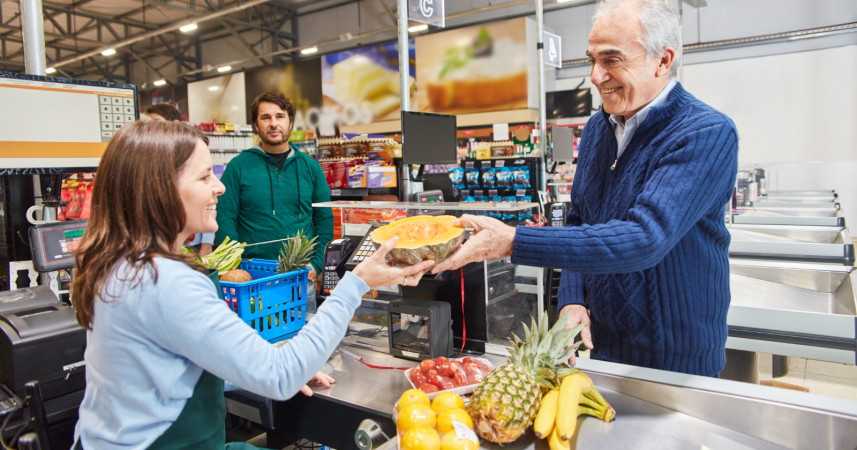
The checkout line has become an unexpected theater of generational values.

Add VegOut to your Google News feed. 
In a Target checkout line last week, I watched a fascinating drama unfold. A woman in her sixties produced an accordion-style coupon organizer while her teenage granddaughter stood beside her, radiating the specific frequency of embarrassment only possible when you're seventeen and in public with family. Behind them, a twenty-something shifted his weight, AirPods in, thumb scrolling through what looked like TikTok. The coupon-sorter chatted with the cashier about which deals could stack. The teen stared at the ceiling. The twenty-something's thumb never stopped moving.
The whole scene lasted maybe four minutes, but it felt like watching tectonic plates shift in real time. The checkout line—that mundane waystation of modern life—has somehow become a perfect theater for displaying generational differences. It's where different relationships to time, technology, and human interaction collide in ways both hilarious and oddly poignant.
What makes these moments so jarring isn't really about efficiency or technology adoption. It's about fundamentally different ideas of what the checkout process is for. For many Boomers, it remains a social interaction, a brief moment of human connection in an increasingly isolated world. For Gen Z, it's a system to be optimized, a task to complete with minimal friction. Neither view is wrong, but watching them clash in real time can feel like witnessing parallel universes briefly intersect.
1. The paper coupon organizational system
The modern Boomer approaches checkout with what can only be described as a filing system: envelopes sorted by store, binder clips organizing categories, Post-it notes marking special deals. This isn't casual couponing—it's archival science applied to grocery savings. Watch as they produce specific coupons from specific sections, each one carefully preserved in plastic sleeves or sandwich bags.
Gen Z shoppers observe this ritual with the same fascination they might reserve for someone using a typewriter in public. Their deals live in apps, automatically applied, algorithmically optimized. The idea of physically organizing paper savings seems like elaborate performance art.
But here's what younger shoppers miss: these systems often outperform their digital equivalents. A seasoned coupon organizer recently showed me her monthly savings—consistently 40-50% off retail. Her binder system, refined over decades, accounts for store cycles, stacking opportunities, and regional variations that apps haven't caught up to. She knows the assistant manager at three different stores will accept expired coupons from regular customers. Try explaining that to an algorithm.
2. The full-conversation cashier experience
Watch a Boomer at checkout and you'll often see something remarkable: an actual conversation. Not just pleasantries, but genuine exchanges about grandchildren, local events, or that troublesome hip. These interactions can stretch a two-minute transaction into a ten-minute social call, complete with wallet photos and recipe recommendations.
Younger shoppers experience these moments as a special kind of torture. Raised on self-checkout and contactless payment, they view the transaction as purely functional. The idea of voluntarily extending time at checkout—of seeking human connection at the register—seems as foreign as voluntarily sitting in traffic.
Yet these conversations serve a purpose beyond mere friendliness. For many older shoppers, especially those living alone, the checkout chat might be their primary social interaction of the day. The cashier who knows their name, remembers their usual purchases, asks about their health—this isn't inefficiency, it's community. What reads as delay to one generation reads as connection to another.
3. The excavation for exact change
Picture this: the total is $12.37. The Boomer shopper has handed over a twenty, but wait—they might have the thirty-seven cents. Thus begins the archaeological dig through purse or pocket, a methodical search through layers of receipts, tissues, and mysterious small objects to locate the precise coinage needed.
Gen Z shoppers, watching this unfold, experience something close to physical pain. In their world of digital payments, the idea of carrying coins—let alone caring about exact change—seems absurd. They've grown up rounding everything to the nearest dollar, if they think about physical money at all.
The exact change hunt represents different relationships with money itself. For older generations, those coins have value worth pursuing. They remember when pennies bought candy and quarters meant phone calls. For younger shoppers, coins are mostly theoretical—an inconvenience that accumulates in car cupholders and couch cushions, eventually deposited in those grocery store counting machines for a fee they don't think twice about paying.
4. The cash-counting ceremony
Watch older shoppers pay with cash and you'll witness something approaching performance art. Bills emerge individually, carefully unfolded and oriented the same direction. The counting happens twice—once while removing from wallet, once while handing over. Then comes the change reception ritual: bills folded precisely, coins counted into palm, everything distributed to its designated wallet compartment before stepping aside.
For Gen Z, who treat physical money like archaeological artifacts, this ceremony seems bewildering. They've grown up with instant transactions, where payment is a tap or a face scan. The idea of manually handling, counting, and organizing physical currency feels like watching someone churn butter.
Yet this careful cash handling reflects a different relationship with money—tangible, countable, finite. These shoppers know exactly what they're spending because they can feel it leaving their hands. In an era of overdraft fees and phantom subscriptions, there's wisdom in this friction. The ceremony that seems excessive to digital natives is actually a form of financial mindfulness that predates apps designed to recreate the same awareness.
5. The payment method shuffle
Credit card declined? No problem, there's a debit card somewhere. Or another credit card. Or perhaps cash? The payment shuffle—that moment when the first attempt fails and alternatives must be located—reveals generational differences in financial management and technological trust.
Younger shoppers rarely experience this shuffle because they've consolidated everything into their phones. Payment failure means technical glitch, not insufficient funds or wrong card choice. They have one payment method that connects to multiple funding sources, all managed by algorithm.
Older shoppers often carry multiple payment methods for specific purposes: this card for groceries (better rewards), that card for gas (lower interest), cash for small purchases (budget control). When one fails, the shuffle begins. It's a system that makes sense within their financial framework but appears chaotic to observers used to seamless digital transactions.
6. The gift card/loyalty card expedition
Every Boomer seems to carry a small archive of gift cards with mysterious balances and loyalty cards for stores they visit twice a year. At checkout, these emerge slowly, each requiring verification. "Do I have anything on this Applebee's card? What about this one from Christmas?"
The loyalty card situation compounds the complexity. Physical cards for every store, some on keychains that could anchor small boats, others loose in wallets. The cashier scans each one, some working, others requiring manual entry of phone numbers remembered from landlines discontinued in 2003.
Gen Z shoppers, whose loyalty programs live in apps that track everything automatically, watch this physical card parade with amazement. They've never experienced the peculiar anxiety of wondering whether the gift card their aunt gave them three years ago still has $3.47 on it. Their gift cards are digital, balances known instantly, applied automatically. The idea of physically carrying store-specific cards seems as archaic as carrying a Rolodex.
7. The receipt investigation ritual
The transaction completes, but the experience isn't over. Now comes the careful examination of the receipt, item by item, price by price. Did the sale price ring up correctly? Was the coupon applied? Better check now, right here at the register, while everyone waits.
This immediate audit seems incomprehensible to younger shoppers who either decline receipts entirely or stuff them blindly into pockets. They trust the system, check their banking apps later if at all, and handle discrepancies through customer service chat. The idea of standing at the register, reading through a receipt like it's breaking news, seems like performance art.
But this vigilance comes from lived experience. These shoppers remember when scanners were new and unreliable, when sale prices required manual override, when checking your receipt immediately was the only way to catch errors. They've been overcharged before, fought for refunds, learned that trusting the system means accepting its mistakes.
Final thoughts
The checkout line divide isn't really about technology or efficiency—it's about fundamentally different orientations toward time, money, and human interaction. What younger generations read as stubborn resistance to progress, older generations experience as maintaining human elements in an increasingly automated world.
These seven behaviors that horrify Gen Z aren't just quirks or technological failures. They're choices about how to navigate a world changing faster than any generation has had to adapt to before. The Boomer with the coupon binder isn't unaware of digital deals—they're choosing a system they understand and trust. The lengthy cashier conversation isn't inefficiency—it's insistence that commerce include community.
Someday, Gen Z will have their own checkout behaviors that horrify whatever comes next. Maybe they'll insist on using their phones when everyone else has moved to neural implants. Maybe they'll demand human cashiers when everyone else prefers AI. The specific behaviors matter less than what they represent: the human tendency to hold onto the familiar as the world shifts beneath our feet, one checkout line at a time.
The generation gap isn't measured in years—it's measured in the time it takes to find exact change












