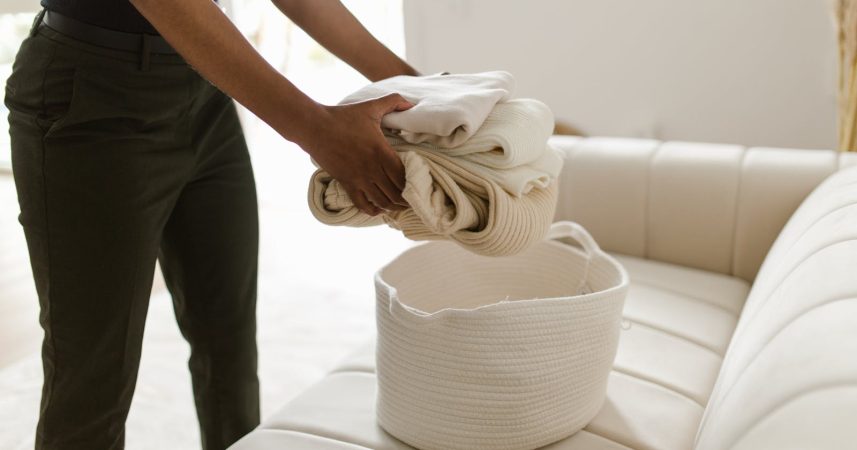
For some of us, that pile of unfolded laundry isn't laziness—it's a battlefield where our childhood survival instincts wage war against our exhausted adult selves.

Add VegOut to your Google News feed. 
Have you ever walked into someone's home and instantly known something about their childhood just by looking at their closet?
I realized this last weekend while helping a friend move. She meticulously folded every single piece of clothing before packing it, even the stuff going to donation. Meanwhile, I'd thrown my own laundry into a basket that morning, telling myself I'd fold it later. Spoiler: I didn't.
But here's what struck me: my friend wasn't trying to be perfect. She was just doing what felt normal to her. And watching her fold those shirts with such automatic precision made me think about all the invisible habits we carry from our childhoods, the ones that look like discipline to outsiders but are actually something much deeper.
When your reputation was your credit score
Growing up, my house had this unspoken rule: if the living room was messy when Dad got home from work, something was wrong. Not just untidy wrong, but deeply, fundamentally wrong. Like maybe Mom had been crying all afternoon, or they'd been arguing about money again.
Clean meant stable. Mess meant chaos.
I didn't realize other families operated differently until I went to college and saw my roommate leave dishes in the sink for days without experiencing a single moment of anxiety. She'd grown up in a house where mess was just mess. Nothing more, nothing less.
But for those of us who learned early that a pile of unfolded laundry could signal a parent's depression, or that scattered toys meant Dad was drinking again, we developed a different relationship with order. We became little sentinels, constantly scanning our environment for signs of impending disaster.
The anxiety of empty surfaces
You know that feeling when you walk into your apartment and immediately start tidying, even though you're exhausted? That's not discipline talking. That's your nervous system remembering what disorder used to mean.
I discovered this about myself when I helped my parents downsize a few years ago. Buried in boxes in their attic, I found my old report cards, each one meticulously organized by semester. My mother had saved every single one, along with notes about my behavior and progress. Looking at them, I could trace my own perfectionism back to age seven.
The thing is, in households where emotional stability hung by a thread, physical order became our way of maintaining control. If we couldn't fix what was broken in our family dynamics, at least we could keep our rooms clean. At least we could fold the towels properly. At least we could create the illusion that everything was fine.
Why some people can't relax in clutter
There's actual science behind this. When children grow up in unpredictable environments, their brains become hypervigilant to environmental cues. A study published in the journal Developmental Science found that children from chaotic households show heightened stress responses to disorder, even years later as adults.
It makes sense when you think about it. If you learned that a sink full of dishes meant Mom was having a bad week, your brain filed that information away. Now, twenty years later, you physically can't relax when there are dishes in your sink, even though you live alone and no one's emotional state depends on your kitchen cleanliness.
I see this in my own life constantly. After a particularly stressful day at work, what do I do? I organize my desk drawers. When I'm anxious about a deadline? I reorganize my closet. It's not productive, and I know it's not actually solving my problems, but my brain still believes that if I can just get everything in order, I'll feel safe.
The invisible labor of hypervigilance
Here's what people don't understand about those of us who compulsively fold our laundry: we're not trying to be better than anyone. We're trying to prevent a catastrophe that already happened, one that we couldn't control as children but desperately tried to manage through the only means available to us.
Think about the mental energy that requires. While others can toss their keys on the counter and forget about them, we're calculating the exact right spot where they should go. While others can leave a bed unmade without a second thought, we're fighting an internal battle between exhaustion and the anxiety of disorder.
This hypervigilance extends beyond our homes. At work, we're the ones who notice when the printer is low on paper before it runs out. We're the ones who can tell when a colleague is having a bad day just by how they've arranged their desk. We've spent our entire lives reading environments like they're emotional weather reports.
Breaking the cycle without breaking down
So what do we do with this information? How do we learn to tolerate a little mess without feeling like our world is falling apart?
First, recognize that your need for order isn't a character flaw or a personality quirk. It's an adaptation. You developed it for good reasons, even if those reasons no longer apply to your current life.
Start small. Leave one dish in the sink overnight. Don't make your bed one morning. Notice the anxiety that comes up, but also notice that nothing terrible happens. Your brain needs new data to override the old programming.
I've been practicing this myself. Last month, I left a pile of clean laundry on my chair for three whole days. Every time I walked past it, my chest tightened. But I also noticed something else: I had more time to read. I went for an extra run. I called a friend I hadn't talked to in months.
The world didn't end because my laundry wasn't folded.
Finding balance in the mess
There's nothing wrong with liking things tidy. Some of us genuinely function better in organized spaces, and that's okay. The problem comes when we can't function without perfect order, when a crooked picture frame can ruin our entire evening, when we choose organizing over connecting with people we love.
If you recognize yourself in this article, be gentle with yourself. You're not broken. You're not neurotic. You're someone who learned early that controlling your environment was a way to feel safe in an unsafe world.
And if you're someone who can leave clothes in the dryer for days without a care, that's okay too. Just maybe have a little extra compassion for those of us who can't. We're not judging your mess. We're fighting our own internal battles, ones that started long before we ever met you.
The goal isn't to become someone who never folds laundry again. The goal is to have a choice. To fold when it serves us, and to leave things unfolded when we have better things to do. To recognize that order can be comforting without being compulsory.
After all, sometimes the most revolutionary act isn't keeping everything in its place. Sometimes it's allowing things to be just a little bit messy, and trusting that you'll still be okay.