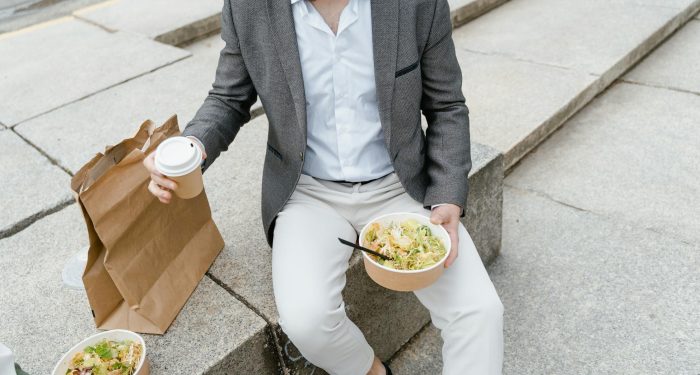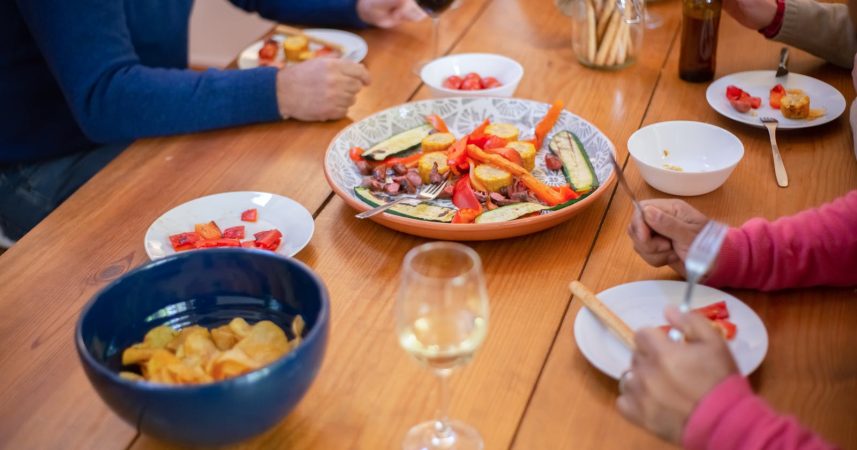
They arrive with three casserole dishes and two desserts, their arms straining under the weight of a debt to a mother who taught them that empty hands meant empty character — and forty years later, they're still trying to earn their seat at every table they approach.

Add VegOut to your Google News feed. 
You know that person who shows up to every potluck with enough food to feed a small army? The one carrying three casserole dishes, two desserts, and a veggie platter "just in case"? That used to be me.
I remember one Thanksgiving potluck at a friend's house where I brought homemade vegan lasagna (two pans), roasted Brussels sprouts, cranberry sauce, and three different desserts. My friend gently joked, "Were you expecting the entire neighborhood?" But I couldn't help myself. The thought of showing up with just one dish made my stomach twist into knots.
It wasn't until years later, during a particularly honest conversation with my therapist, that I understood why. Growing up, my mother would spend days preparing for any gathering we attended. Not because she loved cooking, but because in her family, the amount of food you brought was directly tied to your worth as a person. Empty hands meant empty character.
The inheritance we carry in our hands
When we see someone lugging multiple dishes to a casual get-together, our first instinct might be to think "how generous!" But dig a little deeper, and you'll often find something else entirely.
I've noticed this pattern in so many of my friends who grew up in similar households. The ones whose parents would whisper harsh judgments about the neighbor who "only" brought store-bought cookies. The ones who learned early that contribution equals value, and more contribution equals more value.
Research shows that individuals who over-give may have low self-esteem and feel uncomfortable receiving help, leading to anxiety and depression. Sound familiar? That anxiety I felt about showing up with "just" one dish wasn't about the potluck at all. It was about a deeply ingrained belief that I needed to earn my seat at the table, literally.
The thing is, when you grow up in a household where generosity is performative rather than genuine, you learn to conflate giving with being worthy of receiving. You're not bringing extra food because you want to share. You're bringing it because somewhere, deep down, you're still trying to prove you deserve to be invited.
When abundance becomes armor
There's something almost protective about arriving with your arms full. Nobody can accuse you of not contributing enough when you've clearly contributed too much. It's a preemptive strike against judgment that may never come.
I think about all those elaborate vegan meals I'd spend hours preparing, telling myself I just enjoyed the creative process. And while that was partially true, there was always this underlying current of anxiety. What if someone thought I didn't do enough? What if they talked about me after I left?
My parents, bless them, meant well. My mother, the teacher, and my father, the engineer, both believed deeply in the value of hard work and contribution. But somewhere along the way, that message got tangled up with worthiness. You weren't just expected to contribute; you were expected to over-contribute to prove you belonged.
The culture of competitive generosity
This phenomenon goes beyond individual families. Arathy Puthillam, a Research Assistant studying cultural psychology, notes that "In societies where the rules of civic cooperation are weak, people tend to punish more antisocially. That is, if you are from a culture that thinks tax evasion or not paying fares in a public bus is not a big deal, you are likely to punish antisocially."
Apply this to potluck culture, and you see how certain communities develop unspoken rules about contribution that become weapons of social judgment. The potluck becomes less about sharing a meal and more about proving your social standing.
I've watched this play out in countless gatherings. The subtle eye rolls when someone brings chips and salsa. The overly effusive praise for the person who made everything from scratch. The mental scorekeeping that turns a simple dinner into a competition nobody signed up for.
What's particularly insidious is how this gets passed down through generations. Children watch their parents stress over what to bring, absorb the anxiety about being judged, and learn that food is currency in the economy of social acceptance.
Breaking the cycle of food as currency
So how do we break free from this pattern? How do we learn to show up with just one dish and feel okay about it?
For me, it started with recognizing the pattern. Once I saw how my over-giving was actually a form of self-protection, I could start to challenge it. I began experimenting with bringing less, sitting with the discomfort, and noticing that nobody actually cared as much as I thought they would.
Studies have found that highly sensitive people may over-give due to family dynamics that turn caring into overfunctioning, leading to emotional exhaustion and neglect of their own needs. This resonated deeply with me. All those hours spent cooking weren't just exhausting my kitchen; they were exhausting me emotionally.
I had to learn that my worth wasn't tied to my contribution. That people invited me because they wanted my company, not my three-layer vegan chocolate cake (though they did enjoy that too). This sounds simple, but when you've spent decades believing otherwise, it's revolutionary.
The real gift of presence
What would it look like to show up to a potluck with one simple dish and the confidence that you're enough? To trust that your presence, your conversation, your laughter are the real contributions?
I think about gatherings differently now. Instead of spending the entire day before cooking, I make one dish I genuinely enjoy preparing. Sometimes it's elaborate, sometimes it's simple. But it's always just one. And instead of that time in the kitchen, I spend time being present at the actual event.
The irony is that when you stop over-giving from a place of anxiety, you can start giving from a place of genuine generosity. Your contributions become about connection rather than compensation. You bring food because you want to share something delicious, not because you're paying off an invisible debt.
Final thoughts
If you recognize yourself in this story, know that you're not alone. So many of us are walking around with invisible debts to tables we sat at decades ago, trying to prove our worth through Tupperware containers and serving spoons.
The next time you find yourself loading up your car with enough food for three potlucks, pause. Ask yourself: Am I doing this because I want to, or because I feel I have to? Am I being generous, or am I being anxious?
Remember, the people who truly care about you want your presence, not your performance. They want you at the table because of who you are, not what you bring. And that anxious voice telling you it's not enough? That's not your voice. It's an echo from a kitchen that judged you before you even knew what judgment meant.
You've already paid that debt, probably many times over. It's okay to put down the extra casserole dish. You're enough, just as you are, even if all you bring is yourself and a bag of chips.