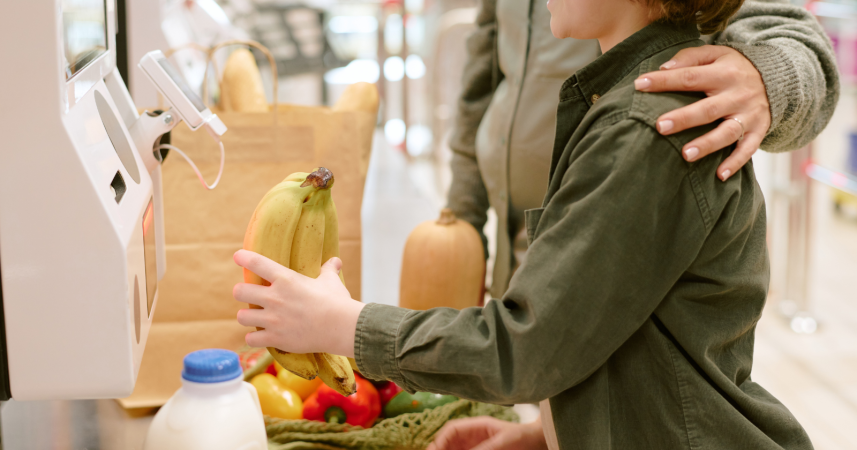
The machine knows who you are before you've even scanned your first item.
Target's self-checkout stations have become America's most unexpected social laboratory, where investment bankers and teachers, teenagers and retirees, all perform the same ritualistic dance with red machines. But watch closely, and you'll notice that while everyone's following the same basic script—scan, bag, pay—the subtle variations in how they perform these acts reveal more about their economic reality than any credit card could.
These aren't conscious choices. Nobody decides to telegraph their tax bracket through their bagging technique. Yet sociologists have long understood that shopping behaviors are deeply encoded performances of class identity, and self-checkout—that supposedly neutral, democratic innovation—has only amplified these distinctions.
1. The speed of your scanning
Watch someone who's never worried about overdraft fees at self-checkout. They scan items with a methodical rhythm, pausing to check screens, reading prompts carefully. There's no urgency, no practiced efficiency. They might even scan items one at a time, placing each carefully in the bagging area before reaching for the next.
Contrast this with someone who's calculated their grocery budget to the penny. They've developed a fluid scanning technique born from countless trips where every second saved matters—because they're shopping on a lunch break from their second job, or rushing to pick up kids from daycare that charges by the minute for late pickups. Their movements are economical, practiced, almost choreographed.
2. How you handle the "unexpected item in bagging area" message
For some, this error message is a minor inconvenience, maybe even amusing. They'll wait patiently for assistance, perhaps making small talk with nearby shoppers about the quirks of technology. The delay doesn't stress them because their time is elastic—there's nowhere urgent to be, no hourly wage being lost.
Others respond to this message with visible tension. They immediately start removing and replacing items, trying different configurations, anything to avoid calling for help. This isn't impatience—it's the learned behavior of people who know that drawing attention, requiring assistance, or causing delays can mark you as difficult. They've internalized that invisibility is safer than visibility in retail spaces.
3. Your relationship with the skip bagging button
The confidence to hit "skip bagging" repeatedly, walking out with unbagged items, comes from never having been followed through a parking lot by security. It's the casual assurance of someone who knows they fit the profile of a "legitimate shopper," whose appearance and demeanor grant them the presumption of innocence.
Meanwhile, others meticulously bag every item, even the single greeting card or pack of gum. They know that walking out with unbagged merchandise, regardless of receipts, invites scrutiny they can't afford. The skip bagging button might as well not exist for people who've learned that following every rule precisely is the only way to shop in peace.
4. Whether you use the hand scanner
Those ergonomic hand scanners attached to some self-checkout stations are fascinating class markers. Using one requires a specific type of confidence—the assurance that you can figure out unfamiliar technology quickly, that making mistakes won't draw unwanted attention, that looking temporarily incompetent won't have consequences.
People who've worked retail, warehouse, or shipping jobs often grab these scanners without hesitation. The technology is familiar from their work lives. But there's another group that avoids them entirely—those for whom admitting unfamiliarity with any technology might confirm stereotypes they're constantly fighting against.
5. How you react to the receipt check
Some shoppers barely break stride when asked to show their receipt at the door. They're already holding it out, or they cheerfully dig through their bags, treating the interaction as routine customer service. This ease comes from never having been accused of theft, from living in a world where these checks feel procedural rather than personal.
Others have their receipt ready before they've even left the self-checkout area, held visibly like a shield. They've learned that retail surveillance isn't equally distributed, that some bodies are watched more closely than others. The receipt isn't just proof of purchase—it's protection against assumptions.
6. Your payment method performance
Watch how people prepare their payment. Some wait until the total appears, then leisurely retrieve their wallet, perhaps debating between cards. They might even realize mid-transaction they'd prefer to use a different card, canceling and starting over without stress.
Others have their payment ready before they've scanned the first item. They know exactly which card has room, which account has funds. There's no browsing through options because there aren't multiple options—there's the one card that works, and they've already checked the balance on their phone twice since breakfast. The choreography of constraint becomes second nature.
7. The volume of your voice when calling for help
"Excuse me, I need some help here" comes in different volumes, different tones. Some people call out with the easy confidence of someone who expects service, who's never been ignored or dismissed when requesting assistance. Their voice carries across the store without embarrassment.
Others barely raise their voice above a whisper, often attempting to catch an employee's eye instead of calling out. Or they'll abandon their cart entirely rather than ask for help. This isn't shyness—it's the learned behavior of people who've been made to feel their needs are impositions, whose requests for help have been met with suspicion or annoyance.
8. How you handle the produce scale
The integrated produce scales reveal perhaps the subtlest class divide. Some shoppers confidently navigate the lookup system, knowing butternut squash from acorn, typing in PLU codes from memory. They might even know that organic bananas are 94011, not 4011—a fifty-cent difference that doesn't matter to them.
Others avoid loose produce entirely, buying only pre-packaged items with barcodes. It's not that they can't figure out the system—it's that they can't afford to make mistakes. Accidentally selecting the wrong type of apple, the organic instead of conventional, could throw off a carefully calculated budget. The cognitive load of poverty means every decision carries weight others can't imagine.
Final thoughts
The self-checkout machine was supposed to be the great equalizer—a neutral interface where human bias couldn't intrude. Instead, it's become a mirror reflecting our deepest social programming. We perform our class position through countless micro-behaviors we're barely conscious of, each scan and bag placement a tiny revelation of our lived experience.
What's most striking isn't that these differences exist, but how invisible they are to those who've never had to think about them. The person who breezes through self-checkout, confident and unhurried, might never notice the careful choreography of someone for whom every shopping trip is a negotiation with visibility, time, and economic constraint. These machines haven't eliminated the human element of shopping—they've simply automated the judgment, making us all unwitting performers in a play about class that nobody admits we're staging. Perhaps the most honest thing about self-checkout is how it strips away the polite fiction that shopping is just shopping, revealing it for what it's always been: a complex social performance where every choice tells a story about who we are and where we fit.
What’s Your Plant-Powered Archetype?
Ever wonder what your everyday habits say about your deeper purpose—and how they ripple out to impact the planet?
This 90-second quiz reveals the plant-powered role you’re here to play, and the tiny shift that makes it even more powerful.
12 fun questions. Instant results. Surprisingly accurate.