
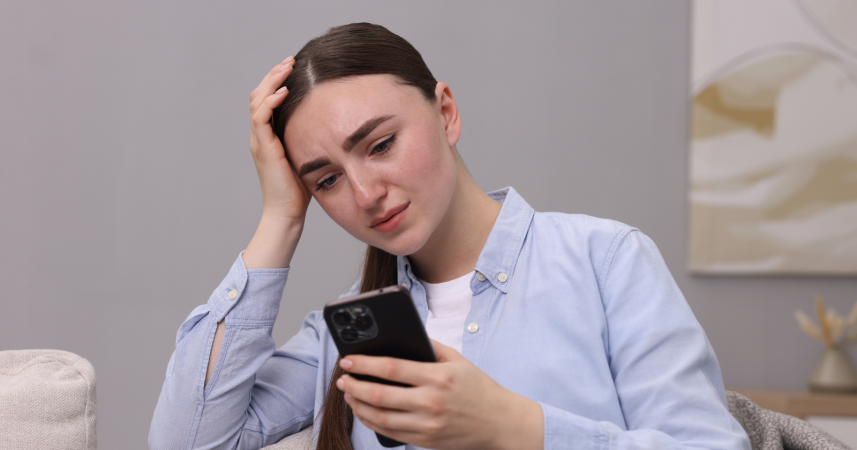
While millions mindlessly scroll through endless feeds of beautiful strangers, those who obsessively browse but never dare to post their own photos are unknowingly revealing a complex psychological profile that goes far deeper than simple shyness.

Add VegOut to your Google News feed. 
Have you ever caught yourself scrolling through Instagram or Facebook, tapping through photo after photo of impossibly attractive people, but when someone suggests you post that nice picture from last weekend, you immediately shut down the idea?
I noticed this pattern in myself a few years back.
There I was, spending way too much time browsing through perfectly curated feeds, double-tapping on stunning selfies and beach photos, yet my own profile remained a ghost town.
It got me thinking about what this behavior really says about us.
After diving into the psychology behind this digital age phenomenon and reflecting on my own journey through perfectionism and self-doubt, I've discovered that this particular social media habit often reveals deeper personality traits.
If you find yourself constantly consuming but never contributing, you might recognize yourself in these seven characteristics.
1) Heightened self-criticism
When I was labeled "gifted" in elementary school, it planted seeds of perfectionism that bloomed into full-blown self-criticism by adulthood.
People who browse but don't post often have an inner critic that's working overtime.
You look at those polished photos and immediately start comparing.
Your brain catalogues every perceived flaw in your appearance, every imperfection that makes you "not good enough" to share.
Studies show that people with high self-criticism tend to engage in more passive social media consumption while avoiding active participation.
The twisted part? The more attractive content you consume, the harsher your inner critic becomes.
You're essentially feeding the beast that's already tearing you down.
I filled entire journal pages dissecting this pattern when I first recognized it in myself.
2) Fear of judgment
Remember that feeling in school when you had to present in front of the class? That stomach-churning anxiety?
For many non-posters, hitting "share" on a photo triggers that exact same response.
You've created a safe space where you can observe without being observed, judge without being judged.
I get it, after transitioning from finance to writing, I lost most of my former colleagues as friends.
That experience taught me how quickly people can turn critical when you step into visibility.
But here's what else I learned: The judgment we fear is often just a projection of our own self-judgment.
3) Comparison tendency
Do you find yourself mentally ranking people's attractiveness? Creating hierarchies in your head about who looks better than whom?
This constant comparison game is exhausting.
Theodore Roosevelt supposedly said "Comparison is the thief of joy," and nowhere is this more true than on social media.
When you're always browsing attractive people's photos, you're essentially training your brain to see life as a competition you're destined to lose.
The non-posting part? That's your way of removing yourself from the race entirely.
If you don't put yourself out there, you can't officially "lose" but you also can't win, connect, or share your authentic self with the world.
4) Perfectionist tendencies
Growing up as that "gifted child," I developed this need for everything to be just right before I'd share it with the world.
Sound familiar?
Perfectionists who browse but don't post often have a folder of photos on their phone that are "almost good enough" but never quite make the cut.
The lighting could be better, the angle isn't quite right, maybe after you lose five pounds, or maybe when your skin clears up.
Maybe, maybe, maybe.
Meanwhile, you're scrolling through feeds of people who seemingly have it all together, not realizing they probably took 47 shots to get that one "casual" photo.
Perfectionism keeps you stuck in consumption mode because nothing you create ever meets your impossible standards.
5) Low self-esteem disguised as humility
"Oh, I'm just not photogenic."
"I don't want to be one of those people who's always posting selfies."
"I prefer to keep a low profile."
These phrases might sound humble, but they often mask deeper self-esteem issues.
I've filled notebooks analyzing this pattern in myself.
What looks like modesty on the surface is actually a belief that you're not worthy of taking up space, even digital space.
People with this trait often feel uncomfortable with positive attention.
When someone compliments them, they deflect; when asked to share something about themselves, they minimize.
Browsing others' photos becomes a way to live vicariously through people who seem to deserve the spotlight more than you do.
6) Vulnerability avoidance
After years of journaling, I've learned that vulnerability isn't the same as being vulnerable to harm, but tell that to someone who refuses to post their photo online.
Posting a picture of yourself is an act of vulnerability.
You're saying, "Here I am, world. See me."
For people who browse but don't share, that level of exposure feels dangerous.
What if people don't like it? What if someone says something mean? What if no one responds at all?
So, instead, you stay in the shadows and scrolling through other people's vulnerable moments while protecting your own.
It feels safer, but it also keeps you disconnected from the authentic connections that come from showing up as yourself.
7) Passive engagement patterns
This trait extends beyond social media.
People who browse but don't post often show similar patterns in other areas of life.
They're the ones who read all the self-help books but never implement the advice, who watch workout videos but don't exercise, and who have opinions in meetings but stay quiet.
Passive engagement feels like participation without the risk.
You're involved enough to feel connected but not so involved that you might fail or face criticism.
It's a protective strategy that keeps you safe but also keeps you small.
I recognize this in myself sometimes.
Those 47 journals I've filled? For years, they were my way of processing life without actually living it fully.
Writing about experiences felt safer than having them.
Final thoughts
If you recognized yourself in these traits, you're not alone.
The browse-but-don't-post phenomenon is incredibly common in our image-obsessed digital age.
But, here's what I want you to consider: What would happen if you posted that photo anyway?
Working through my own people-pleasing tendencies taught me that hiding just ensures we judge ourselves.
Every time you scroll without sharing, you reinforce the belief that others are worthy of visibility while you're not.
You don't have to become an Instagram influencer overnight.
Share a sunset photo, or post a picture with friends where everyone's laughing.
Let yourself be seen, imperfections and all.
The most attractive thing you can share is the courage to show up as yourself.












