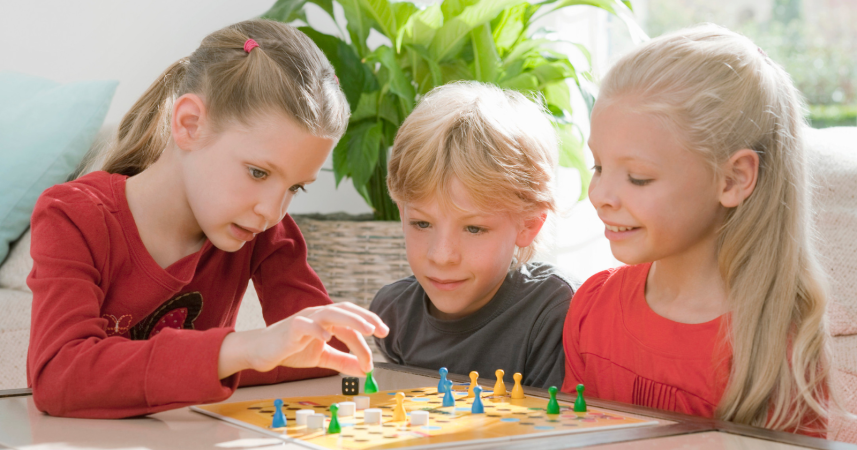
If you mastered even one of these games as a kid, chances are you were training intelligence in a way that didn’t look like “studying.”
Let’s clear something up before we start: Being “intelligent” is not one single trait, like an on or off switch.
It’s more like a messy bundle of skills, such as pattern recognition, memory, self-control, verbal ability, social perception, and planning ahead.
That’s why board games are such a fun clue; when you “master” a game as a kid, you’re training your brain to think in layers and practicing frustration tolerance.
Moreover, you’re building a mini mental toolkit, usually without even realizing it.
If you were the kid who begged for “one more round,” who studied strategies, who learned how to win without flipping the table, you probably developed cognitive strengths that show up in real life too.
Which games tend to correlate with those strengths? Here are seven that quietly demand more brainpower than most people give them credit for:
1) Chess
If you got genuinely good at chess as a kid, you were doing more than moving pieces around.
Chess forces you to hold multiple possibilities in your head at once, kind of like mental juggling.
You plan, predict, weigh tradeoffs, notice patterns, learn to delay gratification because the best move right now might look boring, but it sets up something powerful later.
That’s executive function in action: Planning, working memory, impulse control, and flexible thinking.
The emotional side matters too.
Chess teaches you to lose, sit with it, and come back smarter.
A quote that gets tossed around a lot is, “Chess is the gymnasium of the mind.”
However you feel about that line, the point stands as you’re doing reps over and over.
Reflect for a second: Were you the kid who could “see” three moves ahead? If yes, you were practicing a life skill most adults still struggle with.
The next time you’re stuck on a decision, ask yourself, “If this is move one, what could move three look like?”
That tiny shift can change everything.
2) Go
Go looks simple until you play it, and suddenly your brain is like, “Excuse me, what is happening?!”
Mastering Go as a kid usually means you developed a strong ability to think in systems rather than single moves.
You’re shaping space, influence, and long-term positioning.
It’s strategic patience with a side of humility because the board can flip on you fast.
Psychology-wise, Go leans hard on pattern recognition, spatial reasoning, and what I’d call “big-picture restraint.”
You can’t chase every little conflict because you have to decide what matters.
It reminds me of gardening, honestly.
You set conditions, observe, adjust, and let time do its thing.
Go rewards that same calm, long-range thinking.
If you were good at Go early, you likely got comfortable with complexity without panicking.
That’s a form of intelligence people overlook.
When life feels chaotic, stop focusing on the loudest problem and ask, “Where do I want my influence to expand?”
It’s a Go question, and it’s weirdly grounding.
3) Scrabble
Scrabble is not just “knowing big words.”
That’s the lazy interpretation.
To get really good, you need verbal fluency, yes, but you also need flexible thinking, pattern spotting, and strategic risk-taking.
You’re constantly scanning for letter combinations, prefixes, suffixes, parallel plays, and board geometry.
You’re also doing something psychologists love to study: Rapid retrieval.
Your brain is digging through memory under time pressure, pulling out options, then evaluating them.
If you were the kid who memorized two-letter words and weird vowel dumps, congratulations.
You were basically building a small mental database and learning how to access it efficiently.
I used to play with someone who wasn’t “the smartest” in the traditional school sense, but they crushed Scrabble because they could see opportunities other people missed.
That’s intelligence too: not just knowledge, but use of knowledge.
The next time you learn a new word, make a sentence and think of a synonym.
Notice how it feels in your mouth; that’s how you train retrieval, not rote memory.
4) The Settlers of Catan

If you were a kid who mastered Catan, you were learning economics without calling it economics.
Catan is resource management, probability, negotiation, and long-term planning disguised as little wooden sheep.
You’re tracking what people need, what they’re likely to roll, what they’re building toward, and how to make trades that look fair while quietly benefiting you.
It’s also one of the clearest board game examples of strategic social intelligence.
You can’t play in a vacuum because you have to read the table.
This is where my old financial analyst brain perks up.
Catan feels like a beginner course in risk and allocation.
Do you diversify your resources or go all-in on one plan? Do you build now or save for a bigger move later? Do you trade aggressively or keep a low profile?
If you were good at this young, you probably got comfortable making decisions with incomplete information.
That’s a huge marker of real-world intelligence.
A question for you: Were you the kid who could convince someone to trade even when it wasn’t in their best interest?
It can be persuasion, timing, and understanding incentives.
When you negotiate anything, even something small, ask, “What does the other person value here?”
Catan teaches that better than most business books.
5) Risk
Risk has a reputation for family fights, and honestly, that checks out.
Underneath the drama, Risk trains a very specific set of cognitive muscles: strategic planning, probabilistic thinking, and emotional regulation under uncertainty.
You can do everything “right” and still lose a key battle.
If you keep playing anyway, you learn a hard lesson that a lot of adults avoid: Outcomes are not fully controllable.
Smart Risk players think in range; they understand tradeoffs, know when to push and when to fortify, and learn to recover after a setback instead of spiraling.
That ability to stay calm when the dice do not love you is more than a game skill.
It’s resilience plus reasoning.
If you were the kid who could lose half a continent and still quietly rebuild, you probably have a strong capacity for adaptive problem-solving.
When something goes wrong, separate the two questions: “Was my decision process solid?” and “Did luck swing the outcome?”
That distinction helps you learn without self-blame.
6) Clue
Clue is basically logic training with a dash of social deduction.
To master it as a kid, you had to track information, update hypotheses, and notice patterns in what people asked and revealed.
You learned to eliminate possibilities systematically, which is classic analytical reasoning.
Clue also nudges you into perspective-taking.
You start thinking, “What do they know?” and “Why did they ask that?”
That’s a stepping stone toward theory of mind: Understanding that other people have different information, intentions, and strategies.
Kids who get good at Clue often become adults who are strong in meetings, negotiations, and any situation where reading the room matters.
Here’s a quick self-check: Were you the kid taking neat notes, circling clues, and quietly watching everyone’s reactions?
If yes, you were practicing structured thinking.
The next time you’re confused about someone’s behavior, gather clues and ask, “What information am I missing?”
Clue teaches that kind of intellectual humility.
7) Backgammon
Backgammon is one of those games people underestimate until they get demolished by someone’s grandmother.
It blends probability, pattern recognition, and tactical decision-making.
The dice add randomness, but skill shows up in how you manage that randomness.
Good players calculate risk, position their pieces to reduce vulnerability, and create opportunities that stay open across multiple possible rolls.
That’s a subtle kind of intelligence: Planning for variability.
Backgammon also trains quick math intuition.
Not “school math,” but real-life math: The kind where you feel the odds and make a choice under time pressure.
If you mastered it young, you likely developed comfort with uncertainty plus the ability to stay strategic anyway.
That’s a powerful combo.
When you’re planning something important, build a plan with options.
Backgammon thinking is basically contingency planning in disguise.
Final thoughts
If you mastered even one of these games as a kid, chances are you were training intelligence in a way that didn’t look like “studying.”
If you mastered several? You were probably building a surprisingly well-rounded cognitive skill set: Logic, language, self-control, systems thinking, social awareness, and decision-making under uncertainty.
You can restart this kind of brain training anytime by playing again, teaching someone else, joining a local board game night, and swapping scrolling for a few rounds of something that makes you think.
Tell me, which game were you weirdly good at and what do you think it taught you about how your mind works today?
If You Were a Healing Herb, Which Would You Be?
Each herb holds a unique kind of magic — soothing, awakening, grounding, or clarifying.
This 9-question quiz reveals the healing plant that mirrors your energy right now and what it says about your natural rhythm.
✨ Instant results. Deeply insightful.