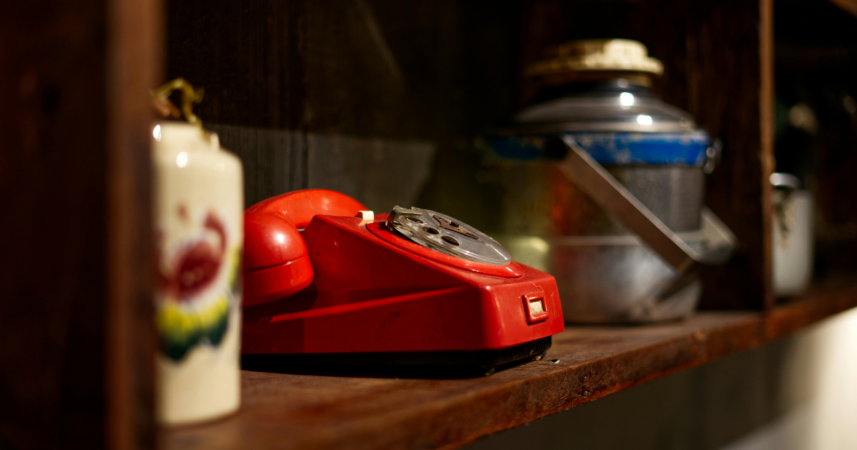
These gadgets weren’t fast or intuitive, but they shaped how people learned to wait, plan, and adapt. Growing up with friction taught lessons modern convenience often hides.

Add VegOut to your Google News feed. 
If you grew up in the 80s, your home probably didn’t feel “technological” at the time.
It just felt normal.
But look back now, and it’s wild how many objects once felt essential and now feel almost archaeological.
I’m not talking about luxury items or rich-kid toys.
I mean the stuff that quietly lived in lower-middle-class homes.
The gadgets that shaped daily routines, family arguments, boredom, and patience.
Kids today would look at half of these and ask one simple question: What does this even do?
Here are eight of them, and why they mattered more than we realized.
1) The rotary phone
Let’s start with the obvious one.
The rotary phone didn’t just sit there.
It demanded effort.
Physical effort.
You didn’t dial numbers.
You committed to them.
Mess up the last digit? Too bad. Start over.
I remember standing in the hallway, finger sore, listening to the click click click as the dial spun back into place.
Calling someone wasn’t casual.
It was intentional. You planned it.
And because phones were usually fixed to one wall, privacy was limited.
If you wanted to talk to a friend, you did it with at least one parent within earshot.
That alone shaped how kids communicated.
Psychologically, this mattered.
When access is limited, you think before acting.
Today, we fire off messages without friction.
Back then, every call felt like a small event.
Kids today wouldn’t recognize the patience this thing required.
Or the anxiety of dialing while someone watched.
2) The VCR with flashing 12:00
Every house had one.
And almost no one knew how to use it properly.
The VCR was supposed to be futuristic. In reality, it was a blinking monument to human confusion.
That 12:00 stayed there for years.
Recording a show meant consulting a paper TV guide, setting times manually, and hoping nothing went wrong.
And something always went wrong.
I’ve mentioned this before but there was something psychologically grounding about waiting for a specific time to watch something.
You didn’t binge.
You showed up.
From a decision making standpoint, this taught delayed gratification without anyone labeling it as such.
You planned ahead or you missed out.
Kids today, used to instant playback and algorithmic recommendations, wouldn’t recognize the stress of realizing you taped over something important.
Or the heartbreak of returning a rental tape without rewinding.
3) The clock radio with mechanical buttons
This thing did two jobs and did neither particularly well.
It told time, sort of.
And it played music, sort of.
The buttons were stiff.
The tuning dial was imprecise.
You had to gently adjust it until the static faded just enough.
But this gadget shaped mornings.
Waking up wasn’t customizable.
You didn’t choose a playlist.
You woke up to whatever song or ad happened to be playing.
That randomness mattered.
Research in behavioral science shows that lack of control increases adaptability.
You learned to deal with what you got.
I still associate certain songs with groggy mornings and cereal bowls because of that radio.
Kids today wake up to curated playlists or gentle vibrations.
They wouldn’t recognize waking up to loud static and a DJ yelling at 6 a.m.
4) The answering machine with cassette tapes
Before voicemail, there was this clunky box sitting near the phone.
It recorded messages on tiny cassette tapes.
Actual physical media.
If someone left a message, you had to press play and listen.
No preview. No transcript. No skipping ahead easily.
And if the tape filled up, that was it.
Missed calls piled up like uncollected mail.
This gadget subtly shaped social expectations.
People didn’t assume instant responses.
Waiting was normal.
From a psychological perspective, this reduced ambient anxiety.
There was no pressure to reply immediately because immediacy wasn’t possible.
Kids today, used to read receipts and typing indicators, wouldn’t recognize a world where silence didn’t automatically mean rejection.
5) The electric can opener mounted under a cabinet
This one feels small, but it was everywhere.
Mounted under kitchen cabinets, humming loudly as it struggled through metal lids.
It felt futuristic.
Like something from a sci fi movie.
Lower middle class homes loved gadgets that promised convenience.
Even if they saved only five seconds.
But this device represented optimism.
The belief that technology would make life easier, one chore at a time.
I remember being told not to touch it because it was “dangerous.”
Which made it even more mysterious.
Kids today wouldn’t recognize why this was exciting.
Manual openers are cheap and efficient now.
But back then, this thing symbolized progress.
And psychologically, symbols matter.
They reinforce narratives about the future.
This one said: we’re moving forward.
6) The handheld calculator that wasn’t for school
Every house had at least one calculator that wasn’t part of homework.
It lived in a drawer.
Usually near bills.
It wasn’t small by today’s standards.
It had chunky buttons and a solar strip that sometimes worked.
This calculator represented adulthood.
It was used for budgets, tips, and arguments about money.
Watching parents punch numbers into it made finances feel serious and opaque.
Money wasn’t abstract.
It was something you calculated carefully.
Kids today grow up seeing numbers on screens constantly.
But those numbers update automatically.
Back then, every total was manual.
That difference matters.
Manual calculation increases awareness.
It forces you to confront limits.
Kids today wouldn’t recognize the weight of watching someone double check numbers before buying groceries.
7) The console TV with dials instead of a remote
The TV was furniture.
Big. Heavy. Wooden. And controlled by dials.
Changing channels meant getting up.
Adjusting volume meant leaning forward.
If the picture went weird, you slapped the side and hoped for the best.
This created natural limits.
You didn’t flip endlessly.
You watched what was on.
Behavioral studies show that effort reduces overconsumption.
The physical effort required to change channels made passive watching less addictive.
I remember family negotiations over what to watch because changing channels was a group decision.
Kids today wouldn’t recognize a TV that demanded physical involvement.
Or a screen that didn’t follow you room to room.
8) The tape recorder used for everything except music
This gadget did a lot of odd jobs.
Recording radio songs. Practicing speeches. Capturing random sounds. Leaving messages.
The quality was bad.
The controls were clunky.
But it was versatile.
For kids, it was a tool for experimentation.
You learned by pressing buttons and seeing what happened.
There was no undo. No delete button. Mistakes were permanent.
That permanence shaped creativity.
You committed to ideas.
You listened back and cringed, then tried again.
Kids today grow up editing endlessly.
Back then, constraints forced focus.
And focus is a skill we rarely talk about enough.
The bottom line
These gadgets weren’t glamorous.
They weren’t fast.
And they definitely weren’t intuitive.
But they shaped how people thought, waited, planned, and adapted.
Growing up with friction teaches you something modern convenience often hides.
That effort changes behavior.
That limits can be grounding.
Kids today wouldn’t recognize these devices.
But they might benefit from understanding what they taught.
Sometimes, progress isn’t about adding features.
It’s about noticing what we lost along the way.
What’s Your Plant-Powered Archetype?
Ever wonder what your everyday habits say about your deeper purpose—and how they ripple out to impact the planet?
This 90-second quiz reveals the plant-powered role you’re here to play, and the tiny shift that makes it even more powerful.
12 fun questions. Instant results. Surprisingly accurate.