
There is nothing “silly” or “dramatic” about how big these little things feel as growing up lower middle class shapes the way you relate to money, comfort, and possibility.

Add VegOut to your Google News feed. 
We talk a lot about “big” milestones: Buying a house, landing a high paying job, and taking that bucket list trip.
If you grew up lower middle class, some of the most emotional moments are tiny.
They are often the first times you get to relax around money, even for a second.
The first times you realize, “Oh, life does not have to feel like constant calculation.”
These are the small comforts that other people might take for granted.
For us, they can feel like crossing an invisible line.
Here are seven of those little upgrades that can feel absolutely massive, and what they reveal about healing your relationship with money, safety, and self-worth:
1) Eating at a restaurant without checking the prices first
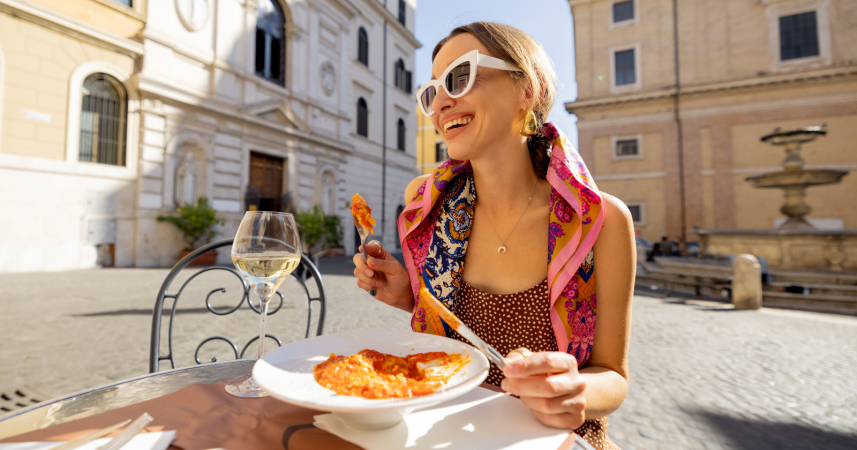
Do you remember your first time at a restaurant where you didn’t scan the right side of the menu first?
Growing up, I learned to read menus like a financial report.
Eyes to the prices, then work backward to what was “acceptable.”
Drinks were usually water, sharing an entrée was normal, and dessert was a rare event that required a family vote.
The first time I sat down, opened a menu, and chose what I actually wanted, it felt almost rebellious.
I ordered the meal that sounded delicious, not the cheapest one, and I even added an appetizer.
For a few minutes I felt both thrilled and vaguely guilty, as if someone would walk over and say, “Sorry, not for you.”
That moment had less to do with the food and more to do with permission.
Permission to enjoy something without performing mental gymnastics about the cost, and permission to trust that I could afford not just survival, but pleasure.
If you ever catch yourself scanning for prices out of habit, even when you are technically okay, notice it with kindness.
Over time, you can retrain your brain to ask different questions, like “What do I actually feel like eating?” instead of only “What is cheapest?”
That shift, from scarcity to choice, is a huge emotional upgrade disguised as a simple meal.
2) Buying groceries that are wants, not just needs
As a vegan adult, I can easily spend ten minutes comparing plant-based yogurts or fancy nut butters.
The younger version of me would be absolutely stunned.
Growing up, groceries were about stretching every cent.
Generic cereal, store brand bread, the cheapest produce on sale.
Snacks were rationed, and anything “extra” felt like it might tip the budget over the edge.
The first time I put purely “fun” food in my cart, I felt like I was getting away with something.
On paper, that is a tiny thing.
Emotionally, it told my nervous system a different story: “We have enough. You are allowed to enjoy food, not just tolerate it.”
If you grew up counting every item in your cart, you might still feel a rush of anxiety at the checkout, even when you are financially stable now.
When that happens, try this little reframe: I am not being irresponsible, I am allowing present-me to have a life that past-me dreamed about.
Buying the “extra” berries or the fancier coffee might seem minor, but for many of us, it is a small practice of abundance.
3) Owning something new that no one else used first
Do you remember your first truly new thing?
Not a hand-me-down, not something from a thrift store (which I still love, by the way), but something that came in a box or with tags, purchased just for you.
For me, it was a pair of running shoes.
Growing up, we made do with whatever was on sale or passed on from cousins.
Shoe shopping was about durability, not joy.
When I bought myself a high quality pair, in the exact style I wanted, I almost did not want to wear them.
They felt too good, too “fancy” for someone like me.
The real luxury was the sense that my comfort and my body were worth investing in.
That I did not have to be in pain, or “make it work”, just because that is what I was used to.
Maybe for you it was a brand new backpack, a winter coat that actually kept you warm, or a laptop that was not already half-broken.
Whatever it was, moments like these gently challenge an old belief: “I only deserve what is left over.”
As adults, choosing new, well-fitting, or high quality items can be a form of re-parenting.
You are showing your past self, “You deserved this softness and support all along.”
4) Having space of your own

Space is one of those invisible luxuries you do not notice until you finally have it.
Maybe you shared a bedroom with siblings, or maybe you did homework at the kitchen table because there was nowhere else to go.
Quiet was rare and privacy almost mythical.
The first time you have a room to yourself, or even just a corner that is entirely yours, it can feel life changing.
For me, having my own space also shifted how I thought about boundaries.
When you grow up without much room, it is easy to believe your needs are negotiable.
You get used to noise, interruptions, sharing everything.
Alone time feels selfish, not necessary.
Creating physical space, even a tiny reading corner or a shelf just for your things, sends a different message to your nervous system.
It says, “Your needs matter. Your rest matters. You can close the door.”
5) Travel that is not purely practical
The first time I traveled for fun, not out of necessity, I felt oddly suspicious of my own life.
Growing up, travel usually meant visiting relatives, moving for work, or going somewhere because we had to.
Vacations were for other people; hotels, flights, even eating at an airport restaurant felt like something I saw only in movies.
As an adult, booking a weekend trip “just because” felt enormous.
I remember sitting in a small hotel room, eating a simple plant-based meal, and thinking, “No one is making me be here. I chose this.”
It was not a luxury resort and it was not extravagant, but it was voluntary.
That is the quiet luxury many of us are chasing, even more than destination photos.
Optional travel teaches your brain that you are not always in reaction mode anymore.
You get to design experiences, not just survive circumstances.
If travel feels out of reach for you right now, even a small day trip can work this magic.
A train ride to a nearby town, a bus to a hiking trail, a night in a cheap guesthouse.
The point is the feeling of “I am allowed to go.”
6) Paying to save time, not just money
One of the biggest mindset shifts for me, especially with a background in finance, was realizing that my time has value too.
Growing up lower middle class, you get very good at trading time for savings.
Paying for convenience can feel like a moral failing.
Hiring someone to clean once a month, taking a cab home when you are tired, buying pre-chopped vegetables, or ordering takeout instead of cooking from scratch, all of it can trigger guilt.
The first time I intentionally paid for convenience, it was a grocery delivery.
I had deadlines, I was tired, and the idea of navigating a crowded store felt like running another marathon; I remember clicking “place order” with a knot in my stomach.
Afterwards, when the food arrived and I still had energy to cook a simple vegan dinner and take a short run, something clicked: I was buying back emotional bandwidth.
If you struggle with this, try rephrasing the question.
Instead of “Is this lazy?”, ask “Is this an investment in my energy, health, or sanity?”
Sometimes, the kindest thing you can do for yourself is choose the option that gives you back even an hour of rest.
7) Saying yes without financial panic in the background
Growing up, every invitation ran through a mental calculator.
Birthday parties, school trips, dinners out, even simple coffee catch-ups came with the silent question: “Can we actually afford this?”
Often, the answer was no, or “Only if we cut something else.”
As an adult, one of the most underrated luxuries is saying yes to an experience without that familiar spike of dread.
Joining friends for brunch and not worrying if you can cover your share.
For me, agreeing to a last-minute dinner with friends, ordering what I wanted, and not obsessively checking my banking app afterwards was huge.
I walked home realizing, “The bill came, I paid it, and nothing bad happened.”
This means being thoughtful about money is a strength you earned.
However, if every yes feels like a threat, your nervous system never really learns that you are safe now.
The real growth is letting yourself participate in your own life, instead of always watching from the sidelines.
Final thoughts
There is nothing “silly” or “dramatic” about how big these little things feel.
Growing up lower middle class shapes the way you relate to money, comfort, and possibility.
It teaches you to be resourceful, but often at the cost of your sense of ease.
When you finally get to taste small comforts that others barely notice, your whole body feels it.
Here is what I want you to remember: Enjoying these small luxuries means you are slowly rewriting an old script that says you only deserve the bare minimum.
The next time you buy the nicer plant-based ice cream, take the quicker route home, book that little trip, or choose the meal you actually want, pause and acknowledge it.
You are quietly telling yourself, “My comfort matters. My joy counts. I am allowed to live a life that feels softer than the one I grew up in.”












