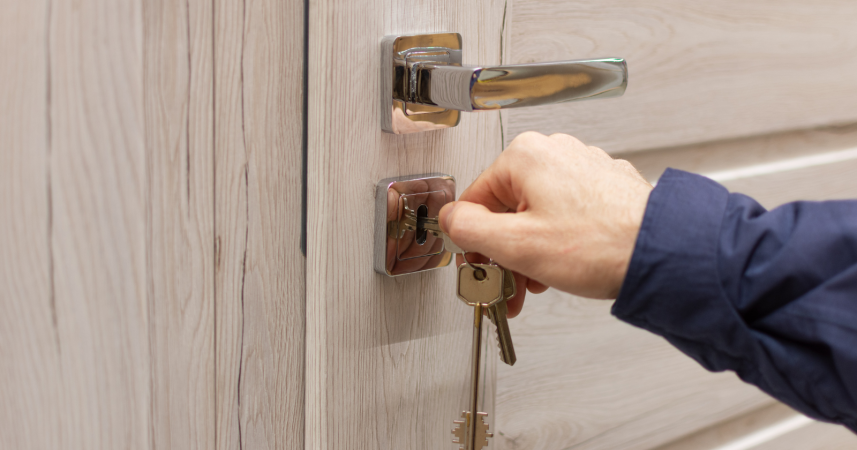
Weird little routines often point to something deeper—and more powerful—underneath.
It’s five steps from my apartment to the elevator—and somehow, that’s still enough distance for me to question whether I locked the door.
I’ll be halfway down the hallway, juggling a coffee, my bag, and a half-open umbrella, when I pause and think, “Wait. Did I hear the click?”
Sometimes I go back. Sometimes I don’t. But the moment always reveals something about me—about my patterns, my caution, and the funny intersection where logic meets emotion.
If you’re someone who habitually double-checks the lock (or the stove, or the alarm, or your Google Calendar…), you’re not “too anxious” or “a little extra.”
In fact, these small habits can point to some surprisingly unique traits—many of which are actually superpowers in disguise.
Let’s break down what they are.
1. You anticipate consequences before they happen
You’re the kind of person who can mentally walk down the entire domino chain—before the first one even tips.
If someone forgets to close a window during a storm, you’re already picturing the water damage on the hardwood floor. You’re not catastrophizing; you’re just running a simulation.
This trait is a hallmark of high prospective thinking. That makes you a lot better at avoiding preventable mistakes—not because you fear the worst, but because you have an internal checklist that helps you spot risks early.
I once worked with someone who left her coffee maker on overnight and came home to a scorched kitchen counter. She started checking the plug every morning after that.
Me? I had already been unplugging mine out of habit—for years. That kind of foresight isn’t always appreciated until something goes sideways.
It’s not about paranoia—it’s pattern recognition.
2. You’re emotionally tethered to a sense of responsibility
When something goes wrong, even if it’s not technically your fault, you still feel like you should have prevented it.
Maybe it’s from being the oldest sibling, or maybe it’s just who you’ve always been. You don’t like shrugging things off.
Double-checking the door isn’t about control; it’s about care. It’s a quiet, habitual way of saying: “I want things to be okay.”
And sometimes, that quiet pressure you put on yourself to be the buffer between chaos and calm becomes part of your identity.
This also shows up in group projects and relationships. You’re the one remembering birthdays, forwarding the calendar invite twice, and texting, “Just confirming we’re still good for 7?”
You do it because it matters—and because when people feel safe around you, it feels like you’ve done your job.
3. You crave peace of mind, not just safety
When you go back to check the lock, you're not necessarily worried about danger—you’re soothing the loop in your head. You're closing the tab so your brain can power down.
This is more about emotional regulation than physical threat.
As the team at Psychology Today points out, "Repetitive actions provide a feeling of control and reduce stress."
This repeatable action sends a calming signal to your nervous system. It’s why double-checkers often feel more mentally relaxed after they’ve done the thing—even if they knew, logically, it was already handled.
In a world that doesn’t pause much, rituals like these offer a tiny pocket of self-reliance. A way to tell your brain, “I’ve got you.” And sometimes, that’s all it takes to feel like you can exhale.
4. You have a strong self-accountability compass
Some people outsource responsibility to fate or “the system.”
Not you. You believe if something matters, it’s on you to follow through.
You keep receipts. You double-confirm plans. You’d rather be slightly over-prepared than leave something to chance.
It also means you're likely the first person to admit when you mess up. You’re not interested in passing the blame—you’re interested in learning what to do differently next time. That mindset is rarer than it sounds.
It’s not about being perfect. It’s about showing up in ways that build trust, both with others and with yourself.
5. You’re sensitive to disruption (and you build safeguards around it)
If your morning routine gets interrupted, your whole day can feel off.
If a task is unfinished, it buzzes in your mind like an open loop.
That’s because you’re likely high in neuroticism’s adaptive cousin—environmental sensitivity.
This trait isn’t a flaw. It just means you feel disruptions more acutely, so you naturally set up systems to prevent them.
Double-checking the door is actually a micro-boundary—a way to anchor your environment so your brain can focus on what really matters.
You might not always love that you feel things deeply—but those same nerves that twinge when a door might be unlocked also light up when someone you care about is a little off. You notice. You sense. You respond.
6. You’re quietly detail-oriented (even if you don’t show it off)
You might not color-code your closet or alphabetize your spices (though if you do, respect). But you notice things.
A flickering light in the hallway. A slightly ajar window. A strange noise when the latch turns.
This shows up in your work, too—you’re the one who spots the missing decimal point in a spreadsheet or catches the tone mismatch in an email draft.
You don't always announce these details, but you notice them. And that noticing builds a foundation of steadiness in everything you do.
You’re not flashy about it. You just quietly keep the wheels turning—and that consistency builds quiet confidence over time.
7. You have a deeper-than-average need for closure
Some people can walk away from unfinished tasks and feel fine.
You’re not one of them. Whether it’s a conversation, a project, or a literal locked door, you crave that sense of full-circle.
In your relationships, this is quite evident, too—you like clear communication, defined boundaries, and knowing where you stand.
Ambiguity makes you uneasy. You’d rather know, even if it’s uncomfortable.
Closure isn’t about being rigid—it’s about mental spaciousness. When something’s settled, your mind can finally wander somewhere new.
Final words: It’s not just about the door
If you’ve ever teased yourself for going back to double-check something, here’s your reminder: these aren’t “weird quirks”—they’re reflections of how deeply attuned you are to your environment, your values, and your internal rhythms.
There’s power in knowing how you move through the world. When you catch yourself checking the door one more time, don’t roll your eyes. Smile a little. That moment? It’s not anxiety. It’s self-leadership in disguise.
And if that means turning back once in a while to make sure things are solid, so be it—you’re simply building a life that holds steady when it counts.
Just launched: Laughing in the Face of Chaos by Rudá Iandê
Exhausted from trying to hold it all together?
You show up. You smile. You say the right things. But under the surface, something’s tightening. Maybe you don’t want to “stay positive” anymore. Maybe you’re done pretending everything’s fine.
This book is your permission slip to stop performing. To understand chaos at its root and all of your emotional layers.
In Laughing in the Face of Chaos, Brazilian shaman Rudá Iandê brings over 30 years of deep, one-on-one work helping people untangle from the roles they’ve been stuck in—so they can return to something real. He exposes the quiet pressure to be good, be successful, be spiritual—and shows how freedom often lives on the other side of that pressure.
This isn’t a book about becoming your best self. It’s about becoming your real self.