
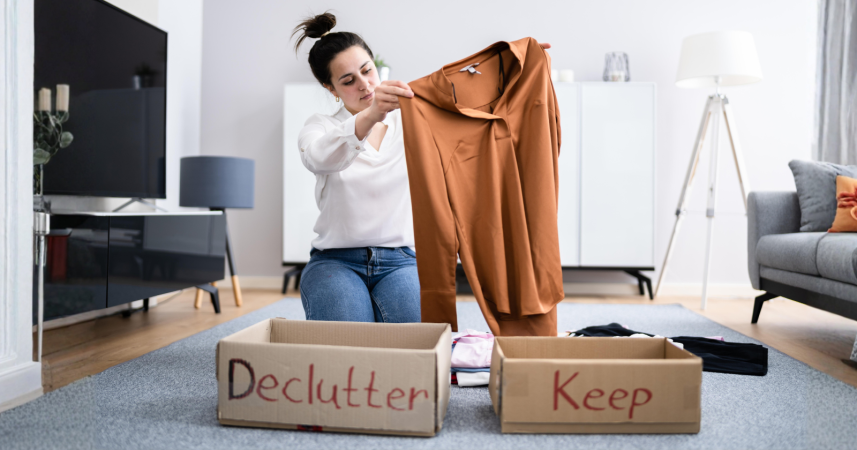
When disgust becomes your decluttering compass, you'll be surprised what you're actually willing to keep.

Add VegOut to your Google News feed. 
Let me be upfront with you. When I first heard about the "poop rule" for decluttering, I thought someone was pulling my leg.
The concept is simple, if a bit crude. When you're staring at that sweater you haven't worn in three years or the decorative bowl collecting dust on your shelf, you ask yourself one question:
If this item was covered in poop, would I bother cleaning it to keep it?
I know, I know. Not exactly coffee table conversation material. But here's the thing about this approach created by lifestyle influencer Amanda Johnson -- it cuts through all the mental gymnastics we usually do when trying to let go of stuff.
We're really good at telling ourselves stories about why we need to keep things. That dress might fit again someday. Those books make you look well-read. The broken picture frame just needs a little glue.
But when you imagine having to clean actual poop off something, your brain suddenly gets very clear about what matters.
It's disgustingly effective for everyday items
The beauty of this method is how quickly it helps you identify what actually holds value in your life.
Take my kitchen, for example. I had three vegetable peelers, two of which barely worked. Would I clean poop off a dysfunctional peeler? Absolutely not. Into the donation bin they went.
Same with that stack of plastic containers missing their lids, the chipped mugs from forgotten vacations, and the mystery gadgets I couldn't even name anymore. The visualization made it instantly clear which items earned their place in my home and which were just taking up space.
This technique works particularly well for clothes, too. That shirt with the stain you keep meaning to treat? The jeans that make you feel uncomfortable but were expensive? When you imagine the effort of cleaning and sanitizing them, your attachment evaporates pretty quickly.
The method also shines when dealing with items you've been holding onto out of guilt rather than genuine affection.
That gift from your aunt you've never used, the souvenir from a mediocre trip, the freebie from a conference. If you wouldn't go through the trouble of properly disinfecting it, it's not adding value to your life.
Your brain makes faster decisions when disgusted
There's something psychologically interesting happening with this technique that goes beyond the shock value.
When you feel disgust, your decision-making process speeds up dramatically. Your emotional response overrides the part of your brain that wants to analyze every angle, consider every possibility, and delay the choice indefinitely.
When you're out walking and you see something gross on the path, you don't stop to debate whether to step over it, right? You just move. The poop rule taps into that same instinct.
This is particularly helpful for people who get stuck in analysis paralysis. You pick up the same item five times during a decluttering session, put it in the donate pile, take it back out, put it in the maybe pile, and eventually just return it to the shelf.
The visualization cuts through that cycle. One question, one vivid mental image, one immediate answer.
It's also harder to lie to yourself when you're using this method. Try justifying why you'd scrub down an old magazine you haven't looked at in four years. The absurdity becomes obvious.
It fails spectacularly with sentimental items
Here's where the method completely breaks down, and it's important to know its limitations.
Would I clean poop off my grandmother's handwritten recipe cards? Yes, without hesitation. Would I clean it off the broken pottery bowl I made in a weekend class ten years ago? Also yes, apparently, even though I can't explain why.
The closest explanation would be that sentimental items don't follow the same logic as functional objects. The value isn't in their utility or replaceability. It's in the memories and emotions they represent.
This is where other decluttering methods work better. The KonMari approach of asking whether something sparks joy gives you permission to keep items based purely on emotional value. Swedish death cleaning encourages you to consider what would burden your loved ones after you're gone.
The poop rule treats everything as potentially disposable if you wouldn't perform a gross task to keep it. But some things transcend that calculation.
My partner's love letters, photos from my early trail running days, the journal I kept during my career transition, these items have value that can't be measured by how much trouble I'd go through to maintain them.
It works best when you pair it with other approaches
I've learned that the most effective decluttering happens when you use the right tool for the right job.
The poop rule excels at cutting through clutter in specific categories. Kitchen gadgets, excess linens, duplicate items, clothes you don't wear, these are all fair game. The visualization helps you be ruthless where ruthlessness serves you.
But for other areas of your home, different methods make more sense. For books, I prefer the one-in-one-out rule. For my running gear, I ask whether each item still performs its function.
The reverse hanger technique works well for clothes. You turn all your hangers backward, then turn them forward after wearing each item. After a season, anything still backward gets donated. It's objective data rather than an emotional decision.
The truth is that our attachment to possessions is complicated. Some items we keep out of habit, some out of obligation, some out of genuine love, and some because we haven't bothered to make a conscious choice about them at all.
The poop rule addresses that last category brilliantly. It forces you to make a choice about objects you've been passively allowing to occupy your space. And sometimes that's exactly what you need.
The real issue is why we accumulate so much
Using the poop rule made me think more deeply about why I had so much stuff to begin with.
When I was working long weeks in finance, I shopped as stress relief. I bought things I didn't need because acquiring them felt like progress, like I was taking care of myself, even though I was really just filling an emotional void with objects.
I'd come home exhausted and order things online. Kitchen gadgets I'd never use. Clothes for a social life I didn't have time for. The packages arriving felt like tiny gifts to my future self, the one who would eventually have time to cook elaborate meals and host dinner parties.
That version of myself never materialized because she wasn't real. She was a fantasy I was trying to purchase my way into.
Now that I'm more intentional about how I spend my time and money, I bring far less into my home. I ask myself whether I'll actually use something before buying it, not whether I'd like to be the kind of person who uses it.
The real work is figuring out what you're using possessions to avoid feeling. What hole are you trying to fill with stuff? What version of yourself are you trying to become through acquisition?
It's a tool, not a religion
The decluttering world can get a bit intense sometimes. People treat their preferred methods like sacred truths rather than practical tools.
The poop rule is just another option in your decluttering toolkit. Sometimes it's perfect for the job. Sometimes it's completely inappropriate. And that's okay.
What matters is that you're being thoughtful about what you allow into your life and what you choose to keep. Whether you get there by imagining poop, by thanking your items before releasing them, or by asking your meditation teacher for guidance, the destination is the same.
You want a home that supports the life you're actually living rather than weighing you down with the accumulated debris of past selves and imagined futures.
Some people will find the poop rule offensive or gross or reductive. Others will find it liberating and hilarious and exactly the kick they needed to finally deal with that junk drawer. Both responses are valid.
The method works if it works for you. If visualizing something disgusting helps you make decisions about your possessions, then use it. If it makes you uncomfortable or doesn't align with how you process choices, then try something else.
That's what decluttering is really about. Not achieving some perfect minimalist aesthetic or proving your discipline. It's about removing obstacles between you and the life you want to live.
Because at the end of the day, your stuff should serve you. Not the other way around.
What’s Your Plant-Powered Archetype?
Ever wonder what your everyday habits say about your deeper purpose—and how they ripple out to impact the planet?
This 90-second quiz reveals the plant-powered role you’re here to play, and the tiny shift that makes it even more powerful.
12 fun questions. Instant results. Surprisingly accurate.












