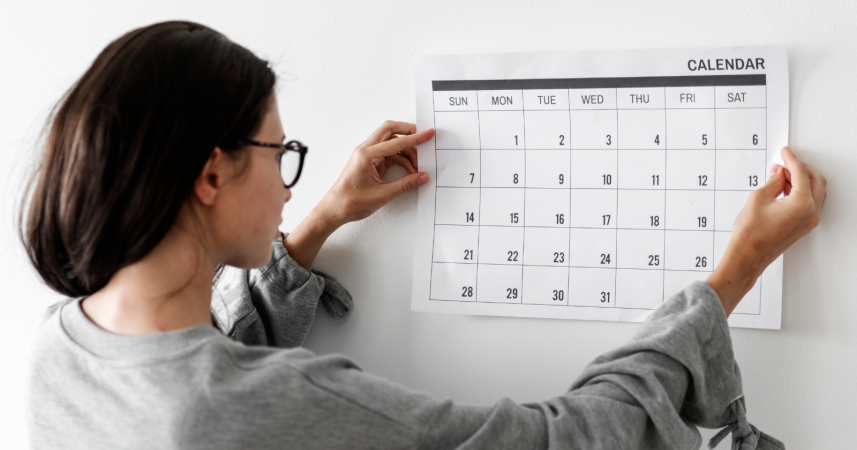
While digital calendars promise endless efficiency, those who still reach for pen and paper possess surprising cognitive advantages that our screen-dependent culture is rapidly losing.

Add VegOut to your Google News feed. 
In our hyper-connected world, pulling out a paper planner might seem like bringing a typewriter to a coding conference.
Yet here's what I've noticed: the people who stick with their trusty paper calendars often have organizational superpowers that those of us glued to our screens secretly envy.
I made this discovery during a recent workshop when I asked participants to share their scheduling methods. The room split almost evenly between digital devotees and paper loyalists.
But as we dug deeper into their organizational habits, a fascinating pattern emerged. The paper calendar users consistently demonstrated certain strengths that went far beyond simple preference.
If you're someone who still reaches for a physical planner instead of your phone, you might not realize just how rare your skills have become. These aren't just quirky habits; they're legitimate organizational advantages that many digital-first folks struggle to develop.
Let me walk you through the seven strengths I've observed in paper calendar users, and why these abilities are becoming increasingly valuable in our distracted age.
1. You can prioritize without endless options
When was the last time you opened your phone to check one thing and found yourself scrolling through three different apps twenty minutes later?
Paper calendar users have a built-in advantage here. When you open your planner, there's no notification badge screaming for attention, no suggested events popping up, no integration with seventeen other apps pulling you in different directions. You see what you wrote, and that's it.
This limitation is actually a strength. Research from the University of California, Irvine found that it takes an average of 23 minutes to refocus after a digital distraction. Paper planners eliminate this problem entirely. You're forced to be intentional about what deserves space on your calendar because you can't just infinitely scroll or create endless subcategories.
I learned this lesson myself when I started scheduling my writing time in focused 90-minute blocks. Using a physical planner meant I had to be selective about what made it onto the page, which naturally led to better prioritization.
2. You remember things better through physical writing
There's something magical that happens when pen meets paper. Scientists call it the "generation effect," and it means we remember things better when we physically write them down versus typing them.
Think about it: when you write a meeting time in your planner, you're engaging multiple senses. You feel the pen in your hand, see the words forming, and even hear the scratch of pen on paper. Your brain creates multiple pathways to that memory, making it stick better than a quick tap on a screen.
I discovered journaling at 36 and have since filled 47 notebooks with reflections and observations. Every evening, I spend 15 minutes writing in my journal, processing the day. The act of physical writing helps me remember not just what happened, but how I felt about it and what I learned.
Digital calendars might send you reminders, but paper calendar users often don't need them. They've already encoded that information more deeply just by writing it down.
3. You think in complete thoughts, not fragments
Have you ever noticed how digital communication has shortened our attention spans? We think in tweets, texts, and quick calendar entries.
Paper planner users, on the other hand, tend to think in complete thoughts and fuller context.
When you write something in a physical calendar, you're more likely to add context, draw connections between events, or jot down relevant notes. There's no character limit, no standardized fields to fill in. You might draw an arrow connecting two related appointments or scribble a reminder about what to bring to a meeting.
This holistic thinking extends beyond just scheduling. Paper calendar users often develop stronger narrative thinking skills, seeing their days and weeks as connected stories rather than isolated data points.
4. You create mindful transitions between tasks
Opening a paper planner is a ritual. You physically turn to the right page, look at your day, maybe cross off completed tasks.
This creates a "transitional object" that helps your brain shift between different modes of thinking.
Compare that to the instant, jarring nature of digital notifications. One second you're focused on work, the next your phone buzzes with a calendar alert, instantly disrupting your flow.
Paper calendar users naturally build in these mindful transitions. The physical act of checking your planner becomes a brief meditation, a moment to breathe and refocus before moving to the next task. It's like having built-in mindfulness breaks throughout your day.
5. You maintain better boundaries with technology
If your calendar lives in your phone, you have to pick up that distraction machine every time you want to check your schedule. And we all know what happens next. "Let me just quickly check if I'm free Tuesday" turns into a Instagram rabbit hole.
Paper planner users have already established a boundary. They can check their schedule without exposing themselves to the endless temptations of the digital world.
This isn't about being anti-technology; it's about being intentional about when and how you engage with it.
I have a monthly "money date" where I review my finances and maintain conscious awareness of spending. I deliberately use a paper ledger for this because opening my banking app invariably leads to checking email, then social media, then suddenly an hour has vanished.
6. You see the bigger picture literally
When you open a paper planner to a monthly spread, you can see your entire month at once. No swiping, no loading different views, no squinting at a tiny screen. This bird's-eye view allows for better pattern recognition and long-term planning.
Digital calendars often trap us in daily or weekly views. Even when month views are available, they're usually too cramped on a phone screen to be truly useful. Paper planner users develop stronger skills in seeing connections across time, identifying patterns in their schedules, and planning for the long term.
This visual comprehension extends to problem-solving in other areas too. People who regularly use spatial layouts to organize information often become better at seeing systemic connections and relationships.
7. You own your organizational system completely
What happens when your calendar app updates and suddenly the interface you've used for years completely changes? Or when the app you depend on gets discontinued? Digital natives often find themselves at the mercy of software developers and tech companies.
Paper calendar users own their system completely. No updates will change how your planner works. No company can suddenly decide to put ads in your calendar or sell your scheduling data.
Your organizational system is yours, customized exactly how you like it, and it will work the same way tomorrow as it does today.
This ownership breeds confidence and consistency. You become the master of your organizational system rather than having to constantly adapt to someone else's vision of how scheduling should work.
Final thoughts
Using a paper calendar in this day and age isn't about being old-fashioned or resistant to change. It's about recognizing that sometimes, the analog way of doing things develops skills that our digital-first world is quickly losing.
If you're a paper planner person feeling pressure to go digital, consider this your permission to stick with what works. Those organizational strengths you've developed aren't outdated; they're increasingly rare and valuable.
And if you're fully digital but struggling with focus, memory, or feeling overwhelmed by your schedule, maybe it's worth experimenting with a paper planner. You might discover that the "limitations" of paper are actually features that help you think more clearly and organize more effectively.
The goal isn't to choose sides in some digital versus analog war. It's to recognize that different tools develop different strengths, and sometimes the old ways teach us skills that no app can replicate.