
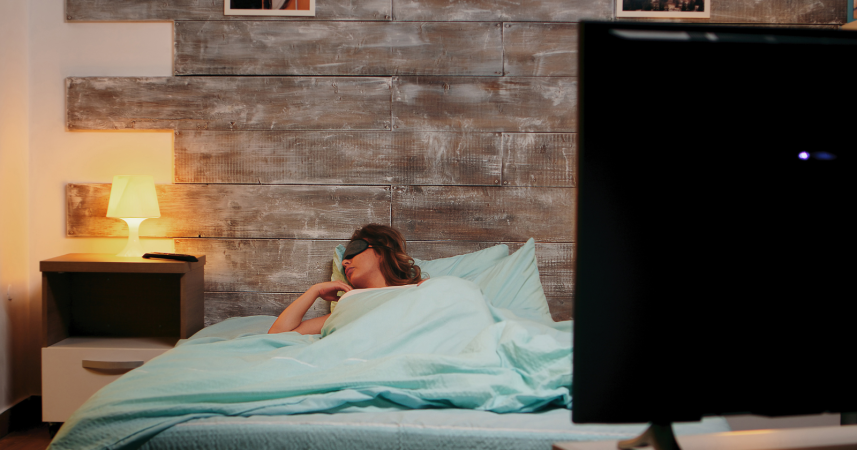
It turns out, how we fall asleep says a lot about how we’re wired.

Add VegOut to your Google News feed. 
Ever find yourself scrolling through streaming services at bedtime, not really looking for something to watch, but needing something, anything, playing in the background?
You're definitely not alone. Millions of people rely on the gentle glow and familiar sounds of television to drift off to sleep each night. And while sleep experts might warn against screen time before bed, there's actually something deeper going on here.
According to psychology, those of us who need the TV on to fall asleep often share certain personality traits and psychological patterns. These aren't flaws or weaknesses, just interesting aspects of how our minds work.
I used to judge myself for this habit until I realized it was tied to some fundamental aspects of my personality. Let's explore what science says about people like us.
1. You have an overactive mind
Does your brain feel like it's running a marathon the moment your head hits the pillow? Welcome to the club.
Research shows that people with racing thoughts often use external stimuli like television to redirect their mental energy. Your mind needs something to focus on besides that embarrassing thing you said five years ago or tomorrow's to-do list.
I spent years believing my analytical brain was only good for spreadsheets and problem-solving at work. Turns out, that same mental energy that made me successful professionally was keeping me up at night. The TV provides just enough distraction to quiet the mental chatter without requiring active engagement.
Think of it as giving your brain a gentle task to focus on, like counting sheep, but more entertaining.
2. You're highly sensitive to silence
Complete silence can feel overwhelming, can't it?
Some of us find that quiet amplifies every little sound: the house settling, a car passing by, even our own heartbeat. And according to psychologists, some people need noise to block out thoughts and regulate their attention.
In this case, the TV serves as a source of consistent background noise that provides a sonic buffer between you and the random creaks and groans of nighttime.
3. You crave comfort and routine
Remember when you were a kid and had that one stuffed animal you couldn't sleep without? The TV might be your adult version of that security object.
According to psychology, familiar shows can trigger feelings of safety and comfort. When you put on that show you've watched a hundred times, your brain recognizes the pattern and begins to relax.
I noticed this pattern in myself when I started reading for an hour before bed. The routine itself became as important as the activity. Whether it's a book or a beloved sitcom, that predictable pre-sleep ritual signals to your brain that it's safe to let go.
4. You might have underlying anxiety
Here's something that might resonate: using TV as a buffer against anxious thoughts.
Anxiety has a nasty habit of showing up right when you're trying to relax. That background television can serve as a form of cognitive distraction from worry cycles.
This doesn't mean everyone who sleeps with the TV on has an anxiety disorder. But if you find that silence leaves too much room for worry to creep in, you might be using television as a coping mechanism. There's no shame in that, though working on the underlying anxiety might help you sleep better in the long run.
5. You're probably an external processor
Do you think better out loud? Need to talk through problems with others? You might be an external processor who finds comfort in the illusion of company that TV provides.
The voices and conversations on screen can fulfill a psychological need for social connection, even when you're alone. It's like having roommates who never expect you to contribute to the conversation.
6. You tend toward all-or-nothing thinking
This one hit close to home for me. For years, I thought rest meant laziness and only constant productivity had value. Sound familiar?
People who struggle with black-and-white thinking often have trouble with the transition states between waking and sleeping. The TV provides a middle ground, you're not fully awake watching actively, but you're not completely disconnected either.
I had to learn that nuance exists in all areas of life, including how we approach sleep. Sometimes the "perfect" sleep environment isn't what works for your particular brain.
7. You might be avoiding emotional processing
When the day ends and distractions fade, emotions have a way of bubbling up.
According to research, many people use media consumption to regulate difficult emotions. The TV can serve as an emotional buffer, keeping you from having to sit with uncomfortable feelings that arise in quiet moments.
This isn't necessarily unhealthy unless it prevents you from ever processing these emotions. But recognizing this pattern can help you understand why silence feels so uncomfortable.
8. You have a creative or imaginative mind
Creative minds often struggle to "turn off" at night. Your imagination might run wild in the darkness, creating scenarios, solving problems, or replaying conversations.
The gentle narrative structure of television gives your creative brain something to follow without requiring it to generate its own content. It's like giving a border collie a job, it keeps that active part of your mind occupied while the rest of you prepares for sleep.
Final thoughts
If you recognized yourself in these traits, you're in good company. The need for TV to fall asleep isn't a character flaw or a sign of weakness. It's simply how some brains are wired.
That said, if this habit is interfering with your sleep quality or your partner's rest, it might be worth exploring alternatives. White noise machines, podcasts, or audiobooks can provide similar benefits without the blue light exposure. I myself found that transitioning to audio-only options helped me maintain the comfort while improving my actual sleep.
But if TV works for you and you're getting decent rest, don't let anyone shame you for it. We all have our unique ways of finding peace at the end of the day. The key is understanding why we need what we need and making conscious choices about our habits.
Sweet dreams, whether they come with a laugh track or not.
What’s Your Plant-Powered Archetype?
Ever wonder what your everyday habits say about your deeper purpose—and how they ripple out to impact the planet?
This 90-second quiz reveals the plant-powered role you’re here to play, and the tiny shift that makes it even more powerful.
12 fun questions. Instant results. Surprisingly accurate.












