
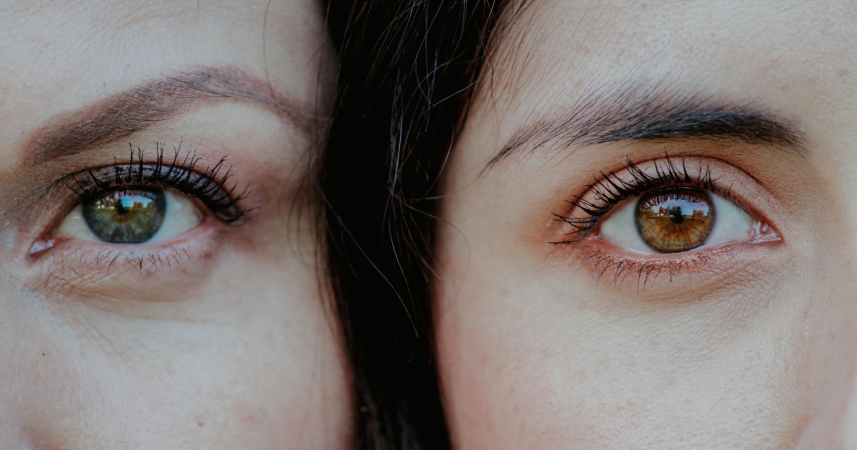
From social anxiety to instant credibility, research reveals how your eye-contact style silently signals confidence—or the lack of it—within seconds.

Add VegOut to your Google News feed. 
We size each other up in milliseconds, and the first data our brains grab are the eyes.
A relaxed gaze tells a potential friend — or hiring manager — that we’re open, steady, and sure of ourselves. A jittery, avoid-the-iris routine whispers the opposite.
Since most of us can’t recite body language theory on command, we rely on instinct.
Luckily, psychologists have mapped that instinct with hard numbers, illuminating how gaze style lines up with self-esteem, anxiety, and even perceived intelligence.
Below, I’ve expanded the 8 most compelling findings, each roughly 140 words, to show exactly why your pupils might be your most underrated confidence tool.
1. “Social anchors” keep conversations from drifting
Imagine you’re at a networking event and someone locks into a soft, steady gaze — no glaring, no stare-downs, just calm attention. Psychology Today contributors call the eyes “social anchors,” explaining that they stabilize conversational flow the way a keel steadies a boat.
When you hold that anchor, listeners register engagement, warmth, and self-assurance before you’ve finished your first sentence.
Lose it—by scanning the room or checking your phone—and you telegraph distraction or doubt.
Confident communicators treat eye contact like punctuation: short pauses when thinking, renewed focus when speaking, a relaxed release when yielding the floor. If you struggle, practice during low-stakes chats.
Pick one eye, hold for two or three heartbeats, then shift naturally when the dialogue hands off. Over time, the rhythm becomes muscle memory, and people will feel that silent assurance before you say a word.
2. A narrow “cone of direct gaze” can reveal shaky self-esteem
Researchers in Finland used high-resolution eye-tracking to plot each participant’s cone of direct gaze—the visual angle within which a face is perceived as “looking right at me.”
Men who required almost perfectly straight alignment to feel seen also scored lower in self-esteem and higher in loneliness. The takeaway: the narrower your acceptance window, the more internal validation you may crave.
Confident people tolerate slight gaze shifts because they don’t interpret them as rejection.
If you often feel dismissed unless someone locks eyes dead-center, ask whether the discomfort stems from their behavior or your own need for precise affirmation. Training wideners include group meetings where you consciously note that engagement can happen even when eyes flick to a slide deck.
Over weeks, your emotional brain learns that connection survives minor deviations, and self-trust, not laser focus, becomes your primary reassurance.
3. Social anxiety shortens gaze time
Socially anxious volunteers broke eye contact far sooner — often within a single second — compared with low-anxiety peers who maintained steady gaze for several seconds at a time.
Faster breaks weren’t deliberate — they were reflexive, tied to threat-monitoring circuits that tell the brain “too vulnerable—retreat.”
The problem is cyclical: avoidance prevents the nervous system from learning that eye contact is safe, which keeps confidence low.
Therapists now use “gaze exposure” drills: clients start by meeting their own eyes in a mirror for thirty seconds, then progress to timed exchanges with friends.
Each successful rep dampens hyper-alert amygdala firing, stretching tolerance for eye contact and shrinking the anxiety loop.
4. Even digital pupils can earn your trust
Eye contact’s power isn’t limited to flesh-and-blood interactions.
In a study using a virtual financial adviser, researchers toggled the avatar’s gaze between direct and averted.
When the adviser locked eyes, users rated it as more competent, trustworthy, and satisfying—even though the scripted advice never changed.
An averted gaze slashed those ratings. The lesson for remote workers is obvious: place talking points near your webcam so your eyes stay aligned with the lens.
Confident speakers rehearse slides in presenter mode but glance back constantly, mimicking the in-person rhythm of look-at-you, glance-at-notes, return-to-you. That tiny calibration sustains the unspoken promise, I’m present with you—even through a screen.
5. Trust, intelligence, and confidence ride on a calm gaze
Communication trainers repeat it because data backs it up: people who keep a consistent, unhurried gaze are flagged as more trustworthy and intelligent.
Behavioral specialists at Verywell Mind caution that intensity matters; over-staring can feel interrogative or flirtatious. The golden mean is a 3–5-second glance while speaking, shorter while listening, with natural blinks and occasional nods.
Darting eyes, on the other hand, broadcast insecurity or deception, triggering a subtle cortical alarm in observers. To recalibrate, film yourself recounting a story.
Notice eye patterns — do they zigzag, hover, or disappear?
Aim for gentle triangles: left eye, right eye, mouth, then back to eyes. Over time, the sequence smooths nervous flicks into confident, connected listening.
6. Mutual gaze sparks a confidence feedback loop
Beyond perception, eye contact can literally generate confidence.
Neuroscientists find that mutual gaze activates dopamine pathways connected to reward and approach motivation.
Think of it as social jet fuel: a calm exchange charges both parties, making further connection feel rewarding rather than risky.
Repeated exposure builds what psychologists call “social self-efficacy”—the belief that you can navigate interactions successfully.
Practical hack: before a pitch or difficult conversation, spend a minute locking eyes with a supportive colleague or even your own reflection.
That brief neural priming nudges your brain into an approach-oriented state, so by the time you face the real audience, confidence feels like a familiar groove rather than a performance you’re faking.
7. Cultural calibration keeps authenticity intact
In some cultures, kids are taught that prolonged eye contact with elders equals disrespect; in others, avoiding a gaze reads as dishonest.
Confident communicators respect these norms without abandoning presence.
The adaptable rule: aim for about 70% eye contact while talking and 50 percent while listening, then dial up or down based on the other person’s comfort signals — brow softness, head nods, pupil dilation. Authenticity shows in micro-expressions: relaxed eyelids, small smiles, and synchronized nods.
If you’re unsure, default to shorter glances paired with verbal engagement cues (“I hear you,” “That makes sense”) to prove attention without violating unspoken etiquette.
8. Mental rehearsal trains your ocular “muscle memory”
Elite athletes visualize perfect form before they step onto the court — confident speakers visualize successful eye engagement. In cognitive-behavioral terms, imagining a calm, connected gaze activates the same neural circuits as doing it live.
Pre-meeting ritual: close your eyes, picture scanning the room, landing on supportive faces, holding eye contact as your key points flow, then releasing smoothly to the next person.
This mental software writes to your hardware—the dorsolateral prefrontal cortex—so when reality arrives, your gaze follows the pre-programmed path, freeing your mind to focus on content rather than where to look.
Final thoughts
Your gaze is a conversation before the conversation: it tells people whether to lean in or armor up.
Unlike height or jawline, gaze habits are malleable.
Shrink social anxiety by extending eye-contact intervals 10 percent each week. Broaden a narrow cone by reminding yourself that slight angle shifts aren’t rejection.
Anchor your words with soft, steady focus, and you’ll notice a subtle shift: people listen longer, nod more, and mirror your calm.
Confidence, then, is less about loud statements and more about silent signals—and your eyes are fluently bilingual in both.












