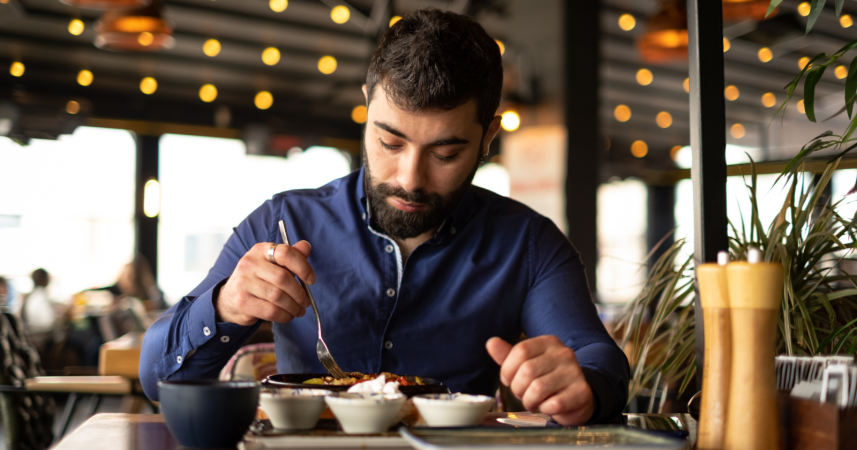
Dining alone without flinching? That quiet confidence says more about your inner life than most people realize, according to psychologists.
There’s something quietly bold about eating alone in public.
No phone in hand as a social shield. No pretend “I’m waiting for someone.” Just you, your meal, and the occasional sideways glance from a stranger. And the thing is—people who do this without flinching often reveal something important about themselves.
Because in a world that subtly rewards group belonging and constant interaction, being visibly alone is still seen as unusual. So when someone does it — and looks comfortable doing it — it says more than you might think.
Here are 9 unique traits that often show up in people who can dine solo with confidence, according to psychology and research on solitude, introversion, and self-possession.
1. They’re grounded in self-worth
It takes a certain kind of quiet confidence to sit down alone in a restaurant and not feel the need to explain yourself to the world.
People who do this comfortably tend to carry a strong internal compass. They don’t need external validation to feel like they belong somewhere.
This isn’t about arrogance — it’s about self-containment.
When you’re grounded in who you are, you’re less likely to interpret other people’s glances as judgment. That solid sense of self-worth radiates, even in silence.
2. They’re comfortable with discomfort
Most people can eat alone — they just don’t like how it feels. But those who lean into that discomfort and stay with it usually have a higher tolerance for vulnerability.
They’ve built that muscle slowly, often through repeated exposure. The more they’ve done things others shy away from, the more resilient they’ve become.
You won’t always see this from the outside, but inside, it’s a deep practice in emotional strength: choosing to be fully present in a setting that pushes against social norms — and not shrinking from it.
3. They embrace independence without apology
People who dine alone without stress usually have a healthy relationship with independence.
They’re not waiting for someone to join them in order to enjoy themselves. They don’t frame aloneness as a fallback. It’s a preference—and sometimes, even a joy.
This independence spills over into other areas: travel, decision-making, hobbies. These are people who know how to take themselves on dates, literally and figuratively.
And they often lead lives that are full — not because they’re constantly surrounded by others, but because they’ve learned to be enough company on their own.
4. They lean into solitude as a source of creativity
Not everyone uses solitude in the same way. Some people avoid it because it feels empty. But for those who embrace it, solitude often becomes a space for original thought.
I'd like to cite Albert Einstein here, who valued solitude and talked about its role in creativity and problem-solving.
As he said, “The monotony and solitude of a quiet life stimulates the creative mind”.
People who eat alone and enjoy the experience often tap into that same energy. They aren’t afraid of what their minds might stir up when the noise fades. In fact, they welcome it.
5. They’re introspective and observant
When you’re dining with others, the focus is usually on conversation. But when you’re alone, your senses open up in a different way.
You notice the body language of the couple two tables over.
The rhythm of the servers. The way the afternoon light hits the water glass just so.
People who comfortably eat alone often display high levels of introspection and observation. They’re tuned in—not to their phones, but to their surroundings.
And this attentiveness often shows up elsewhere too: in how they listen, how they process emotions, and how they connect dots others might miss.
6. They don’t define connection by constant interaction
Psychologist Susan Cain makes a powerful point in her writing about introverts: “Introverts may have strong social skills and enjoy parties and business meetings, but after a while wish they were home in their pajamas.”
She notes that introverts tend to prefer devoting their energy to close friends and family, rather than spreading themselves thin in large social groups.
People who dine alone aren’t necessarily antisocial — they just don’t equate togetherness with meaning. They know that connection doesn’t always have to be loud or performative.
Sometimes, solitude can be a more powerful reset than any group gathering.
7. They’re mentally spacious
There’s a certain mental clarity that comes from spending time alone—and choosing to do so in public amplifies that spaciousness. When you’re not filling every moment with talk or distraction, your brain has room to process, reflect, and create.
Sherry Turkle, a psychologist and professor at MIT, writes about how solitude fuels reflection. In her book Reclaiming Conversation, she notes: “Our brains are most productive when there is no demand that they be reactive.” She adds that creative ideas often stem from those quiet reveries where we allow the mind to wander.
People who eat alone tend to understand this intuitively. They aren’t afraid to sit in stillness because they’ve experienced how fertile that space can be.
8. They’re immune to unnecessary peer pressure
Whether it’s in middle school or middle age, being seen alone in public still comes with assumptions
. Some might read it as loneliness.
Others, as awkwardness. But those who choose to dine solo—and enjoy it—have usually outgrown the need to conform.
They’ve decoupled visibility from validation. That ability to operate outside social expectation without losing composure?
It suggests a higher-than-average resistance to peer pressure — and a healthy boundary between self-perception and external opinion.
9. They enjoy their own company
At the heart of it all, people who eat alone without self-consciousness genuinely like themselves. That doesn’t mean they’re never insecure — but they’re not reliant on constant affirmation to feel okay.
When you’re able to sit across from yourself, share a meal, and feel nourished by the experience—not just the food—it shows a level of emotional maturity that’s worth aspiring to.
These are the people who often become great partners, friends, and parents—not because they’re always available, but because they show up from a place of fullness.
Final thoughts
Eating alone in public used to come with a quiet sense of taboo — something you only did when no one else was free. But now? It’s a subtle sign of someone who’s moved past the noise.
If you’re someone who can settle into a solo meal with ease, you’re likely more introspective, emotionally grounded, and creatively attuned than most.
You’re not trying to make a statement. But without saying a word, you’re doing just that.
And if you’re not quite there yet—if the thought of dining alone still makes you squirm—consider this your gentle invitation. Try it once. Then try it again. You might be surprised by what it reveals—not just about the world around you, but about you.