
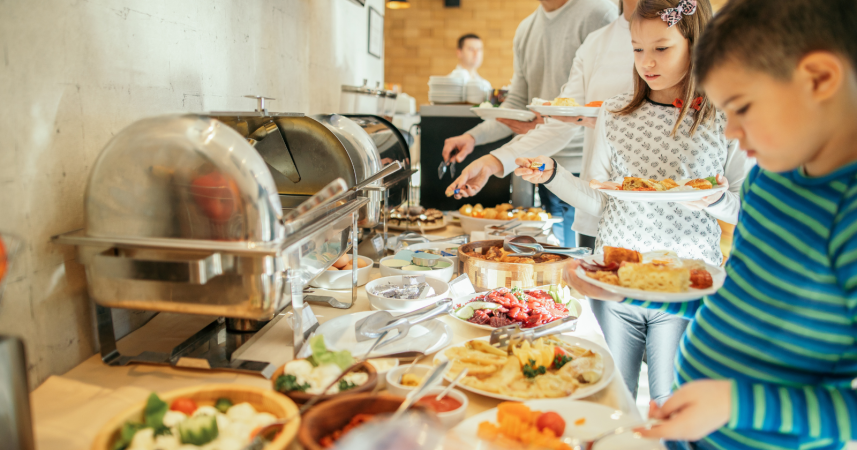
The resort buffet is a social stage—here’s how to get your money’s worth without looking grabby, wasteful, or rude.

Add VegOut to your Google News feed. 
Resort buffets are strange little ecosystems.
There’s an unspoken choreography — scan the room, find your flow, grab what looks good, and try not to clog the line.
Most of us are just trying to get value from the stay we paid for, feed our people, and enjoy the sunny chaos. But buffets also come with social optics.
Tiny habits can read as pushy, wasteful, or rude—even when we don’t mean them that way.
This isn’t a shame list.
It’s a guide to reading the room so you can relax, eat well, and sidestep the micro-judgments that swirl around the carving station.
1. Building a “first-pass mountain” plate
You’re hungry, the options look incredible, and you stack food like a Jenga tower “just in case” it runs out.
Other guests often read this as hoarding or low-key anxious — especially if shrimp, prime rib, or sushi gets buried under a pile of sides.
The practical fix is to treat the first pass like a tasting flight. Walk the room, clock what’s actually special, and start with a sampler plate.
You’ll eat better (because you won’t fill up on filler), and you’ll look like a pro who understands buffet flow. If something you love is dwindling, ask staff whether more is coming; most resorts replenish marquee items on a cadence.
Small plate, confident pace, eye contact with the line—those signals say “I’m here to enjoy myself, not clean out the tray.”
2. Camping at prime stations like it’s reserved seating
It’s normal to hover near the spot you love—the omelet bar, carving station, or fresh naan. But “parking” next to it with a plate and commentary (“I’ll just wait here until the next batch”) reads territorial.
People behind you feel blocked, and staff feel stage-managed.
The graceful move is to step back after your turn, rejoin the line if you want seconds, and keep side conversations to the edges so the queue can snake forward.
If you’re traveling with a group, nominate one person to scout refills and report back rather than forming a human barricade.
When you leave room for others to approach, you get better service—staff can work without dodging elbows—and you stop transmitting “this station is mine,” which is the quickest way to get side-eye from fellow guests.
3. Micromanaging chefs at live stations
Live-action corners (pasta, omelets, stir-fry) invite customization. But narrating every micro-step—“less oil, more salt, wait, extra garlic, flip it again”—comes off like you think the cook is your personal chef.
It slows the line and raises the temperature on a hot station already juggling five pans.
Better: offer one sentence with your key preferences, then trust the pro. “No butter, extra veg, mild spice—thank you!” lands cleanly and lets the cook do their rhythm.
If you need something dietary (vegan, gluten-free), state the constraint once and ask what’s doable—“What’s the easiest way to make this dairy-free?”—then accept the house solution.
That tone reads collaborative rather than controlling, and it’s amazing how far a genuine “This smells incredible—thanks for making it” goes with the person holding the ladle.
4. Cutting the line “just to grab one thing”
It’s tempting to slip in for “one scoop of fruit” or “just a roll.” But to everyone who’s been inching forward, that quick grab registers as line-cutting—even if your intentions are innocent.
Buffets are designed as loops; small detours make big traffic snarls. The classy fix is to flow with the queue or to approach from the start of the station you’re actually using.
If you truly missed a single item two steps back, catch a staffer’s eye and ask, “Is it okay if I grab the chutney I forgot?”
Nine times out of ten, they’ll hand it to you or wave you through.
Clear asks beat stealth lunges, and they keep the vibe light.
Bonus: when you respect the queue, people notice—and they’ll do the same for you later when you’re the one who forgot the salsa.
5. Treating premium items like a scarcity grab
Shrimp towers, sushi, crab legs, carved meats—anything that reads “special” triggers a scarcity reflex.
Many guests respond by overloading a plate “now” and stashing it at the table “for later.” To onlookers, that telegraphs hoarding and kills the spirit of shared abundance.
A calmer strategy is to take a fair portion and plan a dedicated second pass after a reset. Staff usually replenish headliners frequently during peak hours, and you’ll enjoy them more when they’re freshly set out.
If you’re anxious about missing out (understandable), time your loop to when trays typically flip—watch the staff cadence once, then swoop confidently when the new batch lands.
You’ll get premium items at their best while projecting ease instead of grabby energy.
It’s not just optics — it’s a better meal.
6. DIY “taste-tests” with fingers or your own utensils
Buffets are trust systems.
The social contract is simple: use the serving utensil provided, don’t double-dip, and don’t let personal forks or fingers cross the sneeze guard.
Most of us would never intentionally break that rule, but “just a quick taste” while you’re deciding reads unsanitary to the room—even when your hands are clean.
If you need to sample, take a tiny amount onto your plate and decide there.
When serving spoons slip into a dish and then onto someone’s personal plate and back again, staff have to pull the tray and replace it, which slows everyone down.
The hygienic grace move is boring and beautiful: fresh plate for each pass, serving utensils only, and a quick step aside if you need to regroup.
Nothing says considerate like keeping the food safe for the next person.
7. Quietly bagging “to-go” extras for later
Calling it “for the kids” or “for the room” doesn’t change how this lands.
Swiping pastries into a napkin pouch, loading fruit into a handbag, or filling a travel mug at breakfast to drink by the pool is widely read as tacky—even when you’re trying to stretch value.
Most resorts post a dine-in policy for buffets; staff have to enforce it evenly to keep food costs and health codes in check.
If you want snacks later, ask about official takeaway options—many properties offer grab-and-go items at the café or include a to-go cup at breakfast.
Better yet, take what you’ll actually eat now and enjoy it fully.
You’ll avoid the awkwardness of a quiet scold, you’ll stay within the rules you agreed to at check-in, and you’ll look like the guest who understands how the operation works.
8. Over-filling—and then leaving plates half-eaten
Eyes bigger than stomachs is a universal human experience.
The buffet version—three plates per person, half abandoned—signals wastefulness, not enthusiasm.
Staff clock it, neighboring tables notice it, and you end up feeling sluggish rather than satisfied.
The fix isn’t austerity — it’s pacing.
Start lighter, build a “greatest hits” second plate, and save space for one or two desserts you’ll actually savor. If you’re with kids or a big group, share tasting plates so no one is stuck with a mountain of something they don’t love.
Leaving a couple of bites is one thing; dropping off a plate that looks untouched is another.
The irony is that you’ll get more value from the buffet when you take less at a time — because the best bites will be hot, crisp, and chosen on purpose rather than scooped out of FOMO.
Final thoughts
Buffets magnify small choices.
The habits above aren’t moral failures — they’re stress responses to crowds, options, and the subtle pressure to “get your money’s worth.”
A few simple shifts—survey first, queue cleanly, keep requests concise, and pace your plates—make the whole experience calmer for you and kinder for everyone else.
The quiet win is social: you’ll blend in as the guest who gets it.
And the food?
It tastes better when the room feels good.












