
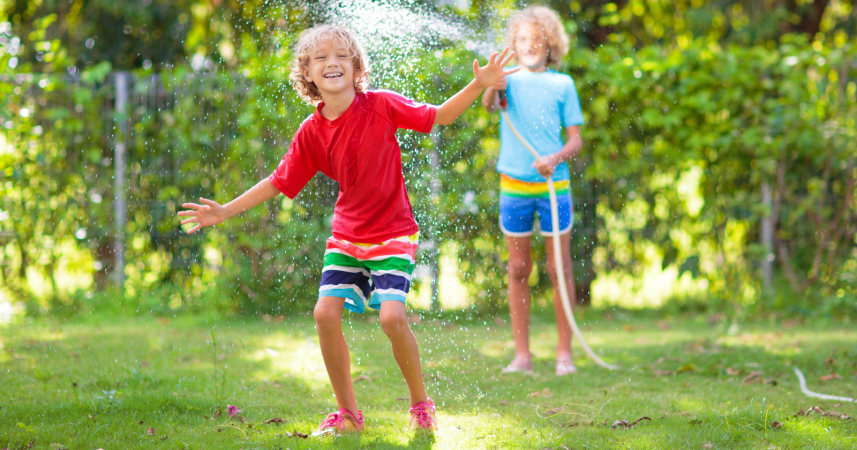
Before tablets and scheduled playdates took over, there was a generation of kids who turned garden hoses into science experiments, mud into gourmet meals, and every tree into a kingdom waiting to be conquered.

Add VegOut to your Google News feed. 
Close your eyes for a moment.
Can you smell the freshly cut grass mixing with the sweet scent of honeysuckle?
Feel the dirt under your fingernails and the sun warming your back as you crouch behind the rhododendron bush, plotting your next adventure?
If these sensations transport you back to endless summer afternoons spent outside, you're part of a special generation that knew the magic of a truly free-range childhood.
I've been thinking a lot lately about how different childhood looks today.
Last weekend, while tending to my vegetable garden, I watched the neighbor kids glued to their tablets on the porch.
It struck me how much has changed since I spent entire days outside, only coming in when the streetlights flickered on.
Growing up as an only child, the garden became my kingdom.
Every corner held a new possibility, every tree a potential fortress.
My parents, busy with their careers, trusted me to entertain myself outdoors.
And boy, did I.
Looking back, there were certain garden staples that defined those golden years.
If you played with these eight things, you probably had the kind of childhood that shaped you into someone who values creativity, resilience, and simple pleasures.
1) A trusty garden hose
Remember when a garden hose was the ultimate summer toy?
It wasn't just for watering plants.
It became a water gun, a jump rope for the brave, a limbo stick, and the source of homemade rainbows when you held your thumb over the nozzle just right.
On scorching July days, we'd take turns drinking straight from it, that distinctive rubber taste somehow making the water more refreshing.
I spent hours creating "rivers" down our sloped driveway, building dams with rocks and sticks, then watching them burst.
My father would come home from his engineering job to find the water bill mysteriously high and me covered in mud, grinning from ear to ear.
The garden hose taught us physics before we knew what physics was.
Water pressure, gravity, trajectory.
We were little scientists without even realizing it.
2) Climbing trees
If you had a good climbing tree in your yard, you had everything.
Mine was an old oak that seemed to touch the clouds.
Each branch had a name and purpose.
The thick one near the bottom was "the reading nook."
The Y-shaped junction halfway up became "the crow's nest" where I'd survey my domain like a pirate captain.
Tree climbing wasn't just about going up.
It was about problem-solving, risk assessment, and building confidence.
Which branch could hold your weight?
How far could you stretch between footholds?
Every climb was a negotiation between ambition and safety.
I'll never forget the day I finally reached the top branch I'd been eyeing for years.
The view was incredible, but more importantly, I'd conquered something that once seemed impossible.
That feeling stays with you.
3) Mud kitchens and dirt pies
Who needs Play-Doh when you have good old-fashioned dirt?
We were master chefs in our outdoor mud kitchens, mixing "chocolate cakes" decorated with dandelion garnishes and "soups" stirred with twigs.
Old pots and pans rescued from kitchen clear-outs became our prized cooking equipment.
The texture of mud squishing between your fingers, the satisfaction of molding it into perfect pies, the creativity of finding the right leaves and flowers for decoration.
This sensory play was pure magic.
We'd serve elaborate meals to imaginary customers or reluctant parents who'd pretend to eat our creations.
Now, working in my actual garden, I realize those mud pie days taught me not to fear getting dirty.
There's something therapeutic about having soil under your fingernails, something honest about it.
4) Homemade obstacle courses
Every piece of garden furniture, every plank of wood, every rope became part of elaborate obstacle courses we'd design and redesign endlessly.
Jump over the wheelbarrow, crawl under the picnic table, hop on one foot to the birdbath, spin around three times, race to the shed.
We'd time each other with watches borrowed from our parents, constantly trying to beat our records.
These courses changed daily.
Sometimes we'd add water balloons to carry without breaking.
Other times, we'd have to balance books on our heads or carry an egg on a spoon.
The creativity was endless, and so was our energy.
Building these courses taught us planning, spatial awareness, and healthy competition.
Plus, we were getting incredible exercise without anyone having to tell us to "go play outside."
5) Bug hotels and worm farms
Armed with jam jars punctured with air holes, we were tiny naturalists on important scientific missions.
Collecting rolly pollies, observing ant highways, creating "hotels" for beetles out of shoe boxes filled with grass and twigs.
We'd spend hours watching caterpillars, convinced we could see them growing before our eyes.
I had a worm farm in an old ice cream container.
Every day, I'd check on my worms, feed them vegetable scraps, and document their "behavior" in a notebook.
My mother, ever the teacher, encouraged this curiosity instead of being grossed out by the container of worms in our garage.
This hands-on exploration of nature fostered respect for all living things.
Today, when I find beneficial insects in my garden, I remember that childhood fascination and handle them with the same gentle curiosity.
6) Fort building with whatever you could find
Branches, old sheets, clotheslines, lawn chairs.
Everything was potential fort material.
We'd spend entire mornings constructing elaborate hideouts, only to tear them down and start fresh after lunch.
The process was more important than the product.
Negotiating space, solving structural problems, learning that the tablecloth from the dining room was absolutely off-limits after that one incident.
Inside these forts, we'd make grand plans, share secrets, read comics by flashlight even in broad daylight.
They were our first taste of independence, our own spaces where adult rules bent just a little.
The problem-solving skills developed from figuring out how to make a roof stay up or walls stand firm? Invaluable.
7) Sidewalk chalk masterpieces
The driveway or patio became our canvas, and those fat pieces of colored chalk were our paintbrushes.
We'd create entire worlds in chalk.
Hopscotch courts, of course, but also elaborate roads for bike riding, giant flowers that took up the entire driveway, messages for parents to find when they came home.
Rain was both enemy and friend.
We'd rush to finish our masterpieces before storms, but we also loved watching the colors swirl and blend as water washed them away, knowing we'd have a fresh canvas tomorrow.
There was something liberating about creating art that wasn't permanent, that existed just for the joy of making it.
8) Water balloon battles and sprinkler runs
The anticipation of filling dozens of water balloons, fingers cramping from tying them off, storing them carefully in buckets for the upcoming battle.
Water balloon fights were serious business.
Alliances formed and broke.
Strategies developed.
That one kid who could throw incredibly far was always picked first.
And inevitably, someone would cry when they got hit in the face, but five minutes later, they'd be back in the game.
Running through sprinklers was pure joy.
That moment of hesitation before the first dash through, the shock of cold water, then doing it again and again until our lips turned blue and parents called us in.
These simple water games taught us resilience, fairness, and how to lose gracefully when you got soaked.
Final thoughts
If you recognized yourself in these memories, you experienced something special.
A childhood where imagination trumped technology, where boredom sparked creativity, and where the garden was an endless source of adventure.
These weren't just games.
They were lessons in problem-solving, creativity, risk-taking, and resilience.
They taught us to appreciate simple pleasures and find magic in ordinary things.
Sure, times have changed.
Safety concerns are real, and technology has its place.
But sometimes I wonder if we've lost something essential in our rush to structure and supervise every moment of childhood.
When I work in my garden now, hands deep in soil, I'm grateful for those unstructured hours of outdoor play.
They shaped who I am, fostering a love of nature and an understanding that the best entertainment doesn't always come from a screen.
Did you play with all eight of these things?
Or did your garden adventures include something I missed?
Either way, if you spent your childhood days outside, creating worlds from nothing but imagination and whatever nature provided, count yourself lucky.
You had the kind of childhood that builds character, creativity, and a lifetime of fond memories.
If You Were a Healing Herb, Which Would You Be?
Each herb holds a unique kind of magic — soothing, awakening, grounding, or clarifying.
This 9-question quiz reveals the healing plant that mirrors your energy right now and what it says about your natural rhythm.
✨ Instant results. Deeply insightful.

Avery White
Formerly a financial analyst, Avery translates complex research into clear, informative narratives. Her evidence-based approach provides readers with reliable insights, presented with clarity and warmth. Outside of work, Avery enjoys trail running, gardening, and volunteering at local farmers’ markets.
More Articles by Avery










