
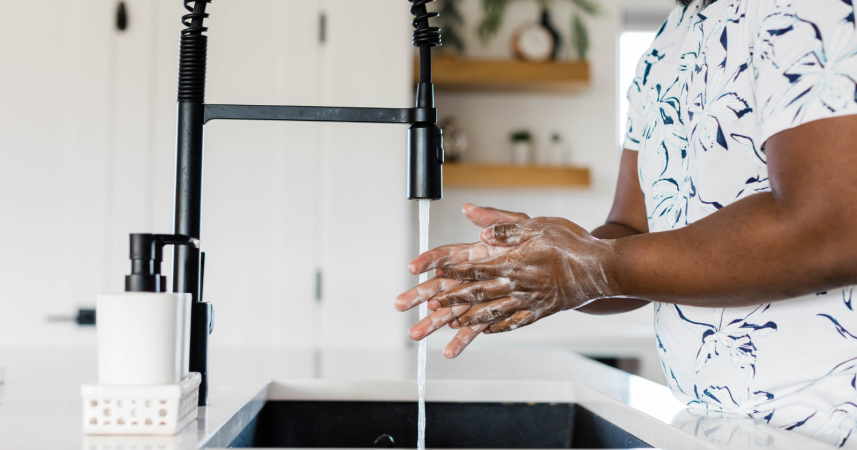
This seemingly simple habit of rushing to wash hands after walking through the door isn't about cleanliness at all—it's a sophisticated psychological ritual that reveals how certain people create an invisible force field between their sanctuary and the chaos of the outside world.

Add VegOut to your Google News feed. 
Ever notice how some people have this automatic ritual the moment they walk through their front door? Keys down, shoes off, straight to the sink to wash their hands. Every single time, without fail.
I used to think this was purely about hygiene, especially after everything we've been through with global health concerns.
But after diving into the psychology behind this behavior and observing friends who religiously follow this routine, I've discovered something fascinating. This habit reveals much deeper traits about personality and what home represents to these individuals.
1) They have strong psychological boundaries
People who immediately wash their hands upon entering their home are often excellent at creating mental compartments in their lives. They understand that different spaces require different versions of themselves, and they've developed physical rituals to help their minds transition.
It marks a transition point: Outside mode off, home mode on."
Think about it. When you wash your hands at the threshold of your home, you're not just cleaning dirt. You're symbolically washing away the stress of traffic, the demands of work, the energy of crowded spaces. It's a psychological reset button that helps you leave the outside world where it belongs: outside.
I remember when I was dealing with burnout at 36, my therapist suggested creating physical rituals to separate work from home life. That simple act of washing hands became my signal to shift gears, and it made a world of difference in my ability to truly relax at home.
2) They value control and predictability
These individuals often thrive on routine and structure. The handwashing ritual is just one piece of a larger pattern of behaviors that help them feel grounded and in control of their environment.
This need for control isn't necessarily negative. In fact, it can be a healthy coping mechanism. When the outside world feels chaotic and unpredictable, having set routines at home provides stability. The act of washing hands becomes a small but meaningful way to exert control over their immediate environment.
During my time in financial analysis, I noticed that colleagues who had the strongest home routines were often the ones who handled workplace stress most effectively. They had created personal systems that helped them process and release the day's tensions.
3) They're highly conscientious
Conscientiousness goes beyond just being organized or responsible. People who wash their hands immediately upon entering home tend to be detail-oriented and thoughtful about their actions. They consider the ripple effects of their behaviors, not just on themselves but on others in their household.
These are the people who remember to turn off lights, who notice when the milk is running low, who think ahead about meal prep for the week. The handwashing habit is part of a broader pattern of mindful living.
A study examining hand hygiene behaviors found that individuals aged 60 and older disinfected their hands significantly more often than younger adults, suggesting that conscientiousness around hygiene often increases with age and life experience.
This aligns with what we know about conscientiousness as a personality trait that tends to strengthen over time.
4) They process stress through physical action
For many immediate hand-washers, this ritual serves as a physical outlet for mental and emotional processing. The sensory experience of warm water, the smell of soap, the mechanical action of scrubbing - all of these engage the body in a way that helps the mind decompress.
This is particularly true for people who work in high-stress or high-contact professions. Healthcare workers, teachers, retail employees - they often develop this habit not just for hygiene but as a way to physically wash away the emotional residue of their day.
I've found this to be true in my own life. After particularly challenging days, that simple act of washing my hands feels almost meditative. It's a moment to breathe, to feel the water, to transition from who I needed to be out there to who I want to be at home.
5) They view home as a sanctuary
Perhaps most tellingly, people who wash their hands immediately upon entering demonstrate a deep reverence for their home space. To them, home isn't just where they live; it's a sacred space that deserves protection and respect.
These individuals often invest significant energy in creating a peaceful, clean, and organized home environment. They see their living space as an extension of themselves, a place where they can fully be themselves without the masks required by the outside world.
The handwashing ritual becomes a form of honoring this space, ensuring that nothing unwanted crosses the threshold. It's about maintaining the purity and peace of their personal sanctuary.
6) They have heightened awareness of transitions
Finally, immediate hand-washers tend to be acutely aware of life's transitions, both big and small. They understand that how we move between spaces and roles affects our wellbeing.
Fredric Neuman, M.D., Director of the Anxiety and Phobia Center at White Plains Hospital, notes that "Washing repeatedly makes the urge to wash again stronger." While this can become problematic if it turns compulsive, for most people, a single transitional washing serves as a healthy boundary marker.
These individuals often excel at work-life balance because they've learned to create clear demarcations between different aspects of their lives. They're the ones who change out of work clothes immediately, who have specific evening routines, who understand that transitions need to be acknowledged and honored.
Final thoughts
If you recognize yourself in these traits, embrace them. Your handwashing ritual is more than just good hygiene; it's a sophisticated psychological tool for managing stress, creating boundaries, and honoring your personal space.
And if you don't have this habit but find yourself struggling with work-life balance or bringing stress home, consider adopting a simple arrival ritual of your own. It doesn't have to be handwashing. Maybe it's changing clothes, taking three deep breaths, or simply standing in your doorway for a moment to acknowledge the transition.
What matters is creating that moment of intention, that physical action that tells your brain: I'm home now. The outside world can wait. This is my space, my time, my sanctuary.
After all, in a world that constantly demands our attention and energy, protecting the sanctity of our home space isn't just practical. It's essential for our wellbeing.












