
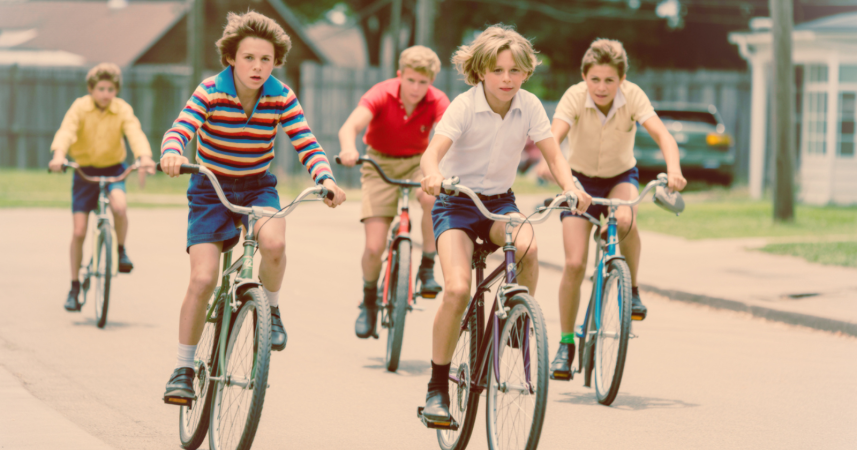
Those unstructured hours between "go play" and the glow of streetlights didn't just fill our summers—they quietly forged a psychological armor against life's uncertainties that no amount of scheduled activities or screen time can replicate.

Add VegOut to your Google News feed. 
Remember those summer days when the only rule was to be home before dark? When scraped knees were badges of honor and boredom was just the beginning of an adventure?
I've been thinking about this a lot lately, especially as I watch my neighbors' kids shuttle from one scheduled activity to the next, their faces illuminated more by screens than sunshine. There's something fundamentally different about how we grew up versus how kids are raised today.
Growing up, I spent countless hours roaming the neighborhood with a pack of kids, making up games, settling disputes, and figuring things out without adult intervention. We learned to read the sky for rain, negotiate who got the good bike, and deal with the disappointment when plans fell through. No GPS tracking, no structured playdates, just pure, unfiltered childhood.
Psychology research backs up what many of us instinctively know: those unstructured outdoor experiences shaped us in profound ways.
Kids who grew up with the freedom to explore until the streetlights came on developed a unique set of traits that serve them well in adulthood. And every single one of these traits involves a comfort with uncertainty that's increasingly rare in our hyper-scheduled world.
1) They embrace ambiguity without needing immediate answers
When you spent your childhood exploring creek beds and vacant lots, you learned that not everything has a clear explanation. Why did that frog disappear? Where does this path lead? You didn't Google it; you wondered about it, made up theories, and sometimes never found out.
As adults, these former free-range kids don't panic when faced with unclear situations. They can sit with not knowing, whether it's waiting for test results, navigating a career transition, or dealing with relationship uncertainties. They understand that some questions don't have immediate answers, and that's okay.
I see this in my own life constantly. While some colleagues need every detail mapped out before starting a project, I'm comfortable diving in with partial information. This wasn't something I learned in my years as a financial analyst.
It came from those childhood afternoons when we'd set off on our bikes with no destination in mind, trusting we'd figure it out as we went.
2) They solve problems creatively with limited resources
Remember building forts with whatever you could find? Three branches, an old tarp, and some rope became a mansion in your mind. You didn't have a kit or instructions. You had imagination and determination.
This resourcefulness translates directly into adulthood. These individuals don't wait for perfect conditions or ideal tools. They work with what they have, finding innovative solutions others might miss. They're the ones who can throw together a presentation with half the usual prep time or fix a problem without calling in experts.
3) They handle rejection and disappointment with grace
Not everyone wanted to play with you every day. Sometimes you got picked last for kickball. Other times, your grand plans for a treehouse got rained out for a week straight. There was no parent swooping in to fix these disappointments or arrange a makeup playdate.
National Geographic notes that "unstructured outdoor play builds stronger brains and lasting ties to nature." Part of that brain-building involves learning to bounce back from setbacks without adult intervention.
This early training in disappointment created adults who don't crumble at the first "no." They understand rejection isn't personal or permanent. They dust themselves off and try again, whether it's after a failed job interview, a rejected proposal, or a relationship that didn't work out.
4) They read social situations without explicit instructions
Out on the playground or in the woods, you learned to read the room (or field) quickly. Was Tommy in a mood today? Could you join the game already in progress, or would you be told to get lost?
You developed an intuitive sense for group dynamics without anyone explaining the rules.
Today, these adults navigate office politics, social gatherings, and new situations with an almost supernatural ability to assess the vibe. They pick up on unspoken tensions, know when to speak up and when to stay quiet, and can adapt their approach based on subtle cues others miss.
5) They tolerate physical discomfort without drama
Too hot? Too bad. Thirsty? The hose is three blocks away. Mosquito bites? Part of summer. We didn't have climate-controlled environments for every activity or water bottles within arm's reach at all times.
This physical resilience extends far beyond temperature tolerance.
These adults push through discomfort to reach goals, whether it's training for a marathon, working long hours on a passion project, or dealing with life's physical challenges without constant complaint. They understand that discomfort is temporary and often necessary for growth.
6) They build trust through repeated interactions
Childhood friendships weren't orchestrated through parent-arranged playdates. You saw the same kids day after day, learned who kept their word and who didn't, who had your back in a pickle and who'd throw you under the bus for a laugh.
UCLA Health confirms that "outdoor play boosts the ability to focus and think critically," and part of that critical thinking involved assessing who you could count on.
These relationship-building skills translate into adults who understand that trust is earned through consistency, not grand gestures. They invest in long-term relationships, show up reliably, and can distinguish between surface-level friendliness and genuine connection.
7) They entertain themselves without constant stimulation
Boredom was a regular visitor in our childhoods. No screens to grab, no structured activities every hour. Just you, maybe a stick, and your imagination. You learned to create your own fun, to find fascination in ant hills and cloud shapes.
As adults, these individuals don't need constant entertainment. They can enjoy a quiet evening without scrolling, find joy in simple pleasures, and generate their own projects and interests. They're rarely bored because they learned early that engagement comes from within, not from external sources.
8) They navigate conflict independently
When disputes arose over who was "it" or whether the ball was in or out, there was no referee. You had to work it out yourselves or the game ended. Sometimes it got heated. Sometimes feelings got hurt. But you learned to advocate for yourself, compromise when needed, and move on when resolution wasn't possible.
According to research from HealthyChildren.org, "when children spent time in natural settings they had less anger and aggression." Perhaps because they learned to process and resolve conflicts naturally, without adult mediation.
These conflict resolution skills create adults who can handle workplace disagreements, relationship tensions, and everyday frustrations without immediately seeking validation or intervention. They know how to stand their ground when it matters and let things go when it doesn't.
The comfort with uncertainty is everything
What ties all these traits together is a fundamental comfort with not knowing what comes next. When you grew up making your own fun until dark, you learned that uncertainty isn't threatening, it's just life. You can't control everything, and trying to removes the very experiences that build character and capability.
I think about this often during my trail runs, especially when I take an unfamiliar path. That little thrill of not knowing what's around the bend, the confidence that I'll figure it out, the trust in my ability to handle whatever comes, that all started in those unstructured childhood hours.
Today's scheduled, supervised, screen-focused childhood might be safer and more predictable, but it doesn't build the same tolerance for ambiguity. And in a world that's increasingly uncertain, that comfort with not knowing might be the most valuable trait of all.
The streetlights aren't coming on anymore to call us home. But those of us who grew up by their rhythm carry something special: the knowledge that we can handle whatever comes, even when we can't see it coming.
If You Were a Healing Herb, Which Would You Be?
Each herb holds a unique kind of magic — soothing, awakening, grounding, or clarifying.
This 9-question quiz reveals the healing plant that mirrors your energy right now and what it says about your natural rhythm.
✨ Instant results. Deeply insightful.

Avery White
Formerly a financial analyst, Avery translates complex research into clear, informative narratives. Her evidence-based approach provides readers with reliable insights, presented with clarity and warmth. Outside of work, Avery enjoys trail running, gardening, and volunteering at local farmers’ markets.
More Articles by Avery










