
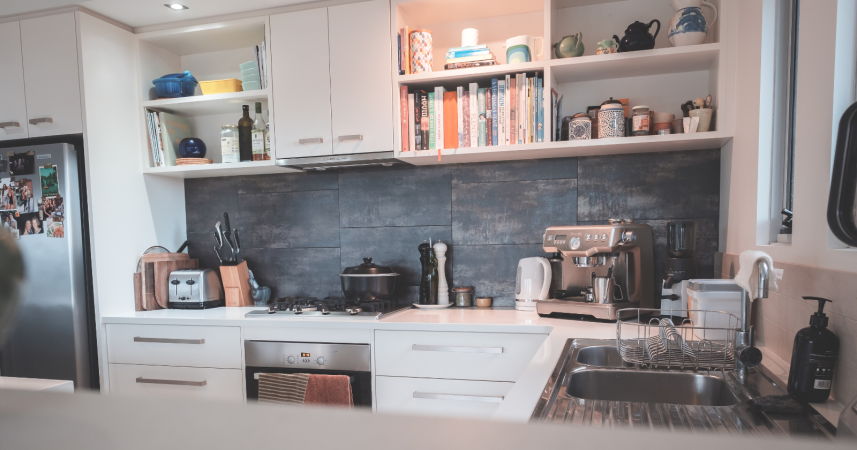
From toasters to paper towels, the everyday items proudly displayed on boomer countertops are exactly what younger generations frantically hide away—and this kitchen clash reveals surprising truths about how different generations find comfort in their homes.

Add VegOut to your Google News feed. 
Walk into my parents' kitchen and you'll see everything from the toaster to the mail pile proudly displayed on the counters. Visit my place, and you'll find surfaces so clear you'd think I don't own anything at all.
This generational divide over counter space has become a surprisingly heated topic in many households. What older generations see as convenient and practical, younger folks often view as visual chaos that needs to be tucked away immediately.
After spending countless Sunday dinners at my parents' house and hosting my own share of gatherings, I've noticed some fascinating patterns.
The things boomers naturally leave out are exactly what millennials and Gen Z rush to hide in drawers and cabinets. And honestly? Both approaches reveal something deeper about how we relate to our homes and our stuff.
So let's explore the eight most controversial counter-dwellers that spark this ongoing debate between the generations.
1) The paper towel holder
Remember when every kitchen had that standing paper towel holder next to the sink? For boomers, this is pure practicality. Quick spills, wet hands, impromptu napkins - having paper towels within arm's reach just makes sense.
But younger generations? We're shoving those rolls under the sink or mounting discrete holders inside cabinet doors. The visible paper towel holder has become synonymous with clutter in the minimalist-inspired kitchens we see on social media.
I recently helped my mom reorganize her kitchen, and when I suggested moving the paper towels to a cabinet, she looked at me like I'd suggested throwing them away entirely. "But then I'd have to open a door every time I need one!" she protested. Fair point, Mom.
2) The knife block
That wooden knife block sitting prominently on the counter used to be a kitchen status symbol. Good knives deserve a good home, right?
Yet walk into most millennial kitchens and you'll find knives hidden in drawers with special organizers or mounted on magnetic strips inside cabinets. The bulky knife block has become enemy number one in the quest for clear counters.
During one of my weekly cooking sessions, I realized I actually miss having my knives readily visible.
There's something satisfying about reaching for exactly the right blade without fumbling through a drawer. Maybe the boomers are onto something here.
3) Small appliances (all of them)
Coffee makers, toasters, blenders, mixers - boomer kitchens display these like trophies. If you use it weekly, why put it away?
Meanwhile, younger folks are investing in appliance garages, deep cabinets, and pull-out shelves to hide every single device. We'd rather haul out a heavy stand mixer from a bottom cabinet than let it live permanently on the counter.
The irony? I spent an hour last week making an elaborate vegan lasagna and probably took my food processor out and put it back three times during prep. Sometimes efficiency trumps aesthetics, but we're too stubborn to admit it.
4) The dish drying rack
This one sparks serious debates. Boomers see a dish rack as essential kitchen equipment. Dishes get washed, they need to dry, the rack stays put.
Younger generations treat dish racks like temporary structures that must be stowed the moment the last plate is dry. We've invented collapsible versions, over-sink models, and fancy bamboo ones that supposedly look better but still get hidden away.
My parents visited last month and were baffled when they couldn't find my dish rack. "It's in the cabinet under the sink," I explained. The look they exchanged suggested they were questioning my life choices.
5) Mail, bills, and paperwork
Every boomer household has that sacred corner of the counter where mail accumulates. Bills to pay, coupons to clip, important documents that need attention - it all lives there in organized chaos.
Contrast this with younger homes where a single envelope on the counter feels like failure. We've created entire systems of hidden filing, digital scanning, and immediate sorting just to keep paper off our surfaces.
Though I'll confess something: Since switching to mostly digital, I've missed important mail more than once. That physical pile my mom keeps? She never misses a bill. Maybe visible reminders aren't the worst thing.
6) Decorative canisters and containers
Sugar, flour, coffee, tea - boomers love displaying these in matching ceramic or glass containers lined up along the backsplash. It's decorative and functional, a win-win in their book.
But younger generations are putting everything in the pantry, even if it means constant trips back and forth while cooking. Clear counters have become more important than convenience or decoration.
Last week while making bread, I found myself wondering why I insist on hiding my flour in the pantry when I bake several times a week. Those old-school counter canisters are starting to make more sense.
7) The fruit bowl
That overflowing bowl of apples, oranges, and bananas? Classic boomer move. Fresh fruit should be celebrated, displayed, and easily grabbed for a healthy snack.
Younger folks? We're hiding fruit in crisper drawers, closed bowls, or stylized arrangements that prioritize looks over function. Heaven forbid someone sees an actual banana on our counter.
The funny thing is, when I keep fruit visible like my parents do, I actually eat more of it. Out of sight really does mean out of mind, especially when it comes to healthy choices.
8) Cooking oils and frequently used condiments
Olive oil, salt, pepper, maybe some soy sauce or hot sauce - boomer kitchens keep the essentials within reach. Why dig through cabinets for things you use daily?
Meanwhile, we're buying special containers to decant everything, then hiding those containers in pantries. We'll sacrifice convenience for the satisfaction of bare counters every single time.
I've started leaving my olive oil out after burning dinner one too many times while searching for it in my overcrowded pantry. Sometimes the old ways really are the practical ways.
Final thoughts
After filling several journal pages reflecting on this topic, I've realized something important: This isn't really about counter space at all.
For boomers, visible items represent a life being actively lived. Those counters tell stories of meals cooked, bills managed, and fruit waiting to be enjoyed. The kitchen is command central, and everything important stays in view.
For younger generations, clear spaces represent control in an increasingly chaotic world. We're bombarded with visual stimulation everywhere else. Our homes have become sanctuaries where we can finally experience visual calm.
Neither approach is wrong. Both reflect different relationships with our spaces and our stuff. Maybe the real wisdom lies in finding what works for you, regardless of what generation you belong to.
Though I will say this: After writing this piece, I might just leave my olive oil on the counter. And maybe the salt and pepper too. Don't tell my millennial friends.












