People who say please and thank you reflexively — without calculating whether the moment warrants it — share a personality profile that psychology consistently links to resilience, richer friendships, and a significantly lower risk of loneliness in later life.

Add VegOut to your Google News feed. 
There's a man I see at the farmers' market every Saturday.
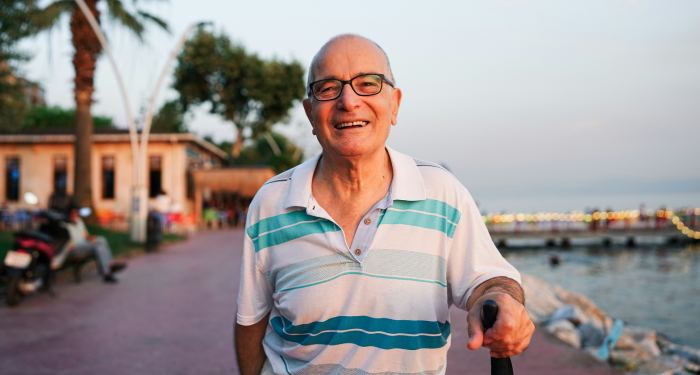
He thanks the person who hands him his change. He says please when asking where the tomatoes came from. He offers a small word of appreciation to the person who moves a stall sign so he can get past. None of it looks effortful. It's not a performance of courtesy. It's just how he moves through the world, a steady, low-level warmth directed at whoever he happens to be near.
I've been watching people long enough to notice that this kind of person tends to have company. There are usually one or two others in easy conversation with him. Vendors who recognise him, wave, say his name. A kind of ambient social ease that doesn't require much tending.
Compare that to the people who move through the same space without the words. Who take the change, pick up the bag, step around the sign. Efficient. Perfectly civil. But somehow less present, as if the transaction is the thing and the person doing it is incidental.
Both types are just getting their groceries. But psychologically, they are doing something quite different. And the research on what that difference means in later life is worth paying close attention to.
It isn't really about manners
When someone says please and thank you automatically, without stopping to assess whether the situation technically requires it, they aren't performing politeness. They're expressing something about how they fundamentally orient toward other people.
Psychologists would recognise this as a cluster of traits that sit under what the Big Five personality model calls agreeableness. It describes people who are cooperative, warm, and genuinely attentive to others. They trust easily, help readily, and are inclined to notice and acknowledge the people around them rather than filtering them out.
Agreeableness also has a close relationship with what researchers call dispositional or trait gratitude — a general orientation toward recognising what others contribute, seeing the world as more giving than withholding, and expressing that recognition in habitual, small-scale ways.
Neither of these things is calculated. That's actually the point. When you have to think about whether to say thank you, you're making a social decision. When you say it without thinking, it's a window into how you're already wired.
And that wiring, it turns out, has significant implications for how well people age.
What the research actually found
A large meta-analysis published in the European Journal of Personality, drawing on 113 studies and nearly 94,000 participants, found that agreeableness was consistently and meaningfully negatively correlated with loneliness. Across all the studies, higher agreeableness meant significantly lower loneliness. Crucially, the analysis found that for older adults in particular, the relationship between agreeableness and loneliness was stronger than it was for younger people, suggesting that this trait becomes more protective, not less, as we age.
The mechanism isn't hard to trace. Agreeable people don't just have larger social networks — they have better quality ones. Research consistently shows that high agreeableness predicts the depth and durability of friendships rather than simply the number of them. These are people others feel genuinely seen by. People tend to return to them. And in later life, when social networks naturally contract and the effort required to maintain connection increases, having a smaller number of genuinely invested relationships matters far more than having a large roster of shallow ones.
A separate body of research on trait gratitude has found parallel results. A study published in the Aging and Mental Health journal, examining adults over 40, found that higher dispositional gratitude was significantly and negatively associated with loneliness, with the relationship partially explained by what researchers describe as psychological flexibility and engaged living — the willingness to remain present and oriented toward life even when circumstances become harder. Grateful people, the research suggests, stay engaged with the world around them in ways that keep loneliness at bay.
Why it compounds over time
Think about what a lifetime of habitual warmth actually builds.
Every thank you that lands, every genuine acknowledgment of another person's effort, every moment of noticing what someone did rather than just what got done — these are small social deposits. Individually they're negligible. Accumulated over decades, they create something significant: a social environment that responds to you positively because you have been consistently, unconsciously signaling that other people matter to you.
The people who end up with deep friendships at 70 didn't usually engineer them deliberately. They became close to people by being the kind of person others feel recognised by. Relationships grew naturally around them because warmth, over time, compounds.
The inverse is also true. People who move through life efficiently but without much warmth, not unkindly, just without the reflexive acknowledgment, tend to find that their social environment has quietly thinned by the time they're older. Not because anyone left. Just because the connections never quite deepened in the first place.
There's no dramatic event in either story. Just the slow accumulation of small moments, and what they did or didn't build.
What this has to do with resilience
The link between these traits and emotional resilience is less obvious but equally interesting.
People high in agreeableness and dispositional gratitude tend to have a fundamentally different relationship with difficulty. Not because they're less affected by hard things, but because their general orientation toward the world is more affiliative. They're more likely to turn toward others when things get hard rather than turning inward. More likely to accept help without shame. More likely to find meaning in connection during difficult periods rather than experiencing difficulty as evidence of isolation.
This matters enormously in later life, where the hard things arrive with increasing frequency. Health changes. Loss. The restructuring of daily life that comes with major transitions. Resilience in those moments is not primarily a function of toughness. It's a function of relationship. Of having people to call, who actually pick up, who were built through decades of reciprocal warmth.
I spent years in finance watching people I respected deeply struggle with difficulty completely alone, because they'd spent their careers building capability rather than connection. They were formidably competent. When the hard moments came, though, there was nobody there. Not because people didn't care. But because the warmth had never quite flowed outward in the years when it would have mattered.
The interesting thing about this trait and age
Here's something that doesn't get enough attention: research consistently finds that agreeableness tends to increase with age. People generally become more agreeable as they move through their forties, fifties, and beyond — less competitive, less guarded, more naturally oriented toward cooperation and warmth.
For people who were already highly agreeable, this deepens something already strong. But for people who spent their earlier decades in high-pressure environments that rewarded competitiveness and efficiency over warmth — a description that fits a large proportion of the current generation approaching older age — there's an interesting possibility here.
The reflexive thank you isn't just a report of a personality trait you either have or don't. It's also a practice. Habitual politeness is what it looks like when warmth has become automatic, but warmth can become more automatic over time, if you point yourself in that direction.
Gratitude interventions, even relatively simple ones like keeping a daily gratitude journal, have consistently shown meaningful reductions in loneliness and increases in wellbeing in older adult populations. What those interventions are doing, at a deeper level, is helping to make gratitude less deliberate and more dispositional, shifting it from something you occasionally perform to something you more consistently embody.
What to actually do with this
None of this requires a personality transplant. It requires attention and repetition, which are available to anyone.
Start with the small, automatic moments. The cashier. The person who holds the door. The neighbor you pass without comment every morning. The colleague who sends information you needed. These are the micromoments where warmth either happens or doesn't, and where the habit gets built or doesn't.
Notice whether you say thank you because the situation calls for it or whether it arrives before you've had time to decide. There's a difference in quality between the two, and other people feel it even when they can't name it.
And think about the friendships you currently have. Are they the kind that have deepened over time? Do the people in them feel genuinely recognised by you, or do they feel efficient — competently maintained but not especially nourished?
These questions are worth sitting with at any age. But they become particularly pointed after 60, when the social scaffolding that used to generate connection automatically has largely dissolved and what remains is what you actually built.
Final thoughts
The man at the farmers' market isn't remarkable in any obvious way. He's not especially charismatic, or powerful, or fascinating to talk to on first meeting.
What he is, is warm. Reflexively, consistently, without apparent effort. And what that warmth has built around him, over time, is a small but solid world of people who are genuinely glad to see him.
That's not luck. That's the long-term return on a lifetime of automatic thank yous.
It might be the most underrated investment there is.