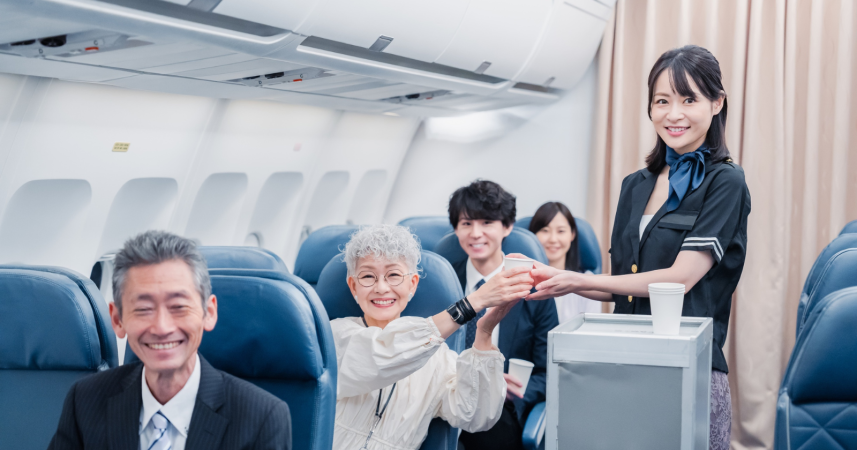
The way you interact with flight attendants when you're exhausted and crammed into a metal tube at 30,000 feet strips away your polite facade and exposes the deepest lessons from your childhood—from how you were taught to view authority to whether you learned that service workers are humans or servants.
Ever notice how differently people act at 30,000 feet?
Last month, I watched a passenger snap his fingers at a flight attendant like she was a personal butler, demanding his drink "right now." Two rows ahead, another traveler quietly thanked the same attendant by name and helped her close an overhead bin. The contrast was striking, and it got me thinking about what our airplane behavior really reveals about us.
After years of observing human behavior and diving deep into psychology, I've realized that how we treat flight attendants serves as a fascinating window into our childhood experiences and the values we absorbed growing up.
These interactions, especially when we're tired, stressed, or delayed, strip away our usual social masks and expose our core programming.
1. Your relationship with authority figures
Do you automatically defer to flight attendants, almost apologizing for existing? Or do you challenge their every instruction, questioning why you need to put your seat upright?
Your response to flight attendants' authority often mirrors how authority was handled in your childhood home. If your parents demanded unquestioning obedience, you might find yourself either extremely compliant or rebelliously resistant to any form of authority.
Growing up with teachers and engineers as parents, I noticed my own tendency to immediately comply with rules, even when they seemed arbitrary. It took years to realize this stemmed from a childhood where questioning authority meant disappointing the people whose approval I desperately needed.
Those who grew up in households where authority was collaborative and explained tend to interact with flight attendants as equals deserving respect, while still acknowledging their role.
2. How you handle service relationships
The way you treat someone serving you reveals volumes about your upbringing's class consciousness and values around service work.
If your family treated service workers as invisible or inferior, you might find yourself barely acknowledging flight attendants. But if your parents modeled treating everyone with equal dignity, regardless of their job, you likely make eye contact, use please and thank you, and recognize flight attendants as professionals doing important safety work.
I once watched a mother teaching her young daughter to say "thank you" to the flight attendant for her juice box. That simple moment spoke volumes about the values being passed down through generations.
3. Your comfort with asking for help
Can you easily press the call button when you need something? Or do you suffer in silence, afraid to be a bother?
This directly connects to whether your childhood needs were met consistently or if you learned early that asking for help meant being a burden. Children who heard "figure it out yourself" or "stop being needy" often become adults who'd rather struggle with an overhead bin for five minutes than ask for assistance.
The opposite extreme exists too. Some passengers treat the call button like a magic wand, expecting immediate service for every minor want. This often stems from childhoods where every need was instantly met, creating adults who never learned patience or self-sufficiency.
4. Your response to rules and boundaries
That person arguing about carry-on size limits? The one insisting their "emotional support" peacock should fly free? They're revealing deep patterns from childhood.
Psychologist Diana Baumrind's research on parenting styles shows that children raised with inconsistent boundaries often become adults who constantly test limits. If rules in your house changed based on mom's mood or dad's presence, you might find yourself seeing which flight attendant will let you slide on that extra bag.
Meanwhile, those raised with clear, consistent boundaries typically follow airline rules without fuss, understanding that regulations exist for everyone's benefit.
5. How you express gratitude
Watch how people thank flight attendants, if they do at all. Some offer genuine appreciation, others give perfunctory nods, and some act as if service is their birthright.
This traces directly back to whether gratitude was modeled and expected in your home. Families who regularly expressed appreciation for each other and for services received tend to raise adults who naturally thank others.
But in homes where gratitude was rare or transactional ("you should be grateful I feed you"), children often grow up struggling to express genuine thanks.
6. Your ability to see others as full humans
Do you know your flight attendant's name? Do you see them as a person with their own struggles, or just as a uniform delivering peanuts?
This reflects whether your upbringing taught you to see beyond roles to recognize shared humanity. Children raised with empathy exercises, diverse friendships, and discussions about others' perspectives typically become adults who naturally humanize service workers.
I remember being on a delayed flight where one passenger asked the visibly exhausted flight attendant, "Long day?" That simple acknowledgment of her experience beyond her role shifted the entire interaction. She smiled genuinely for the first time in hours.
7. How you handle inconvenience and disappointment
Flights get delayed. Drinks run out. Seats don't recline. Your reaction to these minor catastrophes broadcasts your childhood lessons about handling disappointment.
Were you allowed to feel frustrated as a child, or were negative emotions forbidden? Did your parents model calm problem-solving or explosive reactions to inconvenience? The passenger having a meltdown over missing the beverage service likely learned early that dramatic reactions get attention and results.
Those who learned healthy emotional regulation in childhood typically handle flight disruptions with perspective and grace, understanding that flight attendants don't control weather or mechanical issues.
8. Your sense of entitlement versus earned privilege
Perhaps most tellingly, airplane behavior reveals whether you were raised with genuine confidence or manufactured entitlement.
Children given everything without earning it often become adults who expect special treatment everywhere, including at 30,000 feet. They demand upgrades, expect rules to bend for them, and treat flight attendants as personal servants.
But those raised to understand that respect and privileges are earned typically treat their airplane seat, whether economy or first class, as exactly what they paid for, nothing more or less. They understand that flight attendants provide safety and service, not servitude.
Final thoughts
Our behavior in the compressed, often stressful environment of air travel strips away our carefully constructed adult personas, revealing the children we once were and the homes that shaped us.
The good news? Unlike our altitude, these patterns aren't fixed. Once you recognize how your upbringing influences your behavior, you can consciously choose different responses. That snapping passenger from my flight? Maybe he grew up in a home where demanding got results. But he could learn to see flight attendants differently, to treat them with the respect every human deserves.
Next time you fly, pay attention to your automatic responses. Do you like what they reveal about your upbringing? If not, remember that every interaction is a chance to rewrite those old scripts, to be the person you choose to be rather than the one you were programmed to become.
After all, how we treat someone who can do nothing for us except their job says everything about who we really are.