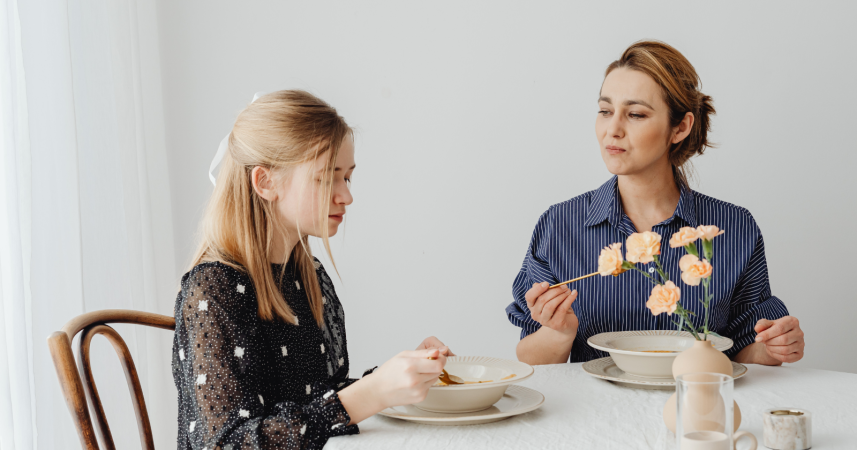
Walking into my friend's house and watching her casually disagree with her mother about dinner plans was the moment I realized that some families don't require their children to become professional meteorologists of one person's mood.

Add VegOut to your Google News feed. 
The kitchen would change color based on her footsteps.
Light, quick steps meant we could breathe normally and maybe even laugh at dinner.
Heavy, deliberate thuds meant silence, invisible children, and the kind of careful chewing that wouldn't make too much noise. We learned to decode the way she closed the car door, how she set down her purse, the particular sigh that meant a storm was brewing. Every micro-expression was a weather forecast we studied for survival.
Growing up, I thought every family operated like a highly sensitive seismic monitoring station, with all instruments calibrated to one person's emotional state. My siblings and I were experts at reading the barometric pressure of our mother's mood before she even entered a room. We could tell from the sound of her keys hitting the counter whether homework help would be gentle or sharp, whether asking for permission to go to a friend's house was safe or foolish.
It wasn't until I went to college and saw my roommate casually disagree with her visiting mother about dinner plans that I realized something. Not every household runs on one person's emotional weather system. Some families have multiple emotional climates existing peacefully in the same space. Revolutionary.
The hypervigilance that became my superpower
That constant emotional monitoring turned me into someone with an almost supernatural ability to read a room. In my financial analyst days, I could sense a client's hesitation before they voiced it. I knew which colleagues were having bad days before they said a word. This skill made me excellent at my job, but it came at a cost I didn't recognize for years.
When you grow up tracking someone else's emotions for safety, you become an emotional chameleon. You shape-shift to avoid conflict, to keep the peace, to maintain that delicate balance you learned was so crucial. I spent my twenties and thirties unconsciously adjusting my personality based on who I was with, what mood they were in, what I thought they needed from me.
The exhaustion of being everyone's emotional thermostat eventually caught up with me. One particularly demanding day at work, after successfully navigating three different colleagues' emotional minefields while suppressing my own frustration about a project, I sat in my car and couldn't remember what I actually felt about anything. I'd become so good at reading and responding to others' emotions that I'd lost track of my own.
Breaking the pattern means disappointing people
When I left finance to pursue writing, the family emotional weather system went haywire. My mother, the teacher who'd always emphasized education and stability above all else, couldn't understand why I'd abandon a secure career. My engineer father kept sending me spreadsheets showing compound interest calculations and retirement projections. Their disappointment was palpable, and my childhood programming kicked in hard.
Every phone call home became an exercise in managing their emotions about my choices. I found myself minimizing my happiness, exaggerating my struggles, anything to make them feel better about my decision. Old habits die hard, especially when they're wired into your nervous system from childhood.
A therapist once asked me, "What would happen if you just let your mother be upset about your career change without trying to fix it?" The question felt like someone asking what would happen if I stopped breathing. But that's exactly what I needed to learn.
Other people's emotions are not your responsibility
This is the hardest lesson for those of us raised as emotional weather vanes. We learned early that survival meant managing the emotional climate, that our safety depended on keeping the household barometer steady. But here's what took me forty years to understand: other adults' emotions are not your problem to solve.
My mother's moods were never actually my responsibility, even when I was a child. The fact that she made them feel like life-or-death situations for the entire household was her issue, not ours. But try explaining that to a seven-year-old who just wants her mother to be happy so everyone can relax.
I started small. When my mother called upset about something completely unrelated to me, instead of spending an hour trying to make her feel better, I'd listen for ten minutes and then say, "That sounds really frustrating, Mom. I hope it gets better." Then I'd change the subject or end the call. The first time I did this, I felt physically ill. My body was convinced I'd done something dangerous.
But you know what? She survived her bad mood without my intervention. The world didn't end. Our relationship didn't crumble. If anything, it got healthier because I stopped treating her like an emotional child who needed constant soothing.
Your emotional weather matters too
Here's something wild I discovered: when you stop being hypervigilant about everyone else's emotions, you suddenly have space to feel your own. For the longest time, I didn't even know what my genuine emotional weather looked like because I was too busy monitoring and adjusting to everyone else's.
These days, I let myself have moods. If I'm frustrated after a difficult writing day, I don't hide it or pretend everything's fine. If I'm excited about something, I express it without first checking if everyone else is in a good enough mood to handle my happiness. This isn't about being inconsiderate. It's about recognizing that my emotions deserve the same space and respect as everyone else's.
Sometimes I catch myself slipping back into old patterns, especially during family visits. The hypervigilance kicks in, and suddenly I'm that kid again, reading facial expressions like tea leaves, adjusting my behavior to keep the peace. But now I notice it happening. I take a breath, remind myself that I'm an adult with my own emotional weather system, and let others be responsible for theirs.
Finding your own forecast
If you grew up in a house ruled by one person's emotional weather, you might not even realize how much energy you spend managing other people's feelings. It feels normal to you, like breathing. But it's exhausting, and more importantly, it's keeping you from developing your own emotional autonomy.
Start paying attention to how often you adjust your mood, opinions, or behavior based on someone else's emotional state. Notice when you apologize for things that aren't your fault, when you shrink yourself to avoid potentially upsetting someone, when you sacrifice your needs to keep someone else's emotional weather sunny.
Learning to have your own emotional weather system while letting others have theirs is like learning a new language in your forties. It's awkward, uncomfortable, and you'll make mistakes. But it's also liberating in ways you can't imagine until you experience it.
The truth is, not every household runs on one person's emotional weather system. Healthy homes have multiple weather patterns coexisting, sometimes clashing, sometimes complementing, but always separate. And that's not just okay. It's how it should be.
What’s Your Plant-Powered Archetype?
Ever wonder what your everyday habits say about your deeper purpose—and how they ripple out to impact the planet?
This 90-second quiz reveals the plant-powered role you’re here to play, and the tiny shift that makes it even more powerful.
12 fun questions. Instant results. Surprisingly accurate.