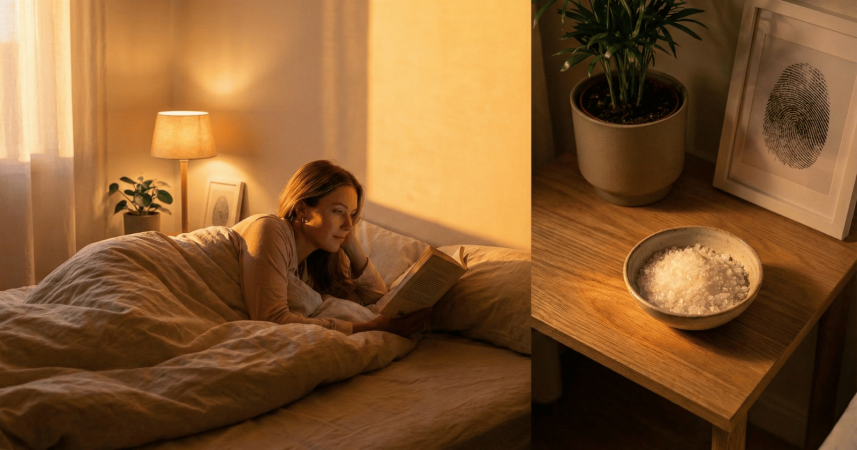
This ancient bedroom ritual that monks have used for centuries costs nothing but a bowl and some salt—and it's the reason I finally stopped tossing and turning after months of sleepless nights.

Add VegOut to your Google News feed. 
Look, I'll be straight with you. When I first heard about putting a bowl of salt in the bedroom, I thought it was just another internet trend that would disappear faster than my motivation to meditate on Monday mornings.
But after a particularly rough patch of sleepless nights and that heavy, stagnant feeling in my apartment in Saigon, I figured why not give it a shot? The worst that could happen was I'd waste a bowl and some salt.
Three weeks later, I was genuinely surprised. Not only was I sleeping better, but the whole energy of my bedroom felt different. Lighter somehow. And before you roll your eyes and click away, hear me out. There's actually some fascinating stuff behind this simple practice that connects to both ancient wisdom and modern understanding of how our environments affect us.
The ancient practice hiding in plain sight
Salt has been used for energetic cleansing for thousands of years across countless cultures. From Buddhist temples in Thailand to Catholic blessing rituals, salt appears everywhere as a purifying element.
During my travels through Asia researching for my book, I noticed monks using salt in various cleansing ceremonies. They'd place small bowls in corners of meditation halls, particularly in spaces that felt energetically heavy or stagnant.
The logic is surprisingly straightforward. In many Eastern philosophies, corners are where energy gets stuck. Think about it like dust accumulating in the corners of your room. Energy works the same way. It flows through your space and can get trapped in those 90-degree angles, creating pockets of stagnation.
Salt acts like an energetic sponge, absorbing and neutralizing negative or stagnant energy. Whether you buy into the metaphysical explanation or not, there's something to be said for a practice that's survived thousands of years across multiple cultures.
What actually happens when you do this
Here's what I've noticed since starting this practice, and what many others report too.
First, there's the placebo effect, and I'm not dismissing it. If you believe something will help you sleep better and feel more peaceful, it often does. Our minds are powerful like that. But there's more going on here.
Salt is hygroscopic, meaning it naturally absorbs moisture from the air. This can actually help reduce humidity in your bedroom, which studies show can improve sleep quality. High humidity can make you feel uncomfortable and restless at night, disrupting your sleep cycles.
The ritual itself matters too. When you place that bowl of salt with intention, you're essentially telling your brain that this space is for rest and renewal. You're creating a bedtime ritual that signals it's time to wind down. And we know from sleep science that consistent bedtime rituals are crucial for good sleep hygiene.
Plus, there's something psychologically powerful about taking action to improve your space. Instead of lying in bed scrolling through your phone and feeling helpless about your insomnia or stress, you're doing something concrete. You're taking control.
The unexpected mindfulness connection
What I didn't expect was how this simple practice would enhance my mindfulness routine.
Every time I see that bowl of salt, it reminds me to check in with myself. How am I feeling? What energy am I bringing into this space? It's become an anchor for present-moment awareness, much like the techniques I explore in Hidden Secrets of Buddhism: How To Live With Maximum Impact and Minimum Ego.
The bowl becomes a physical reminder to let go of the day's stress before getting into bed. Sometimes I'll sit for a minute and visualize all my worries and negative thoughts being absorbed by the salt. It sounds woo-woo, I know, but this visualization technique is actually grounded in cognitive behavioral therapy principles.
When my daughter was born recently, sleep became even more precious and elusive. Having this small ritual gave me a sense of control during those chaotic newborn nights. Even if I could only grab three hours of sleep, at least I was creating the best possible environment for those three hours.
How to actually do this tonight
Ready to try it? Here's exactly what to do.
Grab a small bowl, preferably glass or ceramic. Fill it about halfway with coarse sea salt or rock salt. Table salt works too, but the larger crystals of coarse salt are traditionally preferred.
Place the bowl in a corner of your bedroom, ideally the corner furthest from your bed or one that feels particularly stagnant. You know that corner where stuff always seems to pile up? That's probably a good spot.
Leave it there for at least a week. Some people change the salt weekly, others monthly. I change mine every two weeks, or sooner if it starts looking clumpy or discolored.
When you dispose of the old salt, don't reuse it for cooking. The idea is that it's absorbed negative energy, so you want to get rid of it completely. Flush it down the toilet or throw it in the trash outside your home.
When skepticism meets results
I get it if you're skeptical. I was too. My background in psychology made me question everything about this practice initially.
But here's what changed my mind: it works. Whether through placebo, humidity control, ritual psychology, or actual energy cleansing, people who try this often report better sleep, less anxiety, and a more peaceful bedroom environment.
A friend who's a chronic insomniac tried this after I mentioned it over coffee in Singapore. She texted me a week later saying she'd had the best sleep in months. Coincidence? Maybe. But she's still doing it six months later.
The cost is essentially nothing. The risk is zero. And the potential benefits range from better sleep to reduced stress to simply feeling like you're actively creating a more positive living space.
Final words
Tonight, before you go to bed, take five minutes to set up a bowl of salt in your bedroom corner. Approach it with an open mind but no pressure for miraculous results.
Think of it as an experiment in creating a more intentional sleeping space. You're already spending eight hours a day in your bedroom. Why not optimize that environment in every way possible?
The beauty of this practice is its simplicity. In a world of expensive sleep gadgets, complicated bedtime routines, and endless optimization hacks, sometimes the most powerful solutions are the simplest ones.
Whether you believe in energy cleansing or just want better sleep through the power of ritual and intention, this ancient practice costs you nothing to try and might just surprise you with its effects.
Sweet dreams start with small actions. This could be yours.