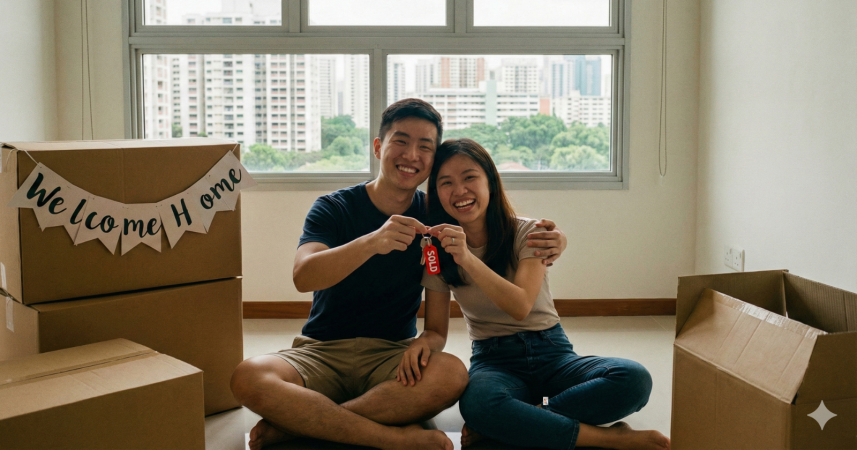
The moment you realize your self-worth fluctuates with property prices is when you understand how deeply Singapore's real estate obsession has hijacked our collective identity.

Add VegOut to your Google News feed. 
I'll admit something that took me years to understand: during my time as a financial analyst in Singapore, I wasn't just analyzing numbers. I was watching an entire nation define themselves through one single metric: property ownership.
You know that feeling when someone asks where you live, and suddenly your entire worth seems to hang in the balance? That's not just social anxiety talking. There's something deeper happening in our collective psyche, especially here in Singapore where owning property has become almost synonymous with success itself.
After nearly two decades in finance, watching people make life-altering decisions based on property prices, I've seen how this obsession goes way beyond simple investment strategy. It's about who we think we are.
The security blanket that became a straightjacket
Remember Maslow's hierarchy of needs from psychology class? That pyramid where safety and security sit right near the bottom? Well, Singapore's rapid transformation from a developing nation to a first-world economy happened so fast that the collective memory of instability still runs deep. Our parents or grandparents remember kampong life, economic uncertainty, and genuine housing shortages.
This historical anxiety gets passed down through generations like a family heirloom nobody asked for. When your parents constantly remind you that "property never goes down" or that "renting is throwing money away," they're not just giving financial advice. They're transmitting generational trauma about scarcity and survival.
I witnessed this firsthand during the 2008 financial crisis. While markets crashed globally, Singaporeans clung to their properties like life rafts. Even those who could barely afford their mortgages refused to sell. Why? Because letting go felt like losing a piece of themselves.
The psychological term for this is "loss aversion," and it's particularly intense when what you're losing feels tied to your identity. Studies show we feel losses twice as powerfully as we feel gains. Now imagine that loss isn't just financial but existential.
When success has only one definition
Here's something I learned the hard way: when everyone around you measures success the same way, you start believing it's the only way.
Social comparison theory, developed by psychologist Leon Festinger, explains that we determine our own social and personal worth based on how we stack up against others. In Singapore, that comparison often boils down to one question: HDB, condo, or landed?
During my analyst days, I watched colleagues skip vacations, delay having children, and sacrifice relationships, all to upgrade from a four-room to a five-room flat. One coworker literally ate instant noodles for months to save for a downpayment. When I asked why, the answer was always some version of "How else will people know I've made it?"
This isn't vanity. It's what psychologists call "extrinsic motivation" gone wild. When your self-esteem depends on external markers of success, you become trapped in an endless cycle of comparison and competition. The executive condo owner envies the private condo owner who envies the landed property owner. Nobody wins this game.
The illusion of control in an uncertain world
Property ownership offers something powerful: the feeling that you're in control. Psychologically, this sense of control is crucial for mental health. We all need to feel like we have some agency over our lives.
But here's the catch: Singapore's property market has created what I call "control theater." You feel in control because you own something tangible, something with your name on the deed. Yet you're actually incredibly vulnerable to interest rates, government policies, and market forces completely beyond your influence.
I discovered this myself when I had to confront the identity I'd built around financial success. For years, I measured my worth by my investment portfolio and the size of my apartment. When market volatility hit, my sense of self crashed along with the numbers. That's when I realized I'd confused ownership with control, and control with identity.
The fear of being left behind
FOMO isn't just about missing parties or social events. In Singapore, it's about missing the property ladder entirely.
This fear is rooted in what behavioral economists call "temporal discounting." We overvalue immediate costs and undervalue future benefits. When property prices keep rising, the fear of being priced out forever overrides rational decision-making. People stretch themselves thin, taking on crushing debt because the alternative feels worse: being permanently excluded from the homeowner club.
The psychology here is brutal. Once you believe that property ownership equals social belonging, not owning property means social exile. No wonder young Singaporeans report feeling anxious about their housing situations. They're not just worried about shelter; they're worried about belonging.
Breaking free from the property prison
So how do we untangle our identities from our property ownership status?
First, recognize that this isn't entirely your fault. We're dealing with deeply embedded cultural programming reinforced by government policies, social structures, and generational messaging. Awareness is the first step toward freedom.
Start questioning the narrative. When someone judges you based on where you live, that says more about their values than your worth. When you catch yourself doing mental calculations about someone's financial status based on their address, pause and ask yourself why that matters.
Consider what psychologists call "values clarification." What actually makes life meaningful to you? Is it really square footage, or is it relationships, experiences, creativity, contribution? I learned that financial security had become a cage I'd built around myself. Only when I started defining success on my own terms did I find real freedom.
Practice what's called "cognitive reframing." Instead of seeing property as identity, see it as a tool. Just one tool among many for building the life you want. Some people need that tool, others don't. Neither choice defines your value as a person.
Most importantly, have compassion for yourself and others caught in this cycle. We're all products of our environment, trying to find security and meaning in an uncertain world. The fact that Singaporeans have focused on property ownership isn't a character flaw; it's a collective coping mechanism.
After years of watching people sacrifice everything for property ownership, here's what I know: your worth isn't measured in square feet or postal codes. The most interesting, fulfilled people I know have learned to separate their identity from their assets. They own their choices, not just their homes.
Maybe it's time we all learned to do the same.
If You Were a Healing Herb, Which Would You Be?
Each herb holds a unique kind of magic — soothing, awakening, grounding, or clarifying.
This 9-question quiz reveals the healing plant that mirrors your energy right now and what it says about your natural rhythm.
✨ Instant results. Deeply insightful.

Avery White
Formerly a financial analyst, Avery translates complex research into clear, informative narratives. Her evidence-based approach provides readers with reliable insights, presented with clarity and warmth. Outside of work, Avery enjoys trail running, gardening, and volunteering at local farmers’ markets.
More Articles by Avery