
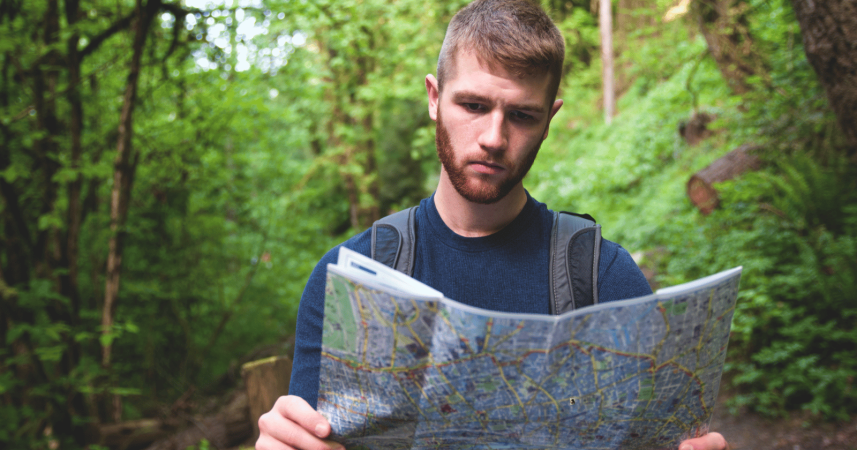
While GPS has made getting lost nearly impossible, neuroscientists have discovered that those who can still navigate with paper maps possess a unique cognitive advantage that extends far beyond finding their way—one that's quietly disappearing as our brains adapt to following the blue dot.

Add VegOut to your Google News feed. 
Remember the last time you had to navigate somewhere without your phone? Maybe your battery died, or you were in a remote area with no signal. If you managed to find your way using an old-fashioned paper map, congratulations. You're part of a shrinking group of people who can still perform what psychologists call "allocentric navigation."
Here's a little experiment for you: Next time you're heading somewhere familiar, try to visualize the route from a bird's eye view. Can you see the streets, the turns, the landmarks all laid out like a map? Or do you think more in terms of "turn left at the Starbucks, then right after three blocks"?
Your answer reveals more about your brain than you might think.
The two ways your brain navigates the world
When I first learned about this concept, it completely changed how I understood my own thinking patterns. Turns out, there are two primary ways our brains process spatial information: allocentric and egocentric navigation.
Allocentric navigation is what you use when reading a paper map. You're creating a mental model of the environment from an external perspective, understanding how different locations relate to each other in space. It's like having a miniature world in your head that you can rotate and examine from any angle.
Egocentric navigation, on the other hand, is all about your personal viewpoint. You remember routes based on your own movements and experiences. Turn left here, walk straight for two minutes, look for the blue building. GPS systems cater perfectly to this type of thinking, giving you step-by-step instructions from your perspective.
Growing up with a father who was an engineer, maps were everywhere in our house. He'd spread them out on the dining table before family trips, tracing routes with his finger while explaining how to read topographical lines and scale. I didn't realize it then, but he was training my brain to think allocentrically.
What map reading says about your cognitive style
Research from University College London found that people who regularly use allocentric navigation have increased gray matter in their hippocampus, the brain region associated with spatial memory and navigation. But here's where it gets really interesting: this type of thinking extends far beyond just finding your way around.
If you're comfortable with paper maps, you likely excel at seeing the big picture in other areas of life too. You might be the person who can visualize how a reorganized living room would look before moving a single piece of furniture. Or maybe you're great at understanding complex systems, seeing how different parts connect and influence each other.
I noticed this connection myself when I transitioned from financial analysis to writing. Those same analytical skills that helped me read market trends and understand economic systems translated perfectly into breaking down psychological concepts. The ability to zoom out and see patterns, to understand relationships between different elements, it all stems from that same allocentric thinking.
During my morning trail runs, I often think about this. When you're navigating trails without constantly checking your phone, you develop an intuitive sense of place. You learn to read the landscape, notice how the sun moves across the sky, remember which ridge leads where. It's a completely different experience from following the blue dot on a screen.
The GPS effect on our brains
Here's something that might worry you: Studies show that heavy GPS use actually shrinks the hippocampus over time. When we outsource our navigation to technology, those neural pathways start to weaken. It's use it or lose it, and many of us are losing it.
A study from McGill University found that people who rely primarily on GPS showed less gray matter in the hippocampus compared to those who navigate spatially. Even more concerning? The hippocampus isn't just about navigation. It plays a crucial role in memory formation and has been linked to conditions like PTSD and Alzheimer's disease when it's not functioning optimally.
But before you panic and throw your smartphone out the window, remember that egocentric navigation has its place too. It's efficient, requires less cognitive load, and gets you where you need to go. The problem arises when it becomes our only navigation strategy.
Why some brains prefer maps over GPS
Your preference for maps versus GPS might be hardwired into your personality. People who prefer allocentric navigation tend to score higher on tests of spatial intelligence and often show stronger problem-solving abilities in non-spatial contexts too.
They're typically more comfortable with ambiguity and uncertainty. Think about it: when you're using a paper map, you have to deal with figuring out where you are, which direction you're facing, and how to get where you're going. There's no reassuring voice telling you to "turn right in 200 feet."
These map readers also tend to be more exploratory in nature. They're the ones who take the scenic route just to see what's there, who notice when a new shop opens three blocks away, who can give you directions using cardinal directions rather than just left and right.
I've found this to be true in my photography walks. When I slow down to notice details I'd normally rush past, I'm not following a predetermined route. I'm exploring, building that mental map, understanding how this alley connects to that street, how the light changes as you move from the east to west side of town.
Strengthening your spatial brain
The good news? Even if you've been relying on GPS for years, you can rebuild those allocentric navigation skills. Your brain remains plastic throughout life, capable of forming new neural connections.
Start small. Next time you're going somewhere familiar, look at the route on a map before you leave. Try to hold that image in your mind as you travel. Pay attention to street names, notice landmarks, think about your position relative to other places you know.
Take different routes to familiar destinations. This forces your brain to update its mental map, strengthening those spatial processing abilities. When you're walking through your neighborhood, try to maintain awareness of which direction is north. It sounds simple, but it's surprisingly challenging if you're not used to it.
Video games can help too. Research shows that certain types of games, particularly those involving spatial navigation and 3D environments, can improve hippocampal function. Just make sure you're playing games that require you to build mental maps, not ones that provide constant guidance.
Final thoughts
Whether you're team paper map or team GPS, understanding how your brain processes spatial information offers valuable insights into your cognitive style. If you can still unfold that paper map and find your way, you're maintaining a valuable skill that extends far beyond navigation.
But if you've become dependent on that turn-by-turn guidance, don't worry. Your brain's remarkable plasticity means it's never too late to develop your spatial thinking. Maybe it's time to dig out that old atlas from the back of your car, or better yet, buy a map of your local area and start exploring.
The way we navigate the physical world shapes how we navigate everything else: problems, relationships, careers. By understanding and developing both navigation styles, we're not just becoming better at finding our way. We're building more flexible, capable brains.
So here's my challenge to you: This week, try navigating somewhere without GPS. Start with somewhere familiar if you need to. Notice how your brain works to figure out where you are and where you're going. You might be surprised by what you discover about yourself in the process.
What’s Your Plant-Powered Archetype?
Ever wonder what your everyday habits say about your deeper purpose—and how they ripple out to impact the planet?
This 90-second quiz reveals the plant-powered role you’re here to play, and the tiny shift that makes it even more powerful.
12 fun questions. Instant results. Surprisingly accurate.












