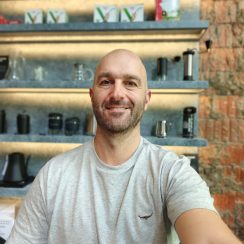
Bryan Johnson's body is performing better than ever, but the life around that body keeps getting quieter, and that gap tells us something the longevity industry doesn't want to hear.

Add VegOut to your Google News feed. 
I've been thinking about homes lately. The kind you build inside yourself over decades, the ones made from the accumulated weight of meals shared, arguments survived, mornings where you woke up next to someone who saw you at your worst and stayed anyway. I've been thinking about them because I spent weeks researching a man who has systematically dismantled every version of home his life ever offered him, and replaced it all with a protocol.
His name is Bryan Johnson. He spends roughly $2 million a year trying not to die. He swallows over 100 pills a day, eats 1,950 calories of algorithmically determined food, finishes his last meal by 11 a.m., and is in bed by 8:30 every night. He monitors more than 70 organ systems. His biological age scores have dropped. His inflammation markers are near zero. His cardiovascular fitness is elite. By every metric he tracks, his body is winning.
But here's the thing about metrics: they only measure what you decide to count.
The Protocol and What It Costs
Johnson has said publicly that the human mind is not a reliable source of judgment. So he removed it from command. An algorithm tells him what to eat, when to sleep, what supplements to take, and how well he performed each day. He's described this as freedom, liberation from the chaos of human decision-making. And on paper, in the narrow frame of biological optimization, you could argue the results speak for themselves.
But pull the frame wider and a different picture emerges. Johnson left his faith at 34. His marriage ended. Of his three children, two have cut ties with him. Only his middle son, Talmage, stayed, and Talmage became part of the protocol itself. Johnson took his son's blood plasma as part of his anti-aging experiments. In the Netflix documentary covering his life, Johnson comments on Talmage's body, openly envying his youth. When Talmage eventually decides to leave for college, to start building his own life, Johnson breaks down in tears.
Then there's Taryn Southern. In 2019, Johnson's fiancée was diagnosed with stage three breast cancer. Johnson left her while she was undergoing chemotherapy. Months later, he had her sign a confidentiality agreement that ended her employment at his company. Southern documented fragments of her experience publicly: the chemo sessions, the loneliness, the disorientation of losing both her health and her partner at once.
I'm not sharing these details to be cruel. I'm sharing them because they are the data Johnson's system doesn't track. They are the cost column in a ledger he's chosen not to read.
The Billion-Dollar Bet Against Death
Johnson is the most visible face of something much larger. Right now, some of the wealthiest people on the planet are pouring billions into the idea that aging is a disease and death is a problem to be solved. Jeff Bezos has funded a lab in San Diego where scientists take old human cells and reprogram them back to a younger state, $3 billion behind one idea. Sam Altman backs a team in San Francisco engineering ways to add 10 healthy years to your life. Google funds a secretive facility studying organisms that barely age at all, $3.5 billion chasing a single question: can death be made optional? Peter Thiel has funded nearly a dozen similar ventures and arranged to have his own body cryogenically frozen when it fails.
The science underneath all of this, cellular reprogramming, is genuinely remarkable. Every cell in your body carries a complete copy of your original genetic code from when you were young. Over time, cells accumulate damage. Some become what scientists call senescent cells: broken, inflamed, leaking toxins into surrounding tissue. New drugs called senolytics are being designed to hunt them down and clear them out. In animal studies, the results have been striking. Mice physically rejuvenated. Their organs recovered function. Their fur grew back. They ran faster. AI has accelerated the whole process, with machine learning models scanning millions of molecular combinations and predicting which ones will target specific decay pathways. Research published in journals like Cell and Nature on Yamanaka factors has shown that aged cells can be chemically pushed back to an earlier state, effectively forgetting they were ever old.
The promise is enormous. The argument now being made by serious scientists is that cancer, Alzheimer's, and heart failure aren't separate problems. They're symptoms of one underlying condition: aging itself. Cure that, and you cure everything downstream.
That's the bet. And the money keeps coming.
We explored this entire landscape in depth on our VegOut YouTube channel, tracing the science, the money, the promises, and the places where this revolution is quietly failing:
The Places Where People Actually Live Longest
What struck me most while researching this piece wasn't the science. The science is dazzling. What struck me was the contrast between Johnson's world and the places on Earth where people actually live the longest.
They're called Blue Zones, a term coined by researcher Dan Buettner to describe five regions where people routinely live past 100: Okinawa in Japan, Sardinia in Italy, Nicoya in Costa Rica, Ikaria in Greece, and Loma Linda in California. Buettner's research, along with studies published in the American Journal of Lifestyle Medicine, found that these communities share a handful of common traits. None of them involve 100 daily supplements or algorithmic meal planning.
What they share is this: predominantly plant-based diets rich in legumes, whole grains, and vegetables. Regular, low-intensity physical movement woven into daily life (gardening, walking, manual work rather than gym sessions). Strong social networks. A sense of belonging to a community or faith group. A clear sense of purpose, what the Okinawans call ikigai. And moderate caloric intake, often naturally regulated by cultural eating practices rather than tracked by software.

The people of Ikaria don't monitor their biomarkers. They drink herbal tea, tend their gardens, nap in the afternoon, and eat dinner with their neighbors. They live in bodies they've turned into homes, warm places where relationships, pleasure, meaning, and even a little red wine have been invited in and allowed to stay.
The data on social connection and longevity is hard to argue with. A meta-analysis by Julianne Holt-Lunstad and colleagues, published in PLOS Medicine, found that strong social relationships increased the odds of survival by 50%, a factor comparable to quitting smoking and exceeding the effects of exercise or obesity on lifespan. Loneliness, by contrast, is associated with a 26% increase in premature mortality risk. Robert Waldinger's Harvard Study of Adult Development, the longest-running study of human happiness ever conducted, has arrived at the same conclusion across 85 years of data: the quality of your relationships is the single strongest predictor of both health and happiness in later life.
Bryan Johnson's inflammation markers are near zero. His relationships are in ruins. The longevity science doesn't know what to do with that contradiction, so it mostly ignores it.
When the Body Becomes a Project
I run digital media companies. I understand optimization. I've spent years measuring engagement metrics, conversion rates, audience growth curves. I know the seduction of turning something alive and messy into something clean and trackable. And I know the moment when optimization becomes its own form of avoidance.
There's a version of health that is actually a withdrawal from life disguised as mastery over it. You control your meals so tightly that you can't eat with friends. You control your sleep so rigidly that you can't stay up late talking to someone you love. You monitor your body so obsessively that you stop listening to it the way a person listens, with intuition and trust, and start interrogating it the way a technician interrogates a machine. The body becomes a project. And a project is something you work on. A home is something you live in.
Johnson told an interviewer, when asked directly whether he would one day die: "False." That single word carries an almost unbearable weight. Because to refuse death absolutely is to refuse the framework that gives human relationships their urgency, their tenderness, their meaning. We hold each other close because we know this ends. We forgive, we reconcile, we show up for people undergoing chemotherapy, we sit with our aging parents, we let our children leave, because time is finite and that finitude is what makes love something other than an abstraction.
Take that away and what you're left with is something technically alive but existentially hollow. A body with perfect biomarkers and no one in the room.
Both Things Can Be True
I want to be careful here, because I don't think the longevity science is worthless. I think senolytics and cellular reprogramming could reduce enormous suffering. I think a world where fewer people die of Alzheimer's or cancer is a world worth working toward. The plant-based dimension of this conversation matters too. The Blue Zone diets are overwhelmingly centered on whole plant foods, and the science linking plant-based eating to reduced chronic disease and longer healthspan is substantial and growing.
But the Silicon Valley version of longevity has a blind spot the size of a human life. It treats the body as a system to be debugged rather than a vessel for experience. It measures everything quantifiable and ignores everything that makes the quantifiable worth having. Johnson's protocol can tell you his rate of collagen synthesis. It cannot tell you whether anyone will hold his hand when the protocol finally, inevitably, fails.
The communities that actually produce the longest-lived humans on Earth didn't get there through optimization. They got there through the accumulation of small, warm, daily acts of connection. Shared meals. Afternoon conversations. Grandchildren underfoot. A glass of wine with a neighbor. Purpose that extends beyond the self. A body that is lived in, not managed.
I think about what Johnson said, that the human mind is not a reliable source of judgment. And I think about the Ikarian grandmother who has never heard of HRV therapy, who drinks mountain tea every morning and knows every person in her village by name, and who will likely outlive most of the biohackers in Los Angeles. Her mind told her to build a life with other people. His algorithm told him to build a life alone.
One of them is still a home. The other is a lab with very good numbers and no one coming to visit.
The loneliest version of immortality was never about living forever. It was always about living in a body so optimized, so controlled, so perfectly measured that there's no room left for anyone else inside it. And the oldest people on Earth keep showing us the alternative: a body you've filled with meals and laughter and arguments and love, a body that was never a project at all, but the place where your life actually happened.