
Bryan Johnson spends $2 million a year trying not to die, but the data from places where people actually live the longest keeps pointing to something his protocol can't measure.

Add VegOut to your Google News feed. 
I've been thinking about Bryan Johnson for months. I watched him swallow over a hundred pills in a single morning, monitored by machines, scored by algorithms, optimized to a degree that would make most of us feel claustrophobic just imagining it. And I kept coming back to one detail that sat heavy in my chest: his fiancée was diagnosed with stage three breast cancer, and he left her during chemotherapy. Then he had her sign a confidentiality agreement. Here is a man who has organized every waking minute around the project of staying alive, and yet something essential about being alive seems to have slipped through the cracks of all that optimization.
The more I sat with his story, the more I realized it reveals something uncomfortable about a cultural obsession many of us share, even if we'd never take it as far as he has. We treat longevity like a math problem. Add the right inputs, subtract the harmful ones, and the equation yields more years. But the people who actually live the longest on this planet have never done this math. They've been too busy living.
The Most Optimized Life on Earth Looks Eerily Empty
Johnson wakes at 4:30 every morning. He eats 1,950 calories a day, the same meals every day, with his last meal at 11:00 AM. He's in bed by 8:30 every night. Over 70 organ systems are monitored. His blood is drawn regularly. His body fat, bone density, and brain function are scanned and scored. By his own metrics, the results are impressive: biological age scores have dropped, inflammation markers are near zero, cardiovascular fitness is elite.
And yet. He left his faith at 34. His marriage ended. Of his three children, two cut ties with him. His remaining son, Talmage, became part of the protocol itself, with Johnson taking the young man's blood plasma as part of his anti-aging experiments. When Talmage decided to leave for college, Johnson broke down in tears. His son chose to begin his own life, and Johnson couldn't bear it. As he's said publicly: "The human mind is not a reliable source of judgment." So he removed it from command. An algorithm now tells him what to eat, when to sleep, what to take, and how well he did.
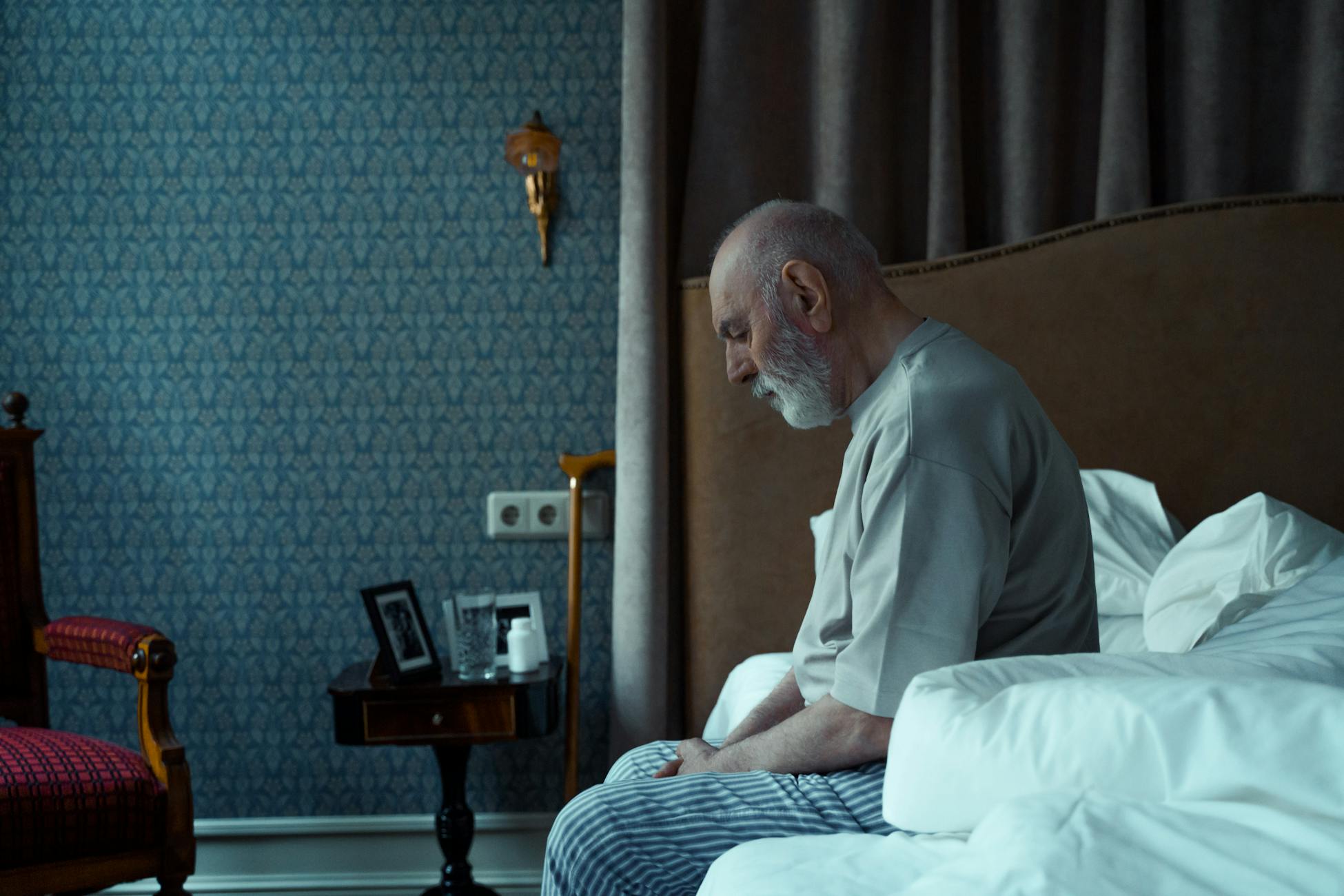
I find this genuinely tragic. The man has achieved an extraordinary degree of physical optimization, and the cost has been nearly every relationship that gives a human life its texture. There's a particular kind of regret that settles in around midlife when you realize the years you spent performing someone else's version of a good life were years you can't get back. Johnson seems to be building toward a version of this, except the performance is for data itself.
The Billion-Dollar Bet Against Death
Johnson is the most visible face of something much larger. Right now, some of the wealthiest people on the planet are pouring billions into the idea that aging is a disease and death is a problem to be solved. Scientists funded by Jeff Bezos are taking old human cells and reprogramming them back to a younger state in a San Diego lab, with $3 billion behind the premise that aging can be reversed at the cellular level. Sam Altman, the man behind ChatGPT, is backing a team in San Francisco engineering ways to add ten healthy years to your lifespan. Google is funding a secretive facility where researchers study organisms that barely age at all, with $3.5 billion allocated to a single question: can death be made optional?
The science behind this, cellular reprogramming, works on an elegant principle. Every cell in your body carries a complete copy of your original genetic code, the version from when you were young. Over time, cells accumulate damage. Some of them refuse to die, sitting broken and inflamed, leaking toxins into surrounding tissue. Scientists call these senescent cells, and new drugs called senolytics are being designed to hunt them down and clear them out. In animal studies, mice given these drugs physically rejuvenated. Their organs recovered function. Their fur grew back. They ran faster.
AI has accelerated the whole process. Machine learning models now scan millions of molecular combinations, predicting which ones will target specific decay pathways. What used to take a decade and a billion dollars can now happen in months. The promise is enormous: the end of cancer, Alzheimer's, and heart failure, reframed not as separate diseases but as symptoms of one underlying condition, aging itself.
I don't dismiss any of this. The science is real, and much of it will likely lead to meaningful medical breakthroughs. What concerns me is the framework. The assumption running beneath the entire enterprise is that the problem of human mortality is fundamentally a technical one. Fix the machinery, and you've fixed everything. But a growing body of evidence from the places where people actually live the longest suggests the machinery was never the main thing.
What the Blue Zones Keep Trying to Tell Us
The VegOut team traveled to communities around the world where people routinely live past 100, places with no protocols, no supplements, no billion-dollar labs, and found something the data keeps confirming but Silicon Valley keeps ignoring. The full exploration of this contrast, including Johnson's story and the science behind longevity, is worth watching in detail:
In Okinawa, Sardinia, Ikaria, Nicoya, and Loma Linda, researchers identified consistent patterns among the world's longest-lived populations. These people eat simply, mostly plants. They move naturally throughout the day, not through structured exercise but through gardening, walking, cooking. They have strong social networks. They belong to communities of faith or purpose. They have a reason to wake up each morning that has nothing to do with biomarkers.
Dan Buettner's research on Blue Zones, published through National Geographic and expanded in collaboration with the University of Minnesota, found that the common denominators of exceptional longevity are overwhelmingly social and psychological. Diet matters, but it exists within a web of belonging, purpose, and daily low-level physical activity that no supplement stack can replicate. A study published in PLOS Medicine by Julianne Holt-Lunstad and colleagues at Brigham Young University found that social relationships have an effect on mortality risk comparable to well-established risk factors like smoking and alcohol consumption, with strong social connections associated with a 50% increased likelihood of survival.
Think about what that means. The thing most likely to keep you alive longer is the thing Bryan Johnson has systematically removed from his life: other people.
When the Algorithm Replaces the Self
There's a concept in psychology called self-determination theory, developed by Edward Deci and Richard Ryan, which identifies three basic psychological needs: autonomy, competence, and relatedness. When all three are met, people flourish. When they aren't, people deteriorate, regardless of how physically healthy they may be. Johnson's protocol maximizes competence (he is extraordinarily effective at biological optimization) while actively undermining autonomy (an algorithm makes his decisions) and relatedness (his closest relationships have fractured or been absorbed into the protocol).
I keep returning to the moment in the documentary where Talmage decides to leave. Johnson's grief is real. But the grief seems to be, at least partly, about losing a participant in his system rather than releasing a son into adulthood. The relationship had become instrumental. And I think many of us recognize some version of this pattern in smaller, less dramatic forms. The way we sometimes reduce the people in our lives to their utility. The way we optimize our morning routines until there's no room left for a spontaneous conversation over coffee. The way we track every metric of our health while ignoring the curiosity and engagement that actually keeps us vital.
Research from Harvard's Study of Adult Development, one of the longest-running studies of human well-being ever conducted, spanning over 80 years, concluded that the quality of a person's relationships is the single strongest predictor of both health and happiness in later life. Robert Waldinger, the study's current director, has said plainly: "Good relationships keep us happier and healthier. Period." The finding held across socioeconomic lines, across personality types, across decades of data.
The Quality Problem
Here's what I keep circling back to. The longevity revolution assumes that if we can extend the human lifespan to 150 or beyond, the quality question will sort itself out. More years means more time to figure it out. But the people living to 100 in Okinawa and Sardinia didn't figure it out later. They figured it out first. They built lives dense with meaning, connection, and purpose, and the years followed.
When I look at my own choices, I see the temptation clearly. I live in Singapore, surrounded by optimization culture. Biohacking is enormous here. Cold plunges, continuous glucose monitors, sleep trackers. I've tried some of it. And some of it genuinely helps. I'm not arguing against eating well or exercising or understanding your own biology. I went plant-based because I wanted to live more deliberately, and that decision has reshaped how I think about food, ethics, and my own body in ways I value deeply.
But I've also noticed a threshold where the pursuit of health becomes its own kind of illness. Where the monitoring replaces the living. Where you're so focused on exactly which inputs are optimal that you forget to sit with someone you love and eat something imperfect together. The research from Blue Zones points to something uncomfortable for anyone in the optimization space: the people who live longest are not the people who try hardest to live longest. They're the people who have the most reasons to be alive tomorrow.
What a Meaningful Life Actually Costs
Johnson has said, publicly, that he believes death is "false." When asked directly whether he will die, he answered: "False." That confidence is striking, and I understand its appeal. Death is terrifying. The desire to defeat it is one of the most human impulses imaginable.
But defeating death and building a life worth living are different projects. Sometimes they're even competing ones. Every hour Johnson spends measuring his blood plasma is an hour he's not spending in unstructured conversation with his sons. Every relationship evaluated through the lens of the protocol is a relationship stripped of the messiness that makes intimacy possible. The same pattern shows up whenever we treat our closest relationships as problems to be managed rather than experiences to be inhabited.
Taran Southern, Johnson's former fiancée, was diagnosed with stage three breast cancer while they were together. She documented her treatment publicly, her vulnerability raw and visible. Johnson left. Then he optimized. The juxtaposition is almost too neat, too symbolic, but it happened. And it says something about where the logic of optimization leads when it becomes the only logic you have.
I don't think the answer is to reject science or to romanticize aging. The cellular reprogramming research may well produce treatments that eliminate cancer and Alzheimer's, and that would be extraordinary. But the framework matters. If we approach longevity as a quantity problem, we'll build lives that are long and hollow. If we approach it as a quality problem, the science becomes a tool in service of something larger, not the thing itself.
The centenarians in Ikaria drink wine with friends in the afternoon. They argue. They garden. They eat beans and wild greens and sometimes too much bread. They don't track a single biomarker. And they outlive almost everyone in the developed world. The data keeps confirming it. The algorithms keep missing it. The most optimized man on Earth is living proof that you can measure everything about a life and still lose the plot entirely.