Fourteen boxes of books sat in my spare room for years, each one a promise I made to someone I never became.

Add VegOut to your Google News feed. 
Fourteen boxes of unread books is a surprisingly accurate autobiography. More accurate, honestly, than anything I could have written about myself on purpose. Each box told a story about ambition and intention and the quiet way a life drifts from its original blueprint without anyone noticing — least of all the person living it.
I loaded them into the car last Saturday. Drove them to a donation center. Carried them in, box by box, and left without looking back. And the strange part, the part I keep circling back to, is how light I felt afterward. Not sad. Not nostalgic. Light. Like I'd been carrying evidence of a crime I didn't commit.
Most people would call this a decluttering story. A weekend project, a feel-good purge. The conventional wisdom around getting rid of things says you're "making space" or "simplifying your life" or whatever the latest organizational guru is selling this month. But that framing missed what actually happened to me. The lightness didn't come from having fewer things. It came from finally stopping a negotiation I'd been having with myself for over a decade about who I was supposed to become.
The library of a person who doesn't exist
Here's what was in those boxes. A three-volume history of the Byzantine Empire. Two books on quantum mechanics written for laypeople. A 900-page biography of Napoleon that I bought in a London bookshop sometime around 2011. Four novels by authors I'd seen interviewed and thought, "I should really read their work." A collection of essays on architectural theory. Psychoanalytic philosophy texts from my academic years that I kept thinking I'd revisit with fresh eyes.
None of them were bad choices. Every single purchase made sense at the time. The problem was that the person who bought them existed in potential, not in practice. I'd imagined a version of myself with long Sunday afternoons and no screen addiction and the kind of focused attention span that makes 900-page biographies pleasurable rather than punishing.
That person never showed up.
The person who actually showed up built a company, moved across several countries, spent his evenings watching YouTube essays about the very topics those books covered, and read maybe thirty pages of the Napoleon biography before setting it on a nightstand where it collected dust for three years.
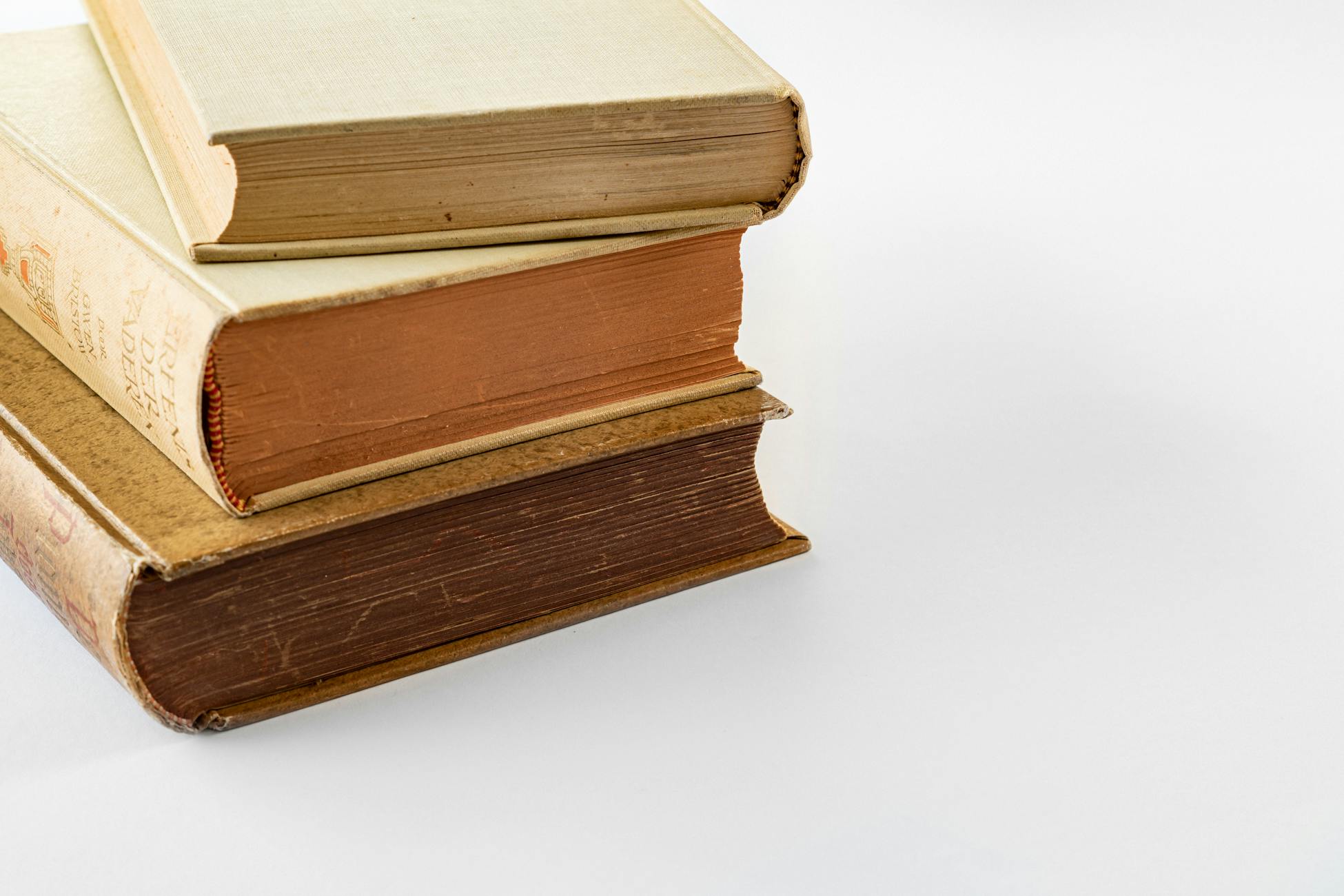
I kept moving those boxes from apartment to apartment — Melbourne to Bangkok, Bangkok to Singapore — as though transporting them was the same as reading them. As though physical proximity to knowledge counted as absorption. And every time I packed them, I told myself the same thing: "When things slow down."
Things never slow down. You just get used to the speed.
The gap between your actual self and your aspirational one
What made those books so hard to give away wasn't sentimentality, exactly. I didn't have childhood memories attached to a quantum mechanics primer. The difficulty was that each book represented a commitment to a self-concept I wasn't ready to abandon. Keeping them meant the door was still open. Donating them meant acknowledging that I had, in fact, walked through a different door entirely and it had closed behind me.
Psychologists have observed the discrepancy between who you are and who you believe you should be. Studies suggest that the wider that gap grows, the more distress it produces. We tend to think of this in terms of social media and body image, but the principle operates everywhere. My bookshelves were a monument to the gap between the intellectual I imagined and the entrepreneur I became.
And the books weren't even the only artifacts. I had a leather journal from a phase when I was going to write longhand every morning. A set of oil paints from a weekend I decided I'd learn to paint. Running shoes in three different styles because I kept thinking I'd become the kind of runner who cared about shoe rotation.
Each object was a fossilized intention. A small, physical lie.
Why we hold on to things we never use
The instinct to keep unused possessions runs deeper than laziness or disorganization. There's a psychological architecture underneath it that most people never examine. The objects aren't really objects. They're placeholders for unlived identities.
I've noticed this pattern in myself for years. Buying a book felt like a micro-commitment to growth. Shelving it felt like progress. The purchase itself delivered a small dopamine hit that mimicked the satisfaction of actually learning, and my brain filed it under "done" even though nothing had been done at all.
Those who work with sentimental decluttering often observe that the emotional attachment to possessions has more to do with identity than with the object's function. You're not attached to the book. You're attached to the version of yourself who would have read it. And letting go of the object forces you to let go of that version too.
That's the part that stings.

Because admitting you won't read the Byzantine history trilogy means admitting something about your actual interests, your actual attention span, your actual life. And "actual" is a much less flattering word than "potential."
The comfort of planning to become
I spent a lot of my thirties in a state I'd describe as perpetual becoming. Always about to start the meditation practice. Always about to read the serious literature. Always about to learn Italian. The planning phase was intoxicating — full of possibility, free from the friction of execution.
Becoming is comfortable because it's noncommittal. You haven't failed at Italian if you haven't started yet. You're still a reader if the books are on your shelf, even if the spines are uncracked. The identity exists in aspiration, and aspiration is protected from judgment in a way that action never is.
Sometime around forty, though, I started to feel the weight of all that deferred becoming. The boxes weren't inspiring anymore. They were accusatory. Every time I walked past them, some small internal voice whispered, "You said you'd get to those." And I'd respond with the usual deflection: "I will. When things settle."
The negotiation could have gone on forever. That's the dangerous part. You can maintain these aspirational identities for decades if nobody forces you to confront them. The books don't expire. The paints don't argue. The running shoes just sit there, patient and unjudging, waiting for a version of you that has already been replaced.
What actually happened when I let them go
The morning of the donation, I didn't feel resolved. I felt something closer to resignation. I'd woken up, looked at the boxes stacked in the corner of my spare room, and thought: "I have been moving these across three countries. For what."
No epiphany. No dramatic catalyst. Just a quiet arithmetic: the cost of keeping them, measured in guilt and self-deception, had finally exceeded the cost of admitting I'd never read them.
At the donation center, a woman behind the counter looked through one of the boxes and said, "These are in great condition." She meant it as a compliment. I heard it as a verdict. Of course they were in great condition. Nobody had touched them.
Driving home, I waited for regret. It didn't come. What came instead was a kind of clarity I hadn't expected. Without the books performing the role of "future intellectual me," I was left with just... present me. The person who reads articles on his phone during lunch. Who listens to podcasts about history instead of reading primary sources. Who learns through conversation and video and experience rather than through 900-page biographies.
That person is real. Imperfect, sure. Less impressive on paper than the imagined version. But real.
Grief for lives you didn't live
There's a specific kind of grief that nobody prepares you for: mourning the versions of yourself that didn't happen. Not because of tragedy or failure, but simply because you made other choices and time moved forward and the window closed.
I genuinely believe this is one of the underexplored experiences of middle adulthood. In your twenties, everything is still possible. In your thirties, you start making commitments that narrow the field. By your forties, you're living inside the consequences of those commitments, and the unchosen paths have started to feel less like open doors and more like sealed rooms.
Donating those books was my way of walking past the sealed rooms without pressing my face against the glass anymore.
And the strange gift of that acceptance is this: when you stop grieving the person you didn't become, you start seeing the person you did become with something approaching compassion. Maybe even respect.
I didn't become the person who reads the Byzantine Empire trilogy. I became the person who built a platform that reached over 300,000 people, who moved to Southeast Asia and then Singapore on instinct rather than plan, who learned more from failed projects than from any book. The real curriculum of my life was written in decisions, not in chapters.
The books would have been a fine education. The life was a better one.
What the empty shelf taught me
My spare room looks different now. Emptier, obviously. But the emptiness doesn't feel like absence. It feels like honesty.
I've started paying attention to other artifacts of aspirational identity that I've been carrying around. A folder on my laptop called "To Read" with 200 saved articles. A bookmarked recipe collection from a phase when I thought I'd become someone who makes elaborate meals from scratch. An app for learning Mandarin that sends me notifications I've been dismissing for two years.
Each one is a tiny contract with a future self who probably won't show up. And the question I keep asking now is: can I be honest about that sooner? Can I close the gap between aspiration and reality before it becomes another decade of boxes in a spare room?
I don't think the answer is to stop aspiring. Aspiration is human. Wanting to grow, to learn, to become something more — that's not the problem.
The problem is when aspiration becomes a substitute for self-knowledge. When "I'll get to it eventually" becomes a way of avoiding the more uncomfortable truth: "I chose differently, and that's who I am now."
Fourteen boxes. Thousands of unread pages. A decade of imaginary Sunday afternoons. Gone.
What remains is a spare room with actual space in it, and a person who is finally, reluctantly, willing to be who he is rather than who he planned to be. The relief is enormous. And a little bit sad. Both things at once, which is how most honest feelings work.