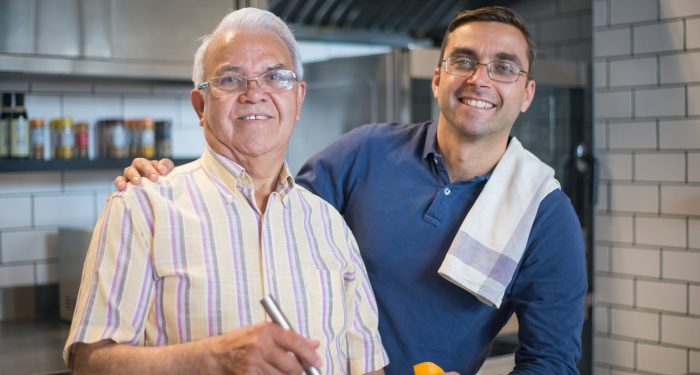
The most striking people over sixty aren't the ones who look like they've beaten aging. They're the ones who've stopped fighting it and started living through it. Their faces carry something that youth can't manufacture: evidence of a life actually experienced. Grief survived. Joy absorbed. Lessons taken on board.
A woman at a café near my apartment has deep lines running from her nose to her chin. Not faint ones. The kind that come from decades of expression, maybe grief, maybe just a lot of talking and laughing in the sun. She's in her late sixties, I'd guess, and she doesn't look young. She looks like someone who stopped trying to look young a while ago and found something better on the other side of that effort.
I've been thinking about what that something is. It's not beauty in the way we usually mean it. It's not preservation. It's more like a face that has stopped performing and started just being — settled into itself the way a house settles into its foundation.
And the research, once you dig into it, suggests this quality isn't just aesthetically compelling. It's psychologically powerful, and measurably better for your health than fighting against every line.
Elegance, not beauty
Researchers at the University of Pennsylvania conducted a study on how aging affects perceptions of facial attractiveness and found something striking. They asked young, middle-aged, and older perceivers to rate faces across three dimensions: beauty, elegance, and gorgeousness. As expected, older faces scored lower on beauty and gorgeousness. But on elegance, older faces scored higher.
That distinction matters more than it seems. Beauty and gorgeousness are youth-coded constructs. They measure symmetry, smoothness, and features associated with fertility and health signals that evolution wired us to notice. Elegance is something else entirely. It captures a quality that only becomes available with time. Composure. Coherence. The sense that a person's exterior matches their interior.
The study also found that older perceivers were less affected by face age when rating attractiveness. Younger raters showed strong bias toward young faces. Older raters showed more nuanced, distributed judgments. They saw attractiveness in places younger eyes didn't.
What this suggests is that the way we perceive aging faces isn't fixed. It's shaped by our own experience, our own exposure, and our own relationship with getting older. The people who are most drawn to the beauty of a lived face are the ones who've started living themselves.
The 7.5-year effect
Becca Levy at Yale has spent decades studying what happens when people internalise the culture's stories about aging. Her stereotype embodiment theory proposes that the age stereotypes we absorb from childhood eventually become self-definitions that influence our functioning and health.
The findings are extraordinary. In a longitudinal study following 660 people over more than two decades, Levy found that individuals with more positive self-perceptions of aging lived an average of 7.5 years longer than those with negative self-perceptions. That advantage held after controlling for age, gender, socioeconomic status, loneliness, and baseline health.
Seven and a half years. That's a bigger effect than the survival benefit from low blood pressure, low cholesterol, maintaining a healthy weight, or not smoking.
Let that sink in. How you feel about aging, including how you feel about the face you see aging, has a measurable effect on how long you live. People who approach their changing appearance with acceptance rather than shame literally live longer.
The mechanism works through multiple pathways. Research shows that people with positive self-perceptions of aging are more likely to engage in health-promoting behaviours, maintain higher self-efficacy, and experience lower chronic stress. When you believe aging is inevitable decline, you stop taking care of yourself. When you see it as a natural process that doesn't diminish your worth, you keep showing up.
The body acceptance research
A study on body acceptance in older adults published in the journal Clinical Gerontologist found that subjective attractiveness and relationship quality were both associated with body acceptance in people over fifty. The researchers found that almost 90 percent of participants felt younger than their actual age.
But what interested me was their conclusion about values. Body acceptance in later life wasn't primarily about how someone looked. It was about whether their life was congruent with their values. People who were living in alignment with what they cared about felt better in their bodies, regardless of what those bodies looked like.
Research from Frontiers in Psychology examining body appreciation among older adults in China found the same pattern. Body appreciation was linked to life satisfaction, and this relationship was mediated by self-acceptance and by how people perceived their own aging. The people who felt best about their bodies weren't the ones who looked youngest. They were the ones who had made peace with the process.
In Buddhism, there's a concept called yathābhūta ñāṇadassana, seeing things as they really are. Not as we wish they were. Not as we fear they might be. Just as they are. The research on body acceptance in aging seems to be describing exactly this: the people who see their aging clearly and without shame are the ones who feel most at home in themselves.
What shame does to the body
If acceptance adds years, what does shame subtract?
The ageism literature is clear on this. Internalized ageism, the absorption of negative cultural messages about aging, is associated with increased anxiety, depression, and reduced self-worth. When people feel ashamed of looking older, they don't just feel bad. They age faster. The stress response triggered by chronic self-criticism accelerates biological aging through cortisol elevation, inflammation, and immune suppression.
Laura Carstensen at Stanford, whose socioemotional selectivity theory has shaped our understanding of emotional aging, has noted that older people who can be present-focused rather than future-anxious tend to have better mental health. The person trying to look thirty at sixty is locked in a future-oriented, loss-avoidance mode. The person who has accepted their face is in the present. And being in the present, the research tells us, is where emotional wellbeing lives in later life.
I'm less sure this is always peaceful, though. I've watched people I know cross this threshold, and it doesn't always look like liberation. Sometimes it looks like a Tuesday morning when you catch yourself in a bathroom mirror and the face there is your mother's face, and you have to decide in that moment whether to grieve or just brush your teeth. The research frames acceptance as a destination. I think it's more like a daily negotiation — some days you win it, some days the mirror wins.
The face as autobiography
I think there's something the research doesn't fully capture but the experience does. A face that has lived and isn't ashamed of it tells a story without speaking. It communicates something beyond physical features.
You can see it in the crow's feet of someone who has squinted into the sun more often than they've stared at a screen. In the looseness around the mouth of someone who stopped clenching their jaw against the world. In the way someone holds eye contact without performing interest or deflecting attention — just looking at you, steady, from a face that's done being rearranged for other people.
The Harvard Study of Adult Development found that the quality of close relationships is the strongest predictor of health and happiness in later life. But I think relationships also shape the face itself. A life spent in warm, close connection leaves different marks than a life spent in isolation or chronic performance. The forehead of someone who has spent decades raising their eyebrows in genuine surprise looks different from the forehead of someone who has spent decades raising them in disapproval. You can see it. Not because faces are perfect records. But because the body doesn't lie the way words do.
Robert Waldinger, the study's director, has described how the participants who fared best over eight decades were those who leaned into relationships. They showed up. They stayed. They were real. And by their seventies and eighties, that realness was written into everything about them, including how they looked.
The quiet rebellion
We live in a culture that spends hundreds of billions of dollars annually telling people over fifty that their face is a problem to be solved. That wrinkles are failures. That grey hair is something to cover. That the signs of a life fully lived are signs of a life in decline.
The people who reject that narrative, not loudly, not performatively, but quietly, in the daily decision to stop apologising for looking their age, are doing something more radical than they know.
Research on emotional well-being across the lifespan consistently shows that older adults experience fewer negative emotions, less stress, and greater emotional stability than younger adults. They've stopped sweating the small stuff. And for many of them, their appearance has become part of the small stuff they no longer sweat.
I watch this from my balcony in Saigon sometimes. The older Vietnamese women who walk along the river in the morning. They're not trying to look twenty. They're not wearing the face they think the world wants to see. They're wearing the face they earned. And there's a beauty in that which no procedure, product, or filter can replicate.
In the Pali texts, the Buddha described the body as anicca, impermanent. Not as a criticism but as a liberation. When you stop trying to freeze the body in time, you stop being at war with reality. And that peace, that settlement, shows in the face more clearly than any intervention.
The face that stops performing
The most striking people over sixty aren't the ones who look like they've beaten aging. They're the ones who've stopped fighting it and started living through it. Their faces carry something that youth can't manufacture: evidence of a life actually experienced. Grief survived. Joy absorbed. Lessons taken on board.
That's not a consolation prize for losing your youthful looks. It's a different category of attractiveness entirely. One that research says is linked to elegance rather than beauty. To acceptance rather than performance. To longer life rather than longer youth.
But I keep coming back to the cost. What do you actually give up when you stop fighting? Not just the vanity — the hope embedded in it. The belief that you can still be seen the way you were seen at thirty. There's a grief in letting that go that the research doesn't measure and the elegance framework doesn't account for. Whether the settlement I see in those faces is peace or just the quiet after surrender — I honestly don't know. And I'm not sure the people wearing those faces always know either.
If You Were a Healing Herb, Which Would You Be?
Each herb holds a unique kind of magic — soothing, awakening, grounding, or clarifying.
This 9-question quiz reveals the healing plant that mirrors your energy right now and what it says about your natural rhythm.
✨ Instant results. Deeply insightful.

Lachlan Brown
Lachlan Brown is a writer and editor with a background in psychology, personal development, and mindful living. As co-founder of a digital media company, he has spent years building editorial teams and shaping content strategies across publications covering everything from self-improvement to sustainability. His work sits at the intersection of behavioral psychology and everyday decision-making.
At VegOut, Lachlan writes about the psychological dimensions of food, lifestyle, and conscious living. He is interested in why we make the choices we do, how habits form around what we eat, and what it takes to sustain meaningful change. His writing draws on research in behavioral science, identity, and motivation.
Outside of work, Lachlan reads widely across psychology, philosophy, and business strategy. He is based in Singapore and believes that understanding yourself is the first step toward making better choices about how you live, what you eat, and what you value.
More Articles by Lachlan