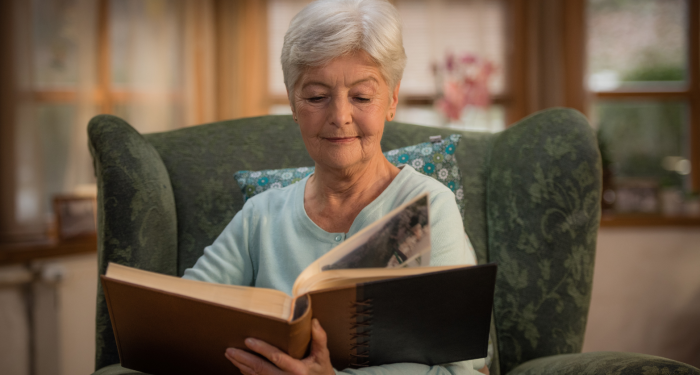
For a lot of older adults, happiness doesn’t come from staying productive - it comes from reconnecting with curiosity, pleasure, and small daily interests that don’t need to earn their place. In many cases, the real shift happens when they stop treating joy like something that has to be useful, impressive, or explained to anyone else.

Add VegOut to your Google News feed. 
Here's something I find genuinely fascinating: the research on what makes older adults happy consistently points away from the things most people spend the bulk of their lives chasing.
Not achievement. Not productivity. Not staying busy enough to feel useful.
What the science keeps coming back to is something quieter and, honestly, harder to give yourself permission for: being genuinely interested in things. Small things. Things that don't have a payoff. Things you can't justify to anyone, including yourself, except to say that you find them interesting.
That's it. That's a significant part of the secret to aging well. And most people are working hard against it their entire adult lives.
The curiosity finding that changed how I think about getting older
I came across a study from UCLA published in 2025 in PLOS One that made me stop and read it twice. Researchers including psychologist Alan Castel and his colleagues studied how curiosity changes across the adult lifespan in a sample of over 1,200 people. The common assumption has long been that curiosity declines with age. And in one sense, that's true — what researchers call "trait curiosity," your general baseline level of intellectual openness, does tend to drop as you get older.
But here's the interesting part. A different kind of curiosity, what researchers call "state curiosity," the in-the-moment interest you feel when something specific catches your attention, actually increases with age, showing a sharp rise after midlife and continuing upward well into old age.
The researchers' explanation for this is both intuitive and kind of beautiful. In early and middle adulthood, people are busy acquiring everything they need: credentials, skills, knowledge, money, status. Their curiosity is spread wide and thin, covering whatever the next phase of life requires. But as they age, as children leave home and careers wind down, they no longer need to allocate so many resources to strategic curiosity. They're free, perhaps for the first time, to follow what they actually find interesting. And when they do, the feeling intensifies rather than fades.
The researchers note that this mirrors the well-documented dip in happiness during midlife. We're not less capable of being interested and joyful in old age. We're just freer to be.
Interest isn't trivial. It might be keeping people alive.
I don't mean that as a metaphor. A landmark study following over 1,100 older adults over five years found that those who were more curious at the start of the study had significantly higher survival rates than those who were less curious, even after accounting for other health risk factors. The pattern held in both men and women.
This was the first study to identify a predictive role for curiosity in the longevity of older adults, and subsequent researchers have built on it considerably. A major review of neuroscientific and psychological literature published in Neuroscience and Biobehavioral Reviews by Sakaki and colleagues concluded that curiosity maintains cognitive function, supports mental health, and protects physical health in older adults, through its influence on the brain's dopaminergic and noradrenergic systems, the same systems involved in reward, motivation, and emotional regulation.
In other words, staying interested in things is not a luxury or a personality quirk. It is, at a neurological level, one of the ways the aging brain keeps itself healthy and alive.
Why most people have to re-learn this
Here's the problem. Most of us spend decades systematically training ourselves out of interest for its own sake.
We learn early that curiosity should be useful. That what you pursue should produce something: a qualification, an income, a skill your employer cares about, something that justifies the time spent. Pure interest, the kind where you read about the history of some obscure thing or spend an afternoon trying to understand how something works because you just want to know, gets quietly deprioritized as life gets serious.
Stanford psychologist Laura Carstensen, who has spent decades studying emotional life across the lifespan, found something striking in her research on what she calls socioemotional selectivity theory. Her work shows that as people age and perceive their remaining time as more limited, they naturally shift away from future-oriented goals, the kind that pay off later, and toward present-oriented, emotionally meaningful ones. They care less about what an experience might lead to and more about how it feels right now.
This isn't decline. It's a kind of recalibration. The things that actually matter in the moment, genuine connection, genuine interest, genuine pleasure, move to the front. The performance of productivity moves to the back.
Carstensen's research found that compared to younger adults, older people reported better emotional regulation, more positive emotional experience, more gratitude, and lower rates of worry, anger, and sadness in daily life. Even during the pandemic, which posed far greater physical risk to older people, older adults reported more positive and fewer negative emotions than younger people did.
They're not in denial. They're just, at long last, orienting toward what matters.
The permission problem
So why does any of this need to be said?
Because the happiest older adults I've read about, and the research backs this up, aren't the ones who kept grinding. They're not the ones who stayed maximally productive until the very end. They're the ones who gave themselves permission, often for the first time in decades, to be interested in small things without needing a reason.
A garden. A particular period of history. The way light falls at a certain time of day. An obscure musical tradition. The migration patterns of birds. Learning a language for no career reason whatsoever. These aren't trivial pursuits. According to the research, they're some of the most health-promoting things an older adult can do.
Older adults in the curiosity studies reported engaging in formal learning later in life primarily for interest and enjoyment, not for any utility reason like developing a needed skill for work. The enjoyment was the point. The interest was enough. And that, it turns out, is more than enough.
What this means for the rest of your life
I study Buddhism and I write about psychology, and the same insight appears in both traditions, though the language is different. Buddhism talks about beginner's mind: approaching experience with openness and curiosity rather than the pre-loaded assumptions of an expert. Psychology talks about intrinsic motivation: doing something because it is inherently rewarding, not for what it gets you.
Both traditions are pointing at the same thing. The capacity to be interested, genuinely interested, without a secondary agenda, is one of the most valuable things a person can cultivate. And the research on aging suggests it doesn't weaken with time. For many people, it finally gets to breathe when the performance pressure of midlife eases off.
The happiest older adults aren't the ones who stayed busiest. They're the ones who stopped waiting for permission to be curious. They picked up the thing they found interesting, for no better reason than that they found it interesting, and they followed it.
That's available to you right now. Not just when you're older, not just when life slows down, but now. The small interest you keep dismissing as not serious enough. The thing you keep meaning to look into but can't quite justify. The question you have that doesn't relate to anything useful.
Those are not distractions from a well-lived life. According to the research, they might be the thing itself.
What’s Your Plant-Powered Archetype?
Ever wonder what your everyday habits say about your deeper purpose—and how they ripple out to impact the planet?
This 90-second quiz reveals the plant-powered role you’re here to play, and the tiny shift that makes it even more powerful.
12 fun questions. Instant results. Surprisingly accurate.