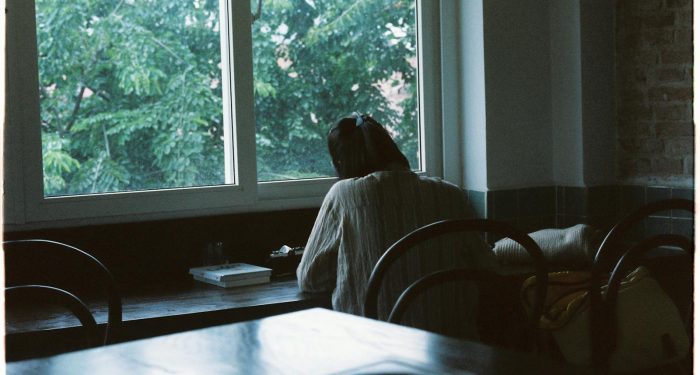
When you've been faking "fine" for long enough, your brain stops sending invitations to actual happiness. Here's how to tell the difference between real joy and the version you've been rehearsing.

Add VegOut to your Google News feed. 
When someone says they can't remember the last time they felt genuinely happy, the instinct is to look for a cause: a loss, a diagnosis, a circumstance that explains it. Sometimes the cause is there. But sometimes what psychology finds instead is something more gradual and more invisible: a person who has been performing contentment for so long, so consistently, and in so many different contexts, that the performance has replaced the thing it was imitating. Not a crisis. An erosion.
This is a different kind of emotional problem than the ones that show up clearly. It doesn't produce obvious distress. It produces a flatness, a vague sense that the life looks correct from the outside while feeling strangely muted from the inside. The person living it often struggles to articulate what is wrong, because nothing is obviously wrong. They are fine. They keep saying so, and they almost believe it.
What performing contentment actually is
Psychologist Arlie Hochschild's foundational work on emotional labor described a process she called surface acting: displaying emotions you do not genuinely feel in order to meet social or professional expectations. The original context was workplace service roles, but the mechanism extends wherever there are sustained expectations about what a person should appear to feel. Research on emotional labor has established that surface acting, displaying emotions one does not internally experience, is consistently associated with feelings of inauthenticity, emotional exhaustion, and burnout, with the gap between what is felt and what is expressed producing a specific kind of psychological cost that accumulates over time.
The cultural expectations around contentment are pervasive and largely unspoken. People are expected to be broadly positive, to be grateful for what they have, to present as doing well when asked how they are. These expectations apply at work, in families, in friendships, on social media. Over time, many people develop a competent performance of contentment that requires very little conscious effort: a default presentation of being okay that activates automatically in almost every social context and that they rarely examine because it runs so smoothly.
The problem is not that the performance is insincere. Most people who perform contentment aren't consciously deceiving anyone. The performance becomes genuinely habitual, and genuinely habitual performance does something to the performer's relationship with their own emotional experience. The display replaces the checking. Instead of feeling something and then deciding how to present it, the presentation happens first, as a kind of standing policy, and the feeling itself is never quite consulted.
How genuine joy gets crowded out
Positive emotions, when actually experienced, do specific things. They broaden a person's momentary awareness and open up their thinking. They build psychological resources over time: social bonds, resilience, the capacity for creative and flexible thought. Researcher Barbara Fredrickson's broaden-and-build theory, one of the most empirically supported frameworks in positive psychology, proposes that genuine positive emotions such as joy, interest, and contentment serve to broaden an individual's momentary thought-action repertoire, which builds their physical, intellectual, and social resources over time. The key word is genuine. The resources that positive emotions build are products of actually having them, not of displaying them.
Performance doesn't produce these effects. A person who shows contentment without experiencing it isn't accessing the resource-building function of the emotion. They are spending energy on an output while skipping the input that would make the output meaningful. Over years of this, the gap between the performed state and the actual state widens, and because the performance is continuous and socially rewarded, the actual state receives less and less attention. It becomes harder to locate. The person has become so fluent in the language of being fine that they have lost access to the vocabulary for anything more specific.
Research on subjective wellbeing has found something important here. Lived experiences of joy and interest, not a general cognitive approval of one's circumstances, are what initiate the process of exploring, learning, connecting, and building new resources; life satisfaction itself is relatively static and does not contribute to its own positive feedback loop. A person can assess their life as fine, as adequate, as something they should be grateful for, without any of the felt positive emotion that actually moves the needle on wellbeing. The assessment is not the experience. Performing contentment is closer to the assessment end: a judgment that things are acceptably okay, held in place as a standing policy, that has replaced the moment-to-moment experience of actual feeling.
The particular texture of not being able to locate joy
Qualitative research exploring loss of positive affect has captured something that clinical language alone often misses. People who have lost access to genuine joy frequently describe it not as sadness but as blankness: a flattening rather than a downturn. People experiencing loss of positive affect describe a global loss of interest and enjoyment, difficulty distinguishing the absence of positive emotion from a blunted experience of all emotion, and a feeling of disconnection from their previous emotional life. It is not that bad things feel worse. It is that good things feel less good, or don't quite register as good at all, as if the signal is arriving but the receiver has been turned down.
This is distinct from depression in its typical presentation. A person in this state often functions well. They meet their obligations, maintain their relationships, are regarded by others as doing fine because they look like someone doing fine. The flatness is internal. The muting is invisible from outside because the performance that covers it is well-maintained and long-practiced. They might even assess themselves as reasonably content, because the baseline has shifted so gradually that they have no clear reference point for what genuine joy used to feel like. They are managing, and managing has been redefined as the goal.
Why the performance sustains itself
The performance of contentment is self-reinforcing in several ways. It is socially rewarded: people who present as consistently positive are generally perceived well, attract less concern, and navigate social contexts more easily. It is cognitively efficient: the standing policy of "I'm fine" requires no internal examination and frees up attention for other things. And it carries a secondary cost to stopping: the moment a person begins to acknowledge that they aren't actually feeling what they've been presenting, there is an implied accounting of how long this has been true, and what has been missed in that time. The performance, once examined, reveals its own duration, which is uncomfortable.
The result is a system that stays in place partly through inertia and partly through the genuine difficulty of locating the alternative. What would it actually mean to not perform contentment? To allow the discrepancy between the displayed state and the actual state to become visible, if only to oneself? Most people who have been performing contentment for years have lost a clear enough sense of the actual state to know what checking it would even involve. The performance has been so continuous that it has absorbed the checking function. Being asked "how are you really doing?" produces not access but absence: a longer pause, and then the same answer.
What the research suggests about recovery
The path back to genuine positive emotion is not, psychology suggests, a matter of trying harder to feel it. Effort applied directly to emotional experience tends to produce more performance, not more authenticity. What seems to work instead is behavioral: re-engagement with activities that previously produced genuine interest and enjoyment, reduced attention to the social display of emotional states, and some tolerance for the discomfort of acknowledging the gap before it closes.
The gap itself, once acknowledged, is useful information. The fact that joy feels distant doesn't mean the capacity for it has been lost. It means the conditions that allowed access to it have been consistently missing. Genuine positive emotion tends to arise when people are actually engaged with something, when the performing has stopped long enough for the experiencing to start. That is a different invitation than trying to feel differently. It is simply an invitation to pay attention to what is actually happening, rather than to what the performance requires the happening to look like.
The people who say they can't remember the last time they felt genuinely happy are often describing something more precise than they realize: they can't remember the last time they let themselves feel it without simultaneously managing how it appeared. Those are different experiences. The gap between them is where a significant amount of daily life gets quietly spent.