The happiest older adults aren't the ones who finally got everything they wanted. They're the ones who stopped wanting everything. And the strange part is that nobody talks about how good that feels.
There's a conversation that happens quietly among people in their late 60s and 70s. It doesn't happen at parties or in self-help books. It happens over coffee, between old friends, in sentences that start with "You know what surprised me?"
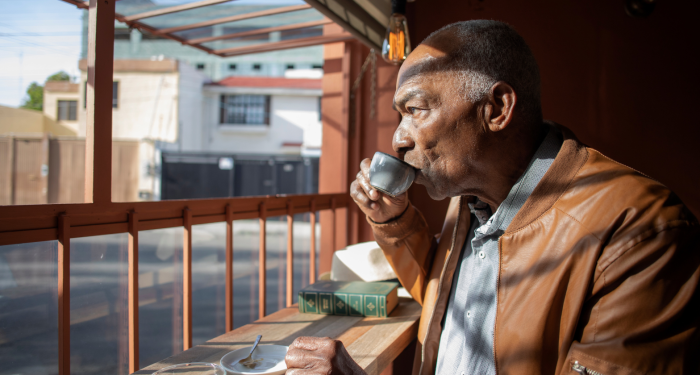
Margaret, 68, told her neighbor she was canceling the trip to Portugal. Not because she couldn't afford it or because her knees were acting up. She just didn't want to go. And then she laughed — not at the trip, but at herself, at the version of her that would have agonized over this decision for a week. She poured more coffee and said something her neighbor would think about for days: "I don't know when I stopped needing to want things. But it's the best thing that ever happened to me."
She's not alone. What keeps surfacing in these quiet conversations among people her age isn't complaint about the aches or the losses. It's surprise. The strange, unexpected lightness of no longer having to want everything, become everything, prove everything. Nobody warned them it would feel this good.
The pressure nobody names
When you're young, everybody celebrates possibility. You can be anything. You can go anywhere. The whole world is open to you. What nobody tells you is that unlimited possibility is also a form of pressure. A relentless one.
In your twenties and thirties, you're supposed to be building a career, finding a partner, accumulating skills, saving money, staying relevant, looking good, being interesting. In your forties and fifties, you're supposed to be hitting your stride, reaching your peak, proving that all those years of building actually led somewhere. Does anyone ever stop to ask whether "supposed to" is doing all the work in those sentences?
It's exhausting. And the data backs this up. Research from USC found that about half of people in their twenties through their late forties experienced considerable stress. From there, stress levels dropped off dramatically in an almost straight line, reaching a low of around 17 percent by age 70.
The researchers themselves were puzzled by the finding. Money didn't explain it. Marriage didn't explain it. Having kids at home didn't explain it. Something else was going on.
What actually changes
Laura Carstensen at Stanford has spent decades trying to understand why older adults are, on average, happier than younger people. Her socioemotional selectivity theory offers one of the most compelling explanations I've come across.
The basic idea is that when people sense their time horizon is getting shorter, their motivation shifts. Younger people are wired to explore, to expand, to accumulate knowledge and contacts for a future that feels infinite. But as people age and time feels more finite, they naturally pivot toward what's emotionally meaningful. They stop trying to impress people and start investing in the people who actually matter. It sounds obvious when you write it down. Living it is a different thing entirely.
And here's what really struck me: Carstensen found that this shift isn't a consolation prize. It's not "well, at least I have my close friends." The emotional payoff is real. A longitudinal study following over 1,000 people for two decades showed that negative emotions like anger, anxiety, and frustration decrease steadily with age. Older adults don't just tolerate life with less. They genuinely feel better.
In Buddhism, there's a concept called nekkhamma, which roughly translates to renunciation. But it's not the grim, ascetic kind of renunciation people imagine. It's more like the feeling when you put down a bag you didn't realize was heavy. That's what a lot of older adults seem to be describing when they talk about this relief.
The identity question settles down
One of the most underrated sources of stress in younger life is the constant question of who you are. Am I successful enough? Am I in the right career? Am I living up to my potential? Am I the person I thought I'd become? You'd think the question would get easier with time, but it doesn't — it just gets louder, more insistent, until something in you either breaks or lets go.
Psychologist Erik Erikson identified that the central developmental task of later life is what he called "integrity versus despair." It's the process of looking back and finding peace with the life you actually lived, rather than the one you imagined. It doesn't require a perfect past. It requires acceptance.
And that acceptance is freedom.
I think about this on my morning runs along the Saigon River. I'm in my late thirties, and I still catch myself measuring where I am against where I thought I'd be. It's a habit. It's also a trap. Because the measuring never stops on its own. The research suggests it only stops when something deeper shifts inside you.
The social circle shrinks. And that's the point.
Here's something that looks like a loss from the outside but feels like a gain from the inside. As people age, their social circles get smaller. Fewer friends. Fewer acquaintances. Less networking, less performing, less keeping up appearances.
Carstensen's research shows that this isn't just passive decline. It's active curation. Older adults retain the people who are most important, most predictable, most emotionally valuable in their lives. The result is what Carstensen calls a "more emotionally dense" social world. Fewer connections, but deeper ones. Think about your own life for a second. How many of the people you spent time with last month actually mattered to you? How many were just... habit?
The Harvard Study of Adult Development, which has tracked people for over 85 years, found that the quality of close relationships is the single strongest predictor of health and happiness in later life. Not career success. Not wealth. Not social status. Robert Waldinger, the study's director, noted that once people get beyond basic financial security, wealth doesn't meaningfully increase wellbeing.
So the person in their late 60s who has three close friends, a partner they can count on, and a quiet Saturday morning routine? They're probably doing better than the ambitious 40-year-old with 2,000 LinkedIn connections and a packed calendar they secretly resent.
The brain literally cooperates
This isn't just a mindset shift.
The brain itself seems to get on board. Research published in the Annals of the New York Academy of Sciences found that compared with younger adults, older adults react less to negative situations, ignore irrelevant negative stimuli more effectively, and remember relatively more positive than negative information. They also recover from negative emotional states faster and find interpersonal tensions less stressful. Scientists call this the "positivity effect," and it's been documented extensively. It's not naivety. The positivity effect is actually strongest in older adults whose cognitive abilities are sharpest. It appears to be an active, skilled deployment of attention toward what matters and away from what doesn't.
In other words, the brain of a healthy 70-year-old has gotten genuinely good at not caring about things that aren't worth caring about. That's not decline. That's mastery.
The secret nobody shares out loud
I've talked to enough older people, both here in Vietnam and back in Australia, to notice a pattern. They're reluctant to say it too loudly because it sounds like they're dismissing younger people's struggles. But privately, many of them will tell you that their 60s and 70s brought a kind of peace they never expected.
Not the peace of having everything figured out. The peace of no longer needing to.
No more pretending to care about office politics. No more comparing yourself to the neighbor's new car. No more lying awake wondering if you chose the right path. The path is the path. And that recognition, which sounds like resignation but actually feels like liberation, seems to be one of the most consistent emotional shifts that aging brings.
A study from the European Journal of Ageing described this as older adults "rescaling goals and adjusting aspirations." The researchers debated whether to call it a "gain" or simply "resignation." But the people living it don't seem confused about which one it is.
What the rest of us can learn
You don't have to wait until your late 60s to start letting go of the pressure to be everything. That's the real takeaway from all this research. The things that make older adults happier, like deeper relationships, present-moment focus, smaller social circles, less comparison, fewer meaningless obligations, are available to anyone at any age.
The Greater Good Science Center at Berkeley noted that the happiest adults in midlife were those who shifted from asking "What can I do for myself?" to "What can I do for the world beyond me?"
That question isn't age-dependent. Neither is the relief it brings.
The happiest older adults aren't the ones who finally got everything they wanted. They're the ones who stopped wanting everything. The researchers call it rescaling. The people living it call it peace. And maybe those are the same thing, or maybe one is just a polite way of not naming the other. The strange part is that an entire economy depends on you never arriving at this feeling — and yet people keep arriving at it anyway, quietly, without anyone's permission.
Whether that's wisdom or surrender is a question that probably doesn't have a clean answer. Maybe it doesn't need one.