It started as a healthy habit - but somewhere along the way, it became the only space in your day that truly belonged to you. What looks like discipline is often just a quiet attempt to carve out a moment of peace in a life where you’re constantly needed.

Add VegOut to your Google News feed. 
My alarm goes off at 5:30am. Not because I'm disciplined. Not because I'm one of those people who posts sunrise photos with captions about "winning the morning."
I get up that early because it's the only sliver of my entire day where no one is calling my name, pulling at my shirt, needing a snack, needing an answer, needing me to fix something, find something, decide something, or just be present for something.
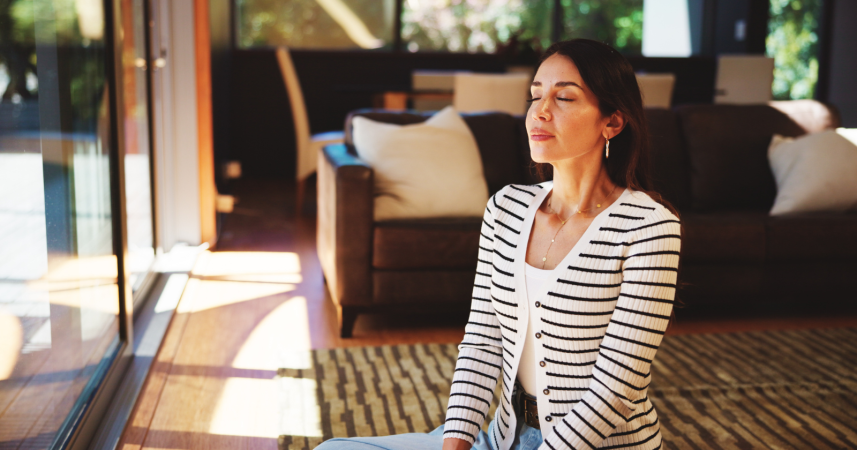
I sit on the floor. I close my eyes. I breathe.
And for about twenty minutes, I'm not a dad. I'm not a husband. I'm not a boss. I'm just a person who exists without anyone needing anything from that existence.
I used to call this my self-care routine. I was proud of it, actually. "I meditate every morning," I'd tell people, like it was proof I had my life together.
But lately I've started seeing it differently. Because self-care implies maintenance. What I'm doing at 5:30am isn't maintenance. It's more like coming up for air right before I drown.
And I don't think I'm alone in this.
Parental burnout is real, and it's not what you think
Here's something that surprised me. Parental burnout is now recognized as a distinct psychological condition, separate from both workplace burnout and clinical depression.
Researchers Moïra Mikolajczak and Isabelle Roskam at the Université Catholique de Louvain have spent over a decade studying this. Their theoretical framework for parental burnout identifies three core symptoms: overwhelming exhaustion tied specifically to your role as a parent, emotional distancing from your children, and a creeping sense that you're failing at the whole thing.
What hit me hardest when I read their work was the emotional distancing part. Because I know exactly what that looks like. It's not that you stop loving your kids. It's that your interactions start becoming mechanical. You're feeding them, bathing them, getting them to bed. But the warmth gets harder to access. You're running on procedure, not presence.
And their 42-country study involving over 17,000 parents showed this isn't a Western problem or a rich-country problem. It's a human problem. Parents everywhere are burning out, and the ones most at risk aren't necessarily the ones with the hardest circumstances. They're the ones whose internal resources can't keep up with the demands they're facing.
That distinction matters. Because it means parental burnout isn't about having it hard. It's about having nothing left.
The autonomy problem nobody talks about
There's a reason that twenty minutes at 5:30am feels like oxygen. And it goes deeper than "everyone needs a break."
Self-determination theory, developed by psychologists Richard Ryan and Edward Deci, identifies three basic psychological needs that humans require for well-being: autonomy, competence, and relatedness.
Most parents have relatedness covered. You're deeply connected to other humans. Perhaps too connected. Competence fluctuates but you're generally managing. But autonomy? The feeling that you are the author of your own actions, that you have genuine choice over how you spend your time?
For many parents, especially in those early years, autonomy effectively drops to zero.
And here's what Ryan and Deci's research consistently shows: when any of these three needs is chronically thwarted, people don't just feel unhappy. They begin to show signs of psychological deterioration. Reduced motivation, increased anxiety, emotional withdrawal, loss of vitality.
Sound familiar? That's because what we casually call "being a tired parent" is often something more clinical. It's chronic autonomy deprivation. And that twenty minutes of morning meditation isn't a luxury. It's the bare minimum required to keep functioning.
Why "self-care" is the wrong word
I have a problem with the way we talk about self-care in parenting culture. Not because self-care is bad. But because the framing assumes you're starting from a baseline of "fine" and adding something nice on top.
Take a bath. Go for a walk. Meditate. Journal. These are all presented as enhancements. Little treats for the overwhelmed.
But what if you're not starting from fine? What if you're starting from depleted?
When I sit down at 5:30am, I'm not enhancing anything. I'm trying to get back to zero. I'm trying to reach the starting line that everyone assumes I'm already standing on.
And this is where the self-care conversation becomes almost insulting, because it puts the responsibility entirely on the individual. You're burned out? Have you tried yoga? As if the problem is a missing hobby rather than a structural collapse in the distribution of demands.
Research into informal caregiver burnout highlights that burnout isn't caused by a lack of coping strategies. It's caused by a sustained imbalance between demands and resources. You can meditate until you levitate and it won't fix the fact that the equation is fundamentally broken.
What I actually learned from meditation (it wasn't peace)
I've been practicing mindfulness for years. I wrote a whole book about Buddhist philosophy. And I'm going to be honest about something that might surprise you.
Meditation didn't fix this. Not even close.
What meditation actually did was make the problem impossible to ignore. Because when you sit still and pay attention, you can't keep lying to yourself. You can't keep pretending you're fine. You can't keep telling yourself that the exhaustion is temporary, that it'll get better when the kids are older, that you just need to push through.
Mindfulness doesn't give you peace. It gives you clarity. And sometimes clarity is deeply uncomfortable because it shows you exactly how depleted you actually are.
In Buddhist practice, there's a concept called "dukkha," which is often translated as suffering but more accurately means something like unsatisfactoriness or the stress of things being slightly (or majorly) out of alignment. The Buddha didn't teach people to escape dukkha. He taught them to see it clearly and understand its causes.
And when I sit at 5:30am, what I see clearly is this: the problem isn't that I need more meditation. The problem is that I've built a life where the only time I exist as a full human being is when everyone else is unconscious.
What actually needs to change
I'm not writing this to complain about my kids. I love being a dad. My daughter is the best thing that ever happened to me, and I mean that without any qualification.
But I think there's a conversation we're not having. We talk endlessly about optimizing parenting. Being more present. Being more patient. Being more engaged. And almost nobody talks about what it costs to do all of that without any real space to exist as a person who is not defined entirely by their usefulness to others.
This isn't just a feelings problem. The research on parental burnout shows that when parents are chronically depleted, the consequences extend to the children. Emotional distancing, reduced quality of care, increased conflict. The parents who give everything without replenishing anything don't become better parents. They become hollowed-out ones.
So if you're reading this at some ungodly hour because it's the only time you have to yourself, I want you to know something. That instinct to carve out space, even if it's just twenty minutes in the dark while everyone sleeps, isn't indulgent. It's intelligent. It's your psyche telling you that something essential is missing.
But I also want you to know that it's not enough. And pretending it's enough, calling it self-care and patting ourselves on the back, is how we stay stuck.
I explored a lot of these ideas about ego, identity, and the trap of losing yourself in your roles in my book Hidden Secrets of Buddhism: How To Live With Maximum Impact and Minimum Ego. When I wrote it, I understood the concepts intellectually. Now, sitting on the floor at 5:30am with a toddler about to wake up, I understand them in my bones.
The morning meditation isn't self-care. It's a signal. And the sooner we start treating it like one, the sooner we can have an honest conversation about what parents actually need, which is a lot more than twenty minutes and a candle.