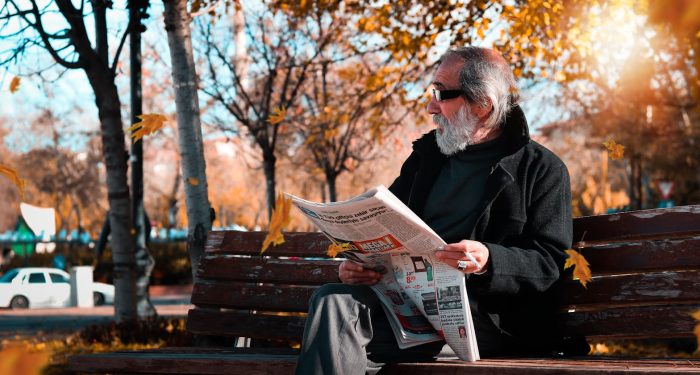
It might look like a reaction to something falling apart - but more often, it’s a quiet rebuilding happening from the inside out. What you’re seeing isn’t a crisis - it’s a man finally taking ownership of his time, his energy, and the life he actually wants to live.

Add VegOut to your Google News feed. 
I know what it looks like from the outside.
A guy in his forties who suddenly changes his habits. He's at the gym at 6am. He's meal-prepping on Sundays. He's turning down Friday drinks to go home and read. He's quieter. More deliberate. Less available for the things he used to say yes to automatically.
And the people around him start exchanging glances. Is he okay? Is something wrong? Is this a midlife crisis?
I turned 37 recently, and while I'm not quite in the demographic this article describes, I can already feel the early edges of what I'm about to talk about. And having studied human behavior and Buddhist psychology for years, I want to make a case that what looks like a man falling apart is almost always a man putting himself back together.
The "midlife crisis" is mostly a myth
Let's start with the thing everyone assumes is true but largely isn't.
The concept of the midlife crisis was popularized in the 1960s, and it stuck because it makes for a good story. The red sports car. The affair. The dramatic career abandonment. It's vivid, it's cinematic, and according to the actual research, it describes roughly 10 to 20 percent of people at most.
A comprehensive review published in American Psychologist by researchers Frank Infurna and colleagues examined the dominant narratives about midlife and found that most of them are wrong. The stereotypical midlife crisis, characterized by impulsive decisions and psychological upheaval, is the exception, not the rule. The vast majority of middle-aged adults don't experience a crisis at all. What they experience is something quieter, more deliberate, and far more constructive.
The researchers describe midlife as a period defined by a unique constellation of roles and transitions, not a period of breakdown. Gains are observed in emotional experience, crystallized abilities, and control beliefs. The picture of well-being in midlife, when measured longitudinally rather than through snapshots, is considerably more positive than the cultural narrative suggests.
So when a man in his forties starts overhauling his daily habits, the data suggests he's far more likely to be responding to an internal recalibration than spiraling into crisis.
What's actually happening
Here's what I think is going on, and the research supports this.
For most men, the twenties and thirties are defined by building. Building a career. Building a family. Building financial stability. Building a reputation. The goals are largely external: earn more, achieve more, accumulate more, prove more.
This works for a while. External goals are motivating when the future feels infinite. But somewhere around forty, something shifts. The future stops feeling infinite. Not in a morbid way. In a clarifying way.
Stanford psychologist Laura Carstensen's socioemotional selectivity theory describes exactly this mechanism. As people begin to perceive their remaining time as limited, their motivational priorities shift from knowledge-seeking and network-expanding goals toward emotionally meaningful ones. They stop optimizing for breadth and start optimizing for depth.
When a forty-three-year-old man stops going out four nights a week and starts spending his evenings cooking dinner and reading, he's not withdrawing from life. He's reorganizing it. He's shifting from "more" to "better." From quantity to quality. From performing for other people's expectations to actually living according to his own.
That's not a crisis. That's the opposite of a crisis. That's a man who finally has enough self-awareness to ask himself what he actually wants.
Why the gym matters more than you think
People love to mock the guy who suddenly gets into fitness in his forties. Another middle-aged man trying to fight the aging process. Another ego refusing to accept reality.
But think about what going to the gym every day actually represents. It means a man has decided that his own physical health is worth prioritizing. That's not vanity. For most men, who have spent fifteen or twenty years putting work, family, and everyone else's needs first, choosing to take care of their own body is one of the most radical acts of self-respect they've ever performed.
Research from the MIDUS longitudinal study (Midlife in the United States) has shown that frequent engagement in physical and cognitive activity during midlife doesn't just maintain health. It can actually reverse some of the decline associated with earlier life disadvantages. The researchers describe a form of "plasticity" in midlife, the capacity for meaningful change and enhancement beyond existing levels of functioning.
In other words, the science says that midlife isn't just about managing decline. It's a genuine window for growth. And a man who recognizes that window and walks through it by showing up at the gym every morning is responding to that opportunity, not running from a problem.
The same goes for cooking. When a man who has spent two decades eating whatever was fastest and most convenient starts deliberately preparing his own meals, he's doing more than changing his diet. He's taking ownership of a basic dimension of self-care that he'd outsourced for years. He's slowing down. He's paying attention to what goes into his body. He's treating himself as someone worth feeding properly.
The solitude piece
This is the one that worries people the most. A man who suddenly wants to spend time alone must be depressed. He must be isolating. Something must be wrong.
But wanting solitude in your forties is often the healthiest impulse a man can have. Because for many men, solitude in adulthood is genuinely unfamiliar. They've spent their entire adult lives surrounded by obligations, noise, and other people's needs. They've been performing the role of provider, partner, colleague, and friend so continuously that they've lost contact with who they are when nobody's watching.
Choosing to be alone isn't the same as being lonely. Choosing solitude is a man saying: I need to remember who I am when I'm not being useful to someone else. I need to sit with my own thoughts for long enough to figure out whether the life I've built is the life I actually want.
That takes courage. It takes more courage than just continuing the performance.
Why people get uncomfortable
Here's the part nobody talks about. When a man starts changing his habits, the discomfort rarely comes from him. It comes from everyone around him.
Because when someone you're close to starts acting differently, it forces you to examine your own patterns. If your buddy who used to drink with you every Friday is now at the gym instead, it raises an implicit question about your own Friday nights. If your partner who used to be constantly available is now carving out time for himself, it disrupts the equilibrium of the relationship.
The discomfort isn't evidence that the man is doing something wrong. It's evidence that systems resist change, even positive change. And labeling his transformation a "crisis" is often the most convenient way for everyone else to avoid examining what his growth is revealing about their own stagnation.
What Buddhism taught me about this
In Buddhist philosophy, there's a concept called "the middle way," but there's a less discussed idea that I find more relevant here: "renunciation."
In the West, renunciation sounds extreme. Monks in robes. Giving up everything. But in Buddhist psychology, renunciation simply means letting go of things that no longer serve you. Not dramatically. Quietly. A man who stops drinking every weekend isn't performing austerity. He's renouncing a habit that was costing him more than it was giving him.
A man who starts waking up early to exercise is renouncing the version of himself who put his body last. A man who starts cooking his own food is renouncing the carelessness with which he used to treat his own nutrition. A man who starts spending time alone is renouncing the compulsive availability that kept him from ever knowing his own mind.
None of that is a crisis. All of it is growth. And the only reason we're suspicious of it is that we've been conditioned to expect men in their forties to fall apart, so when one starts putting himself together instead, we don't have a category for it.
Give him the category: he's finally paying attention to his own life. And the evidence says he's going to be better for it.
I wrote about many of these ideas in my book Hidden Secrets of Buddhism: How To Live With Maximum Impact and Minimum Ego. The book is about stripping away the ego-driven performances that keep us stuck and learning to build a life around what genuinely matters. If you've watched a man you know go through this transformation, or if you're in the middle of it yourself, the book will make a lot of sense.
Because the crisis isn't the change. The crisis was everything before it.
If You Were a Healing Herb, Which Would You Be?
Each herb holds a unique kind of magic — soothing, awakening, grounding, or clarifying.
This 9-question quiz reveals the healing plant that mirrors your energy right now and what it says about your natural rhythm.
✨ Instant results. Deeply insightful.

Lachlan Brown
Lachlan Brown is a psychology graduate, mindfulness enthusiast, and the bestselling author of Hidden Secrets of Buddhism: How to Live with Maximum Impact and Minimum Ego. Based between Vietnam and Singapore, Lachlan is passionate about blending Eastern wisdom with modern well-being practices.
As the founder of several digital publications, Lachlan has reached millions with his clear, compassionate writing on self-development, relationships, and conscious living. He believes that conscious choices in how we live and connect with others can create powerful ripple effects.
When he’s not writing or running his media business, you’ll find him riding his bike through the streets of Saigon, practicing Vietnamese with his wife, or enjoying a strong black coffee during his time in Singapore.
More Articles by Lachlan