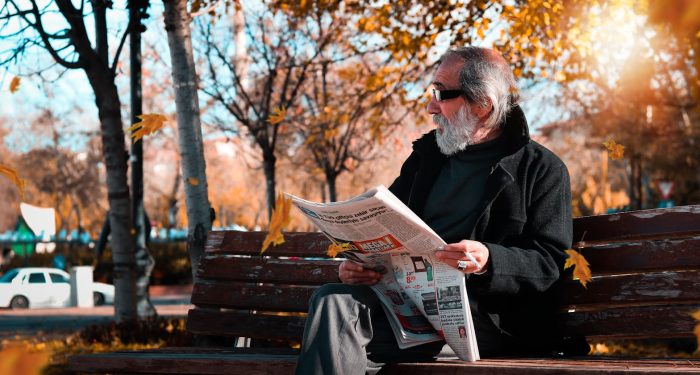
It wasn’t a dramatic change - just a quiet decision to stop filtering every thought, and let your words land as they are. What followed wasn’t chaos, but clarity - where being understood mattered less than finally feeling like yourself.

Add VegOut to your Google News feed. 
I turned 37 last November and realized I'd spent the better part of my adult life editing my sentences before I spoke them. Smoothing the edges. Softening the opinions. Making sure whatever came out of my mouth was palatable, safe, and unlikely to create friction.
And then one day, I just stopped.
I don't even remember the exact moment. It wasn't dramatic. There was no breakdown, no epiphany on a mountaintop. I was in a conversation with someone — I think it was over dinner in Saigon — and they said something I disagreed with and instead of nodding politely and steering the topic somewhere safer, I just said what I actually thought.
The words came out unpolished. Unrehearsed. A little clumsy.
And the sky didn't fall.
The internal editor
If you've ever caught yourself mid-sentence, rerouting a thought because you sensed it might land wrong — you know the editor I'm talking about.
It's the voice that rewrites your honesty in real time. That swaps "I don't agree" for "that's interesting." That replaces "I need help" with "I'm fine." That turns a genuine opinion into a question, because questions are safer than statements.
I've been running that editor since childhood. And I suspect most people have. Because the message most of us absorbed early on was clear: say the right thing, or risk the consequences.
Research by psychologists studying authentic and inauthentic self-expression found that these are genuinely distinct psychological behaviors — not just two ends of the same scale. Across four studies, they found that authentic expression was consistently associated with greater psychological need satisfaction and better wellbeing outcomes. Inauthentic expression, by contrast, was linked to less autonomy and more negative emotion.
That tracked with my experience perfectly. Every time I edited myself, I was choosing safety over authenticity. And every time I chose safety, something small inside me went quiet.
What thirty-seven years of editing costs you
The cost isn't obvious at first. That's what makes it so dangerous.
You don't notice the toll of a single edited sentence. But multiply it across decades — thousands of conversations, hundreds of relationships, every meeting, every dinner, every phone call — and what you get is a life built on an approximation of who you are rather than the real thing.
You become an expert in reading rooms. In adjusting your tone. In giving people the version of you that creates the least resistance.
And the people around you? They think they know you. But they don't. They know the edited version. The one that was designed to be easy to be around.
A major study published in Nature Communications, analyzing over 10,000 individuals alongside a longitudinal experiment, found that people who expressed themselves more authentically reported significantly greater life satisfaction. This held true regardless of personality type — even people with less socially desirable traits benefited from being genuine rather than performing an idealized version of themselves.
I read that and thought: of course. Because the opposite of authenticity isn't politeness. It's self-erasure.
What the research says about authenticity and wellbeing
The science on this is surprisingly clear.
Psychologist Alex Wood and colleagues developed the Authenticity Scale — published in the Journal of Counseling Psychology — to measure three dimensions of authenticity: self-alienation (how disconnected you feel from your own thoughts and feelings), authentic living (whether your behavior actually matches what you think and feel inside), and accepting external influence (how much you conform to what others expect of you).
The findings were striking. Authentic living was strongly and positively associated with self-esteem, life satisfaction, and psychological wellbeing. Self-alienation — the disconnect between who you are and who you present — was one of the strongest negative predictors of life satisfaction the researchers had ever measured.
In fact, the correlation between self-alienation and life dissatisfaction was stronger than 18 out of 24 character strengths in a separate major study. Authenticity wasn't just one predictor of wellbeing. It was among the most powerful.
A meta-analysis of 75 studies involving over 36,000 people confirmed the pattern: authenticity was positively associated with wellbeing at a robust level, and the effect held across ages, genders, and sample types.
The message from the research is unambiguous: being yourself isn't a luxury. It's a psychological necessity.
What happens when you stop editing
I'll tell you what I noticed.
The first thing is that some people don't like it. The ones who were comfortable with the edited version of you — the agreeable, easy, no-friction version — they get a little startled when you start saying what you actually mean.
Some of them pull away. That hurts. But it also tells you something important about the nature of those relationships.
The second thing is that other people lean in. The ones who've been craving a real conversation, who've been editing themselves just as hard as you have, they recognize what you're doing and they match it. The conversations get better. Deeper. More honest. More alive.
The third thing — and this is the one that surprised me — is that you start to recognize your own voice. After years of curating it for other people, hearing yourself speak unfiltered is disorienting. You think: is that really what I believe? Is that really how I feel about this?
And the answer is yes. That's you. That's the version that was always there, just behind the edits.
Why 37 was the tipping point
I don't think there's anything magical about the number. But I think there's something about the late thirties that makes this shift more likely.
You've been performing long enough to feel the weight of it. You've accumulated enough life to know that the editing hasn't actually protected you from anything — it just delayed the discomfort. And you're old enough to understand that the time you spend performing could be spent actually living.
I'm not saying I've become reckless. I'm not walking into rooms dropping unfiltered opinions like grenades. There's a difference between being authentic and being careless.
What I've stopped doing is pre-screening every thought for its potential to make someone uncomfortable. If something is true and it matters, I say it. If someone disagrees, I let them disagree. If the room goes quiet for a second — well, that's what honesty sounds like sometimes.
The faces
Here's the part I didn't expect.
When you say exactly what you mean — without the softeners, the qualifiers, the apology wrapped around every statement — people's faces change.
Some of them light up. Because what you just said is the thing they were also thinking but didn't have the nerve to say.
Some of them flinch. Not because you've been cruel, but because they're not used to hearing something undiluted.
And some of them just look at you with this expression that I can only describe as recognition. Like they're seeing you for the first time.
That expression, right there, is worth every awkward silence and lost acquaintance.
Because after 37 years of editing, the experience of being seen — actually seen, for who you actually are — is the closest thing I've found to feeling alive.
I'm not going back to the edited version. It was a good performance. But it was never me.
And I'd rather be clumsy and real than polished and invisible.