What separates a good talk from a great one often isn’t the words—it’s the body language. After analyzing 1,000 TED talks, these are the 10 patterns that make speakers unforgettable.

Add VegOut to your Google News feed. 
When you think about the best TED talks—the ones that go viral, rack up millions of views, and stay with you years later—it’s not just the ideas that make them memorable. It’s the delivery. After watching and analyzing over 1,000 TED talks (yes, I really went that deep), I realized something important: great speakers all use body language in strikingly similar ways.
It’s not about being overly polished or robotic. In fact, the opposite is true. Their body language feels natural, confident, and deeply connected to their words. And while every speaker has their own style, the most impactful ones consistently share 10 key patterns.
Let’s break them down.
1. They own the stage without pacing nervously
Great TED speakers use the stage with intention. They don’t pace aimlessly back and forth like they’re trying to burn calories. Instead, they move with purpose.
For example, when making a strong point, they might step forward to close the distance with the audience. When telling a reflective story, they might slow down and stay still, letting the silence work in their favor.
Movement, when intentional, communicates confidence. Nervous pacing, on the other hand, tells the audience you’re trying to escape.
2. They use open hand gestures
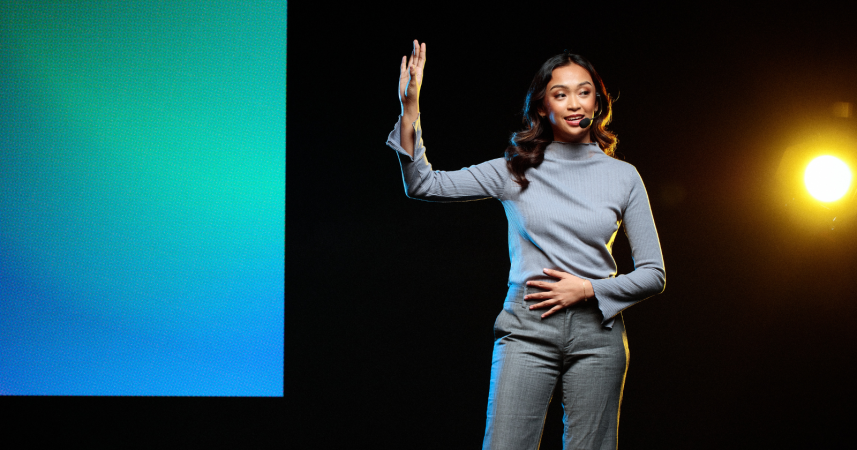
If you watch enough TED talks, you’ll notice that great speakers rarely keep their hands in their pockets or cross their arms for long. Instead, they use open gestures—palms up, arms uncrossed, movements that are expansive rather than closed.
Psychologically, open hand gestures signal honesty, warmth, and inclusivity. Audiences instinctively trust someone more when they can “see their hands.” This goes back to evolutionary psychology: open hands meant no weapons, no threat.
3. They align gestures with their words
The best speakers don’t just wave their arms randomly. Their hands, arms, and body movements match the rhythm and content of their speech.
If they’re describing something big, they spread their arms wide. If they’re making a list, they count with their fingers. If they’re emphasizing contrast, they may gesture left and right.
This synchrony between verbal and non-verbal communication makes the talk easier to follow—and more persuasive.
4. They use their face like a canvas
Body language isn’t just about arms and legs—it’s about micro-expressions. The most memorable TED talks show speakers who emote. They smile at the right moments, frown in thought, or raise their eyebrows when something surprising is revealed.
A flat, expressionless delivery makes even the most brilliant idea sound boring. The greats treat their face like a visual amplifier of emotion.
5. They make purposeful eye contact
One of the strongest patterns I noticed is how great speakers use their eyes. They don’t stare at their slides or gaze vaguely above people’s heads. Instead, they connect—making eye contact with different sections of the audience as if they’re having a series of conversations.
This creates intimacy, even in a giant room. On video, it translates to authenticity, as though they’re talking directly to you.
6. They use pauses like punctuation
This might seem like a verbal technique, but pauses are also physical. Great speakers allow their body to settle during a pause. They don’t fidget. They breathe, hold still, and let the silence land.
Pauses give the audience time to process—and they give the speaker time to recalibrate. It’s one of the most underrated aspects of body language, because silence paired with stillness radiates confidence.
7. They ground themselves with strong posture
Slouching, leaning too heavily on one leg, or folding into yourself communicates insecurity. The best TED speakers stand tall—shoulders back, feet planted firmly, head upright.
This doesn’t mean stiff military posture. It means balanced, relaxed, and aligned. They look like they belong on the stage.
And posture has a feedback effect: standing tall doesn’t just look confident, it makes you feel confident (thanks to the mind-body loop).
8. They use the “personal bubble” wisely
Great speakers know how to use space. They don’t invade the audience’s personal bubble by leaning too far forward or pointing aggressively. At the same time, they don’t shrink into themselves.
They project an invisible “bubble” of energy outward—big enough to command the room, but not so big that it feels threatening.
This spatial awareness is subtle, but it’s one reason why some talks feel magnetic and others feel awkward.
9. They animate their stories with their whole body
When great TED speakers tell stories, they act them out. They’ll physically mimic the way someone moved, lean into dialogue, or shift their body to embody different characters.
This storytelling through body language makes the audience visualize the moment more vividly. It’s why talks about personal journeys—overcoming hardship, chasing a dream, or making a discovery—stick with us. We don’t just hear the story. We see it.
10. They radiate congruence
Ultimately, the single most important body language pattern is congruence: their movements, facial expressions, posture, and gestures all align with their words.
If someone says, “I’m passionate about this idea,” but they stand stiff with their arms crossed, we feel the disconnect. But when someone says the same line while leaning forward, eyes lit up, hands open—the passion feels real.
Great speakers’ body language never feels like an afterthought. It is their message, delivered in a second channel alongside their words.
The big takeaway
Studying 1,000 TED talks taught me that body language is not about looking perfect or rehearsed. It’s about amplifying your message in ways that feel natural, confident, and human.
These 10 patterns aren’t tricks—they’re habits of connection. And the more you internalize them, the more natural they become.
When you practice speaking, don’t just rehearse your words. Practice how you stand, how you gesture, how you pause. Imagine you’re not presenting to an audience but having a conversation with people you genuinely care about.
Because in the end, that’s what great body language really is: the physical expression of care, presence, and passion.
If You Were a Healing Herb, Which Would You Be?
Each herb holds a unique kind of magic — soothing, awakening, grounding, or clarifying.
This 9-question quiz reveals the healing plant that mirrors your energy right now and what it says about your natural rhythm.
✨ Instant results. Deeply insightful.

Lachlan Brown
Lachlan Brown is a psychology graduate, mindfulness enthusiast, and the bestselling author of Hidden Secrets of Buddhism: How to Live with Maximum Impact and Minimum Ego. Based between Vietnam and Singapore, Lachlan is passionate about blending Eastern wisdom with modern well-being practices.
As the founder of several digital publications, Lachlan has reached millions with his clear, compassionate writing on self-development, relationships, and conscious living. He believes that conscious choices in how we live and connect with others can create powerful ripple effects.
When he’s not writing or running his media business, you’ll find him riding his bike through the streets of Saigon, practicing Vietnamese with his wife, or enjoying a strong black coffee during his time in Singapore.
More Articles by Lachlan