It’s not just nostalgia. It’s not ignorance. It’s a different set of priorities: human contact over convenience, stability over constant change, dignity over speed.
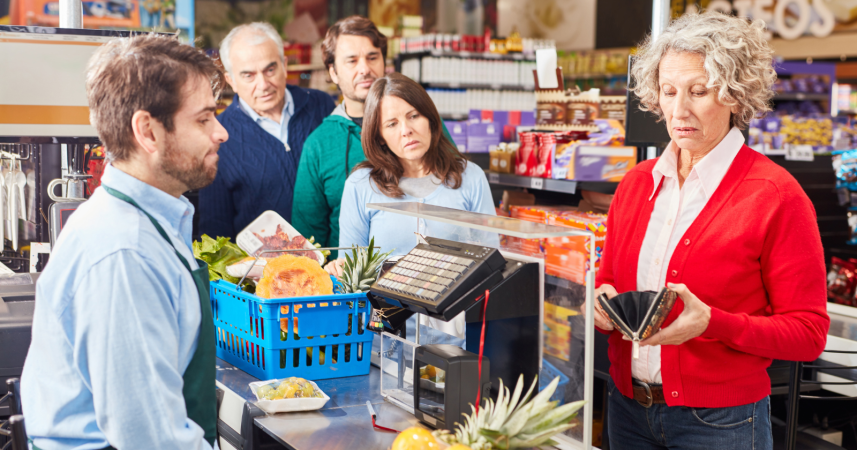
If you’ve ever gone to the supermarket with a Boomer, you’ve probably seen this scene play out:
Meanwhile, my mum is three people deep in a line, clutching her basket, chatting with a stranger about the price of tomatoes.
My dad is standing beside her, arms folded, looking mildly suspicious of everything beeping.
For a long time, I just assumed it was a “technology thing”—you know, Boomers and screens.
But over time, I’ve realized there’s a lot more going on under the surface.
Boomers who refuse to use self-checkout often share a set of distinctive traits and values.
It’s not just that they “don’t know how.” It’s that their worldview, their upbringing, and their sense of what’s right and normal all pull them toward that human cashier.
Let me walk you through 7 traits I’ve noticed—using my own parents as imperfect, very human, and often endearing examples.
1. They deeply value human interaction
My mum treats the checkout line like a social event.
She knows the names of half the cashiers at her local supermarket.
She asks about their kids, comments on their earrings, and sometimes leaves knowing more about a stranger’s sore knee than I know about my own neighbours.
For her, that small human interaction isn’t a “waste of time”—it’s part of what makes life feel connected.
Growing up, most of her daily experiences involved other people: shop owners, bank tellers, post office staff, librarians.
You spoke to humans, not screens.
Self-checkout removes that micro-moment of connection.
To her, it feels cold, rushed, and strangely isolating.
Boomers who avoid self-checkout are often the same people who:
- Chat with waitstaff instead of just ordering mechanically.
- Know their pharmacist by name.
- Ask the bus driver how their day is going.
- Still call companies on the phone instead of using chatbots.
It’s not that they can’t use the machine. It’s that they prefer the moment of shared humanity.
To them, that’s part of what makes society feel like a community rather than a transaction.
2. They have a strong sense of loyalty to workers
My dad once said something that stuck with me.
We were at the supermarket, and I casually asked, “Why don’t you try the self-checkout? It’s quicker.”
He shook his head and replied:
“If everyone starts using those machines, these people won’t have jobs.”
It wasn’t a speech. It wasn’t political. It was just a simple, deeply held belief: people matter more than efficiency.
Many Boomers grew up in a world where you stayed in jobs for decades.
They saw what happened when factories closed, when automation replaced workers, when “efficiency” meant layoffs.
So when they see self-checkout, they don’t just see convenience—they see a quiet but steady replacement of human labour.
Boomers who refuse self-checkout often:
- Avoid replacing human interaction with apps when they can help it.
- Feel more comfortable supporting businesses that keep staff employed.
- See people behind counters as part of the social fabric, not just service providers.
When my parents choose the staffed checkout, it’s their way of saying:
“Your job matters. You’re not invisible.”
3. They have a low tolerance for frustration with tech
Let’s be honest: self-checkout is not always smooth.
It’s fine when everything scans perfectly. But if something goes wrong—an unexpected item in the bagging area, a barcode that won’t read, a prompt that disappears too quickly—it can become a minor nightmare.
I’ll sigh, tap a few buttons, wait for assistance, and move on.
My parents? They would rather stand in a long line than risk that awkward, slightly humiliating “Please wait for an assistant” moment.
For many Boomers, tech frustration doesn’t feel neutral—it feels like a personal indictment.
They grew up in a world where “doing things properly” meant knowing what you were doing.
Struggling with a machine in public triggers something deeper:
embarrassment, annoyance, and a sense that the world moved on without them.
So they pre-empt that discomfort by avoiding the situation altogether.
Boomers who avoid self-checkout often:
- Prefer processes they fully understand, even if they’re slower.
- Hate feeling “watched” by strangers while battling a screen.
- Would rather wait for a human who does this all day than fumble with a machine for three minutes.
To them, standing in line isn’t inefficient—it’s emotionally safer.
4. They equate “proper service” with being served by a person
My parents still see certain things as “the right way” to do them.
For example, when they go to a bank, they prefer talking to a teller.
When they book a big trip, they still like calling an agent or speaking to a person at the counter.
They grew up in a service culture where being served by a human wasn’t a luxury—it was the default.
You didn’t pump your own petrol in some places. You didn’t bag your own groceries. You didn’t print your own boarding pass.
Self-checkout flips that script.
Suddenly, the customer is part cashier, part bagger, part tech support.
Boomers who refuse self-checkout often share this trait:
they believe that if they’re paying for something, it should include a human element of service.
To them:
- A staffed checkout feels respectful and “proper”.
- Self-checkout feels like the store is making them do more work for the same price.
- Being served by a person is part of the experience, not an add-on.
My dad once said, half-joking, half-serious:
“If I have to scan it, they should give me a staff discount.”
Underneath the joke is a real belief: service is part of what they value in a transaction.
5. They are deeply habitual and loyal to routines
Boomers are often creatures of habit—and I say that with affection.
My parents shop at the same supermarket, park in the same rough area, walk the same aisles in the same order, and then line up at the same couple of checkouts they always use.
Routines are comforting.
They provide predictability and a sense of control in a world that feels increasingly fast and unfamiliar.
To someone who’s done things a certain way for 40+ years, self-checkout isn’t just “another option.”
It’s an interruption to a tried-and-true pattern that has always worked just fine.
Boomers who avoid self-checkout often:
- Use the same petrol station, pharmacy, and bakery for decades.
- Stick to particular brands and products they trust.
- Prefer familiar faces and familiar processes over “new and improved” systems.
We often assume change is neutral.
For many in their generation, constant change feels like erosion—of stability, of identity, of the world they understood.
Self-checkout isn’t just a new machine to them. It’s another reminder that the world keeps shifting under their feet.
Routines are their way of anchoring themselves.
6. They are quietly skeptical of corporations and hidden costs
My parents don’t talk about “late-stage capitalism” or corporate profit margins.
But they have a deep, instinctive skepticism about big companies and their motives.
When they see a row of self-checkout machines, they don’t think:
“Oh, how convenient.”
They think:
“How much money are they saving by not hiring people?”
They’ve lived through enough economic cycles to know that cost-cutting often doesn’t benefit the everyday customer or the worker.
Boomers who refuse self-checkout often have this quiet, unspoken belief:
- If a company can get you to do the work, they will.
- If they can reduce staff and still charge the same, they will.
- If something is presented as “convenience,” they ask, “Convenient for who?”
Their refusal to use self-checkout sometimes functions as a small act of resistance—even if they wouldn’t label it that way.
It’s a way of saying:
“I see what you’re doing, and I’m not fully on board with it.”
7. They carry a strong sense of dignity about “doing things properly”
One of the most interesting traits I’ve noticed in my parents is their sense of dignity around doing things “the proper way.”
They don’t cut corners.
They queue patiently. They put the divider on the conveyor belt. They greet the cashier. They don’t scan and dash.
To them, the old-fashioned checkout line is part of a social contract:
we take our turn, we behave politely, we respect the process.
Self-checkout, with its glitches, rushed pace, and slightly chaotic energy, can feel undignified.
They don’t want to feel clumsy, rushed, or confused under fluorescent lights while a machine tells them what to do.
Boomers who avoid self-checkout often:
- Have a quiet pride in following systems correctly and respectfully.
- Prefer structures where roles are clear: customer, worker, manager.
- Don’t want to feel like they’re fumbling through a process designed for someone else’s comfort zone.
My mum once admitted:
“I don’t like feeling stupid in public. At the checkout, I know what I’m doing.”
That sentence says a lot.
It’s not about incompetence. It’s about self-respect.
A different kind of intelligence
It’s easy to roll our eyes and say:
“Boomers just don’t like change” or “They’re scared of technology.”
But when I look at my parents—their loyalty to workers, their appreciation for human connection, their desire to keep some parts of life human rather than automated—I see a different story.
I see people who:
- Value community over pure efficiency.
- Care about the dignity of work.
- Want to feel competent, not constantly outpaced by new systems.
- Are wary of a world that replaces humans wherever possible.
Do self-checkouts make sense? Absolutely. I use them all the time when I’m in a rush.
But I’ve also begun to understand why my parents still queue up for a human cashier.
It’s not just nostalgia.
It’s not ignorance.
It’s a different set of priorities:
human contact over convenience, stability over constant change, dignity over speed.
And while I might tap and go at the self-checkout most days, there’s a part of me that hopes we don’t lose what my parents are trying, in their own quiet way, to hold onto.
What’s Your Plant-Powered Archetype?
Ever wonder what your everyday habits say about your deeper purpose—and how they ripple out to impact the planet?
This 90-second quiz reveals the plant-powered role you’re here to play, and the tiny shift that makes it even more powerful.
12 fun questions. Instant results. Surprisingly accurate.