
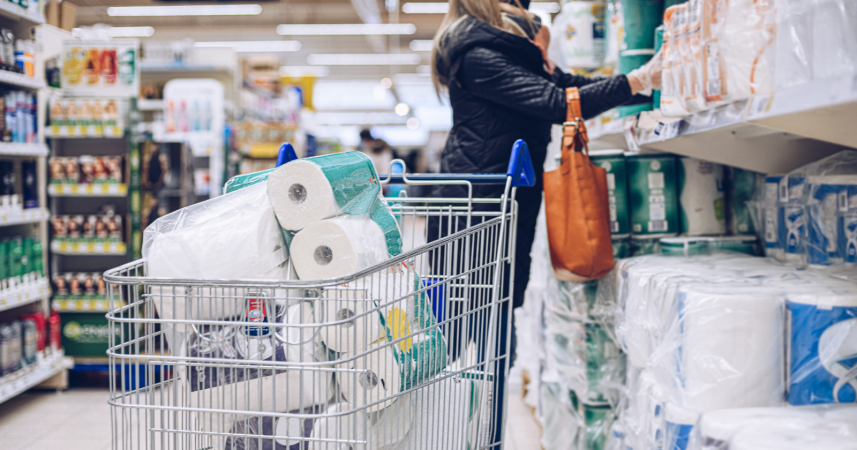
Even with a healthy bank account and investment portfolio, that childhood voice still makes you throw three jumbo packs of toilet paper in your cart—because some fears from growing up poor never really leave, no matter how many digits your checking account shows.

Add VegOut to your Google News feed. 
When I was thirty-five and finally made that last student loan payment, I celebrated by going to the grocery store.
Not exactly a champagne moment, right? But here's what happened: I walked past the toilet paper aisle and immediately threw three jumbo packs into my cart. My checking account had five figures in it. My investment portfolio was healthy. Yet there I was, stockpiling toilet paper like the apocalypse was coming.
That moment hit me hard. After years as a financial analyst, I understood numbers and rational decision-making. But apparently, my childhood brain hadn't gotten the memo that we weren't poor anymore.
If you grew up without much money, these behaviors might feel eerily familiar. Even when your bank account says you're doing fine, that scarcity mindset keeps whispering in your ear. It's like your past self is still trying to protect you from hardships that no longer exist.
During my years analyzing financial behavior, I noticed something fascinating: the wealthiest clients often had the strangest hoarding habits. The ones who'd grown up poor? They were the most likely to have pantries that could survive a nuclear winter.
Let's talk about those things we can't stop panic-buying, even when logic tells us we're being ridiculous.
1) Toilet paper and paper towels
You know that feeling when you see your toilet paper supply dip below ten rolls? That little spike of anxiety? Welcome to the club. Growing up, running out of toilet paper wasn't just inconvenient; it meant waiting until the next paycheck to buy more. Sometimes it meant using napkins from fast food restaurants or tissues if you were lucky.
Now I keep what my partner jokingly calls a "toilet paper fortress" in our garage. Could I buy it when I need it? Absolutely. Will I ever let my supply run low? Not a chance. The peace of mind from knowing I have months of toilet paper is worth more than the storage space it takes up.
2) Non-perishable food items
Open my pantry and you'll find enough canned goods to feed a small army. Beans, soup, pasta, rice. All bought on sale, all stockpiled like I'm preparing for a siege. When pasta goes on sale for fifty cents a box, I still buy twenty boxes. My rational brain knows this is excessive. My childhood brain remembers when dinner was whatever was in the clearance section.
A colleague once asked why I had so much food when I could afford fresh groceries anytime. How do you explain that having a full pantry feels like a safety net? That seeing those shelves stocked means you'll never have to skip a meal or feed your kids cereal for dinner three nights in a row?
3) Soap and shampoo
I currently have seventeen bottles of shampoo under my bathroom sink. Seventeen.
For one person.
But when CVS has a buy-one-get-one sale, something in my brain short-circuits. The memory of watering down shampoo to make it last longer kicks in, and suddenly I'm loading my cart like hygiene products might become extinct.
The funny part? I use expensive shampoo now. The kind I could only dream about as a kid. But I still can't shake the habit of hoarding it when it's on sale.
4) Batteries
Remember when the TV remote died and you had to steal batteries from another device? Or when the power went out and you couldn't find working batteries for the flashlight? That specific panic stays with you. My desk drawer looks like I'm planning to power a small electronics store.
AA, AAA, 9-volt, those weird little circular ones for watches. I have them all, in bulk.
Last week, I bought a 48-pack of AA batteries. I live in an apartment with maybe five devices that use batteries. But the thought of not having batteries when I need them? That sends me straight to Costco.
5) Medicine and first aid supplies
Growing up, getting sick meant toughing it out because doctor visits cost money we didn't have. Now my medicine cabinet rivals a small pharmacy. Pain relievers, cold medicine, bandages in every size, antibiotic ointment by the tube.
If someone gets a headache at 2 AM, we're covered for the next decade.
During my finance days, I watched the 2008 crisis unfold and saw people choosing between medical care and mortgage payments. Maybe that's why I can't stop myself from buying backup bottles of ibuprofen, just in case.
6) Cleaning supplies
There's something about a clean house that signals stability, isn't there? When money was tight, we stretched every drop of dish soap, every spritz of cleaner. Now I have enough bleach, detergent, and all-purpose cleaner to sanitize a hospital.
Sales on cleaning supplies trigger something primal in me. Two-for-one laundry detergent? I'm buying six. Even though I do laundry once a week and one bottle lasts me two months.
7) Socks and underwear
This one might seem weird if you've never worn socks with holes until they literally fell apart.
But if you know, you know. My dresser drawer is stuffed with packages of new socks and underwear, still in their wrappers. Good quality ones too, not the bargain packs we grew up with.
There's something deeply comforting about knowing you'll never have to safety-pin your underwear or wear socks that are more hole than fabric ever again.
8) Light bulbs
Living in the dark because you couldn't afford to replace burnt-out bulbs leaves a mark. Now I have a whole shelf in my closet dedicated to light bulbs. LED, incandescent, those fancy smart bulbs. Different wattages, different sizes.
If a bulb burns out anywhere in my home, I have three replacements ready.
Is it rational to have forty light bulbs for a two-bedroom apartment? Probably not. Does it make me feel secure? Absolutely.
9) School and office supplies
September still makes me anxious, and I haven't been in school for decades. But the memory of starting the school year without proper supplies, of using the free pencils until they were tiny nubs, that stays with you. Now I have enough pens, notebooks, and printer paper to supply a small office.
When those back-to-school sales hit, I'm there with everyone else, loading up on supplies I don't need. My home office has containers of pens, stacks of notebooks, and enough printer paper to print a novel. Twice.
Final thoughts
Here's what twenty years in finance taught me: our relationship with money is rarely logical. The fear of scarcity doesn't disappear just because your bank balance changes. Those survival instincts that helped you navigate poverty? They don't come with an off switch.
And maybe that's okay. Maybe keeping extra toilet paper makes you sleep better at night. Maybe that stockpile of canned goods is your version of an emotional support blanket. As long as you're not going into debt or letting it control your life, these habits might just be part of your story.
What matters is recognizing where these behaviors come from. Understanding that the scared kid who remembers empty cupboards is still part of you, trying to keep you safe. You can acknowledge that part of yourself while also reminding them that things are different now.
So yes, I still panic-buy toilet paper. But now I laugh about it. Because recognizing these patterns is the first step to making peace with them. And hey, if the apocalypse does come, at least we'll all be well-stocked on batteries and clean socks.
If You Were a Healing Herb, Which Would You Be?
Each herb holds a unique kind of magic — soothing, awakening, grounding, or clarifying.
This 9-question quiz reveals the healing plant that mirrors your energy right now and what it says about your natural rhythm.
✨ Instant results. Deeply insightful.

Avery White
Formerly a financial analyst, Avery translates complex research into clear, informative narratives. Her evidence-based approach provides readers with reliable insights, presented with clarity and warmth. Outside of work, Avery enjoys trail running, gardening, and volunteering at local farmers’ markets.
More Articles by Avery










