
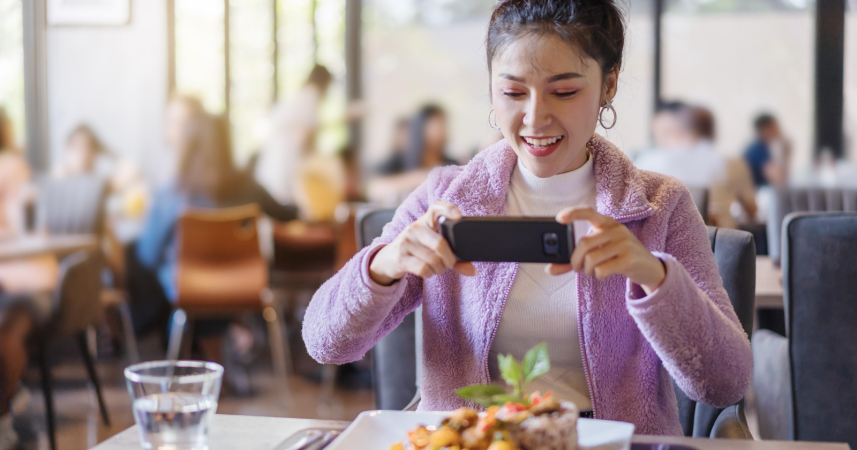
While documenting life's moments seems harmless, psychologists have discovered that people who compulsively post everything online are often trapped in validation-seeking behaviors that rob them of genuine experiences and authentic connections.

Add VegOut to your Google News feed. 
Ever notice how some people seem to photograph their morning coffee every single day?
Or how certain friends can't enjoy a concert without filming the entire thing through their phone screen?
I used to be one of those people.
Not the coffee photographer, but close enough.
My turning point came when I realized I'd spent an entire sunset scrolling through comments on a photo of... the same sunset I was missing in real time.
Talk about irony.
This constant documenting isn't just about sharing memories anymore.
Psychology research suggests it's often tied to deeper validation patterns that can actually harm our well-being.
When we're more focused on crafting the perfect post than living the actual moment, something's off balance.
After years of observing this in myself and others, and diving into the psychological research behind it, I've identified seven validation patterns that tend to plague those of us who feel compelled to broadcast every life event.
If you find yourself unable to enjoy a meal without photographing it first, this might hit home.
1) Living for the likes instead of the moment
Remember the last time you did something purely for yourself, without thinking about how it would look online?
If you had to think hard about that, you're not alone.
Research from the University of Pennsylvania found that heavy social media users often experience what psychologists call "audience consciousness," where every experience becomes a potential performance.
I learned this the hard way when I published my first viral article.
The rush of seeing those numbers climb was intoxicating.
But then I found myself crafting every subsequent piece not for what I wanted to say, but for what I thought would get the most engagement.
The work suffered.
My authenticity suffered.
And honestly? The likes started dropping anyway because people could sense the inauthenticity.
When we live for external validation through likes and comments, we lose touch with our internal compass.
We start choosing restaurants based on how Instagram-worthy they are, planning vacations around photo opportunities, and worst of all, experiencing life through a screen rather than our own senses.
2) Using comparison as your primary measurement tool
Social psychologist Leon Festinger's theory of social comparison tells us that humans naturally evaluate themselves relative to others.
But social media has turned this occasional tendency into a constant, exhausting marathon.
Every time you post, you're not just sharing.
You're competing.
Did your vacation photos get as many likes as your friend's?
Why did their announcement get more comments than yours?
This comparison trap is particularly vicious because we're comparing our behind-the-scenes reality with everyone else's highlight reel.
Studies show this constant comparison correlates strongly with increased depression and decreased life satisfaction.
3) Seeking permission to feel your feelings
"Is it okay that I'm upset about this?"
"Should I be happy about my promotion?"
"Am I overreacting?"
If you find yourself posting vague emotional updates and waiting for others to validate your feelings, you've handed over the keys to your emotional well-being to strangers on the internet.
Psychologists call this external emotional regulation, and it's exhausting.
When we need others to confirm that our feelings are valid before we can fully experience them, we're essentially outsourcing our emotional lives.
Your feelings are valid simply because you're feeling them. You don't need 47 comments agreeing with you to make them real.
4) Creating memories for content rather than connection
A few years ago, I realized something unsettling.
I'd been performing friendships rather than experiencing them.
Every gathering became a photo shoot.
Every meaningful conversation got interrupted for the perfect candid shot.
Research from the Journal of Experimental Social Psychology found that taking photos during experiences can actually reduce our enjoyment and memory of those moments.
We become so focused on documentation that we miss the actual experience.
Think about it.
When was the last time you went to dinner with friends and nobody pulled out their phone?
When did you last attend a wedding and just watched the ceremony instead of recording it?
These moments of genuine presence have become surprisingly rare.
5) Measuring self-worth through online engagement
The dopamine hit from social media notifications is real.
Neuroscience research shows our brains respond to likes and comments similarly to how they respond to gambling wins or drug hits.
No wonder we get addicted.
But when your mood for the entire day depends on how well your morning post performed, you've given away too much power.
I learned that conquering my achievement addiction meant recognizing that external validation was never going to be enough.
There would always be someone with more followers, more engagement, more apparent success.
Your worth isn't determined by your follower count. It never was.
6) Experiencing withdrawal when disconnected
Can you go 24 hours without checking your social media? How about 48?
If the thought makes you anxious, you're experiencing what researchers call FOMO, fear of missing out.
But here's what I discovered during my regular digital detox weekends: the only thing I was missing out on was my actual life.
The irony is thick.
We document everything because we don't want to forget, but we're so busy documenting that we're not fully present to create real memories in the first place.
7) Confusing visibility with vulnerability
Sharing everything isn't the same as sharing authentically.
In fact, constant posting can be a shield against real vulnerability.
Publishing that viral article taught me something crucial.
Real vulnerability isn't about sharing every detail of your life.
It's about sharing the truth of your experience, even when it's messy or unflattering.
There's power in that kind of authentic sharing, but it's entirely different from the compulsive documentation of every life event.
When I shifted from maintaining a large network for career purposes to nurturing a small, close circle of friends, I discovered what real connection felt like.
No performance required.
Final thoughts
If you recognized yourself in these patterns, you're already ahead of the game.
Awareness is the first step toward change.
These behaviors aren't character flaws.
They're coping mechanisms we've developed in response to a world that constantly demands our performance.
But just because everyone else is doing it doesn't mean it's serving you.
Try this: pick one day this week to experience without documenting.
Eat a meal without photographing it.
Take a walk without posting about it.
Have a conversation without sharing quotes from it.
Notice how it feels to have experiences that belong only to you.
Notice the freedom in not needing anyone else's approval or acknowledgment.
Notice how much more you actually remember when you're not viewing life through a screen.
Your life is valid whether you document it or not.
Your experiences matter whether anyone else sees them or not. And you are enough, with or without the likes to prove it.












