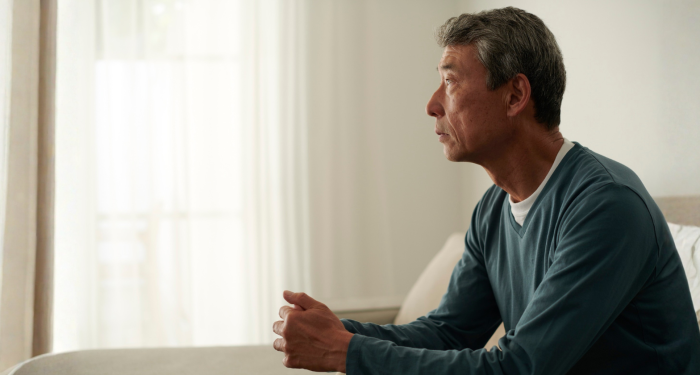
Behind the reflexive "I'm fine" response that rolls off the tongues of countless older adults lies a silent epidemic of isolation, depression, and cognitive decline that most sufferers don't even realize they're experiencing.

Add VegOut to your Google News feed. 
"How are you doing, Margaret?"
"Oh, I'm fine, dear. Just fine."
I heard this exchange at the grocery store last week, and something about the way Margaret said "fine" made my chest tighten. Maybe it was the slight pause before she answered, or how her smile didn't quite reach her eyes.
But mostly, it reminded me of myself during those six months after my second husband died, when "fine" became my automatic response to every well-meaning inquiry, even as I barely left the house.
We've turned "fine" into a social password, haven't we? A quick way to move past the uncomfortable question of how we're really doing. But for older adults especially, this simple word has become a dangerous mask that hides genuine suffering.
The psychology of being "fine"
When I was going through my people-pleasing phase (which, let's be honest, lasted most of my life until therapy in my 50s), I became an expert at "fine." It was easier than explaining that I felt invisible, that divorce had cost me most of my couple friends, or that learning to sleep alone after 25 years of marriage felt like drowning in an ocean-sized bed.
But here's what psychology tells us: older adults who consistently describe themselves as "fine" are often the ones struggling most. Research from Cambridge examining self-reported health among community-dwelling older adults found that depressive symptoms and multimorbidity are associated with lower self-reported health, suggesting that those who claim to be "fine" may be underreporting health issues.
Think about that for a moment. The very people who need help most are the ones least likely to ask for it, hiding behind a word that's become socially acceptable shorthand for "please don't dig deeper."
Why older adults hide their struggles
Erik Krom, president of Clear Creek Advisors, notes that "This often comes from childhood experiences." Many of us grew up in generations where admitting struggle was seen as weakness, where "pulling yourself up by your bootstraps" was the only acceptable response to hardship.
I remember sitting in my therapist's office, finally admitting that I wasn't fine at all. That after years of being the strong one, the caregiver, the one who had it all together, I was exhausted from the performance. She asked me a simple question that changed everything: "What would happen if you told people the truth?"
The answer terrified me. I might burden them. They might think less of me. They might stop inviting me places (though honestly, after my divorce, that ship had already sailed with many of my former couple friends).
The hidden cost of silence
What scares me most about our collective "fineness" is what it's actually costing us. Elena Portacolone, a Professor of Sociology, warns that "There is strong evidence that living alone increases the likelihood of developing dementia."
Can you imagine? The very isolation we're trying to hide could be actively harming our cognitive health. It's like we're slowly poisoning ourselves with politeness.
A recent study found that depressive symptoms mediate the relationship between social isolation and subjective cognitive decline in older adults, suggesting that those who report being "fine" may be silently suffering from depression leading to cognitive issues. We're not just hiding our pain; we're potentially accelerating our decline by refusing to acknowledge it.
Breaking the stigma around struggle
Lona Choi-Allum, a Senior Research Adviser, puts it perfectly: "We need people to talk about it so there's not this stigma associated with it."
But how do we start that conversation when we've spent decades perfecting the art of appearing fine?
I think about my own journey toward honesty. It started small. Instead of "fine," I began saying things like "It's been a challenging week" or "I'm working through some things." Not a full emotional download on the grocery store clerk, mind you, but enough honesty to crack open the door to real connection.
The response surprised me. People didn't run away. Instead, they often shared their own struggles. It turns out that my "fine" had been keeping others at arm's length, preventing the very connections I desperately needed.
Recognizing when "fine" isn't fine
How do you know if your "fine" is masking something deeper? In my experience, it often shows up in unexpected ways. Maybe you find yourself canceling plans more often. Perhaps you're sleeping poorly but telling yourself it's just age. Or you notice that activities you once enjoyed feel like too much effort.
Research indicates that older adults with serious mental illness often report unmet needs in areas such as housing, access to care, and social support, highlighting that self-reports of being "fine" may mask significant challenges.
After my husband died, I thought I was handling things well. I got up every day, did my errands, answered "fine" to every inquiry. But I'd also stopped reading, something I'd done daily for decades. I told myself I was just tired, but looking back, I see it was depression wearing the mask of "fine."
The path forward
Elena Portacolone reminds us that "We now know that a lack of strong ties and emotional connections can affect a person's health."
So where do we go from here? How do we move beyond "fine" to something more honest, more connected, more real?
It starts with recognizing that admitting struggle isn't weakness. It's actually the opposite. There's tremendous courage in vulnerability, in saying "Actually, I'm having a hard time" or "I could use some support."
I've learned to check in with myself before automatically responding "fine." Am I really fine, or am I just avoiding the discomfort of honesty? Sometimes I am genuinely fine, and that's wonderful. But when I'm not, I'm learning to say so, even if my voice shakes a little.
Final thoughts
Yesterday, I ran into an old friend at the library. When she asked how I was doing, I paused. Then I said, "You know, it's been a tough month. My arthritis is acting up and I've been feeling a bit isolated."
Her whole face changed. "Oh thank goodness," she said. "I thought I was the only one struggling. Can we grab coffee?"
That's the gift hidden in moving beyond "fine." When we dare to be honest about our struggles, we give others permission to do the same. And in that shared vulnerability, we find the connections that make life worth living, at any age.
What’s Your Plant-Powered Archetype?
Ever wonder what your everyday habits say about your deeper purpose—and how they ripple out to impact the planet?
This 90-second quiz reveals the plant-powered role you’re here to play, and the tiny shift that makes it even more powerful.
12 fun questions. Instant results. Surprisingly accurate.