
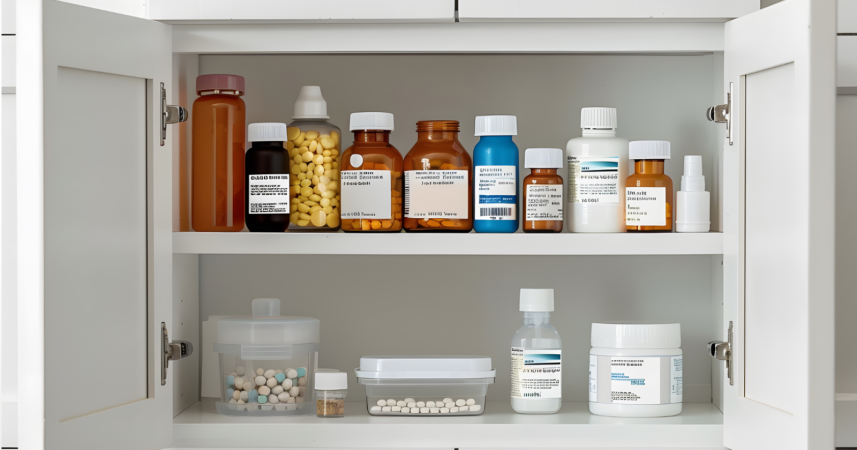
Your medicine cabinet might be a psychological goldmine—those expired bottles and forgotten tubes you've been ignoring could reveal surprising truths about your deepest fears, control issues, and the person you desperately want to be versus who you really are.

Add VegOut to your Google News feed. 
Ever peeked into someone's medicine cabinet and wondered what it says about them?
We all have that drawer or shelf where half-used tubes and forgotten bottles go to die.
But here's what fascinated me when I started researching this topic: Our medicine cabinets are like psychological time capsules, revealing patterns we don't even realize we have.
After helping my aging parents downsize last year, I stumbled upon their medicine cabinet that hadn't been cleared out in ages.
Between expired cough syrups from 2015 and ancient bottles of aspirin, I started noticing something interesting. The items we hold onto, even when they're well past their prime, tell a story about our habits, fears, and quirks.
So I dove into the research, and what I found was pretty eye-opening. Psychologists have actually studied this phenomenon, and it turns out that certain expired items correlate with specific personality traits and behaviors.
Ready to discover what your medicine cabinet might be revealing about you?
1) Expired prescription medications
If you're holding onto that antibiotics bottle from your bout with strep throat three years ago, you might be displaying what psychologists call "just in case" thinking.
This habit often indicates difficulty letting go of the past and a tendency toward catastrophic thinking.
You're essentially preparing for emergencies that statistically won't happen, while potentially creating actual risks by keeping medications that could become harmful over time.
People who keep expired prescriptions often struggle with decision fatigue in other areas of life too.
Sound familiar? You might be the person with 47 browser tabs open or the one who takes forever to choose a restaurant because you're trying to prepare for every possible scenario.
The deeper pattern here? Control issues. When we feel uncertain about the future, we try to control it by hoarding resources, even useless ones.
2) Old sunscreen bottles
Found that crusty bottle of SPF 30 from your beach vacation in 2019?
This one hits close to home for me. As someone who loves trail running, I used to have a collection of half-empty sunscreen bottles scattered everywhere.
What I discovered through my journaling practice was that holding onto these items reflected my relationship with self-care.
People who keep expired sunscreen often display what researchers call "aspirational hoarding." You're not just keeping sunscreen; you're keeping the idea of the person who regularly applies it.
The person who goes on adventures, who takes care of their skin, who has their life together.
But here's the kicker: Keeping the expired version actually prevents you from being that person. You're living in the fantasy instead of the reality.
These individuals often struggle with follow-through on health goals and tend to buy gym memberships they rarely use.
3) Ancient first-aid supplies
Those Band-Aids that lost their stick five years ago? The gauze that's turned slightly yellow?
If this is you, psychology suggests you might be what experts call a "security accumulator." You find comfort in being prepared, even when that preparation is more illusion than reality.
This behavior often stems from childhood experiences where you learned that having supplies meant safety. Maybe your family struggled financially, or perhaps you had a parent who was always prepared for everything.
Now, as an adult, you're recreating that sense of security through accumulation.
The challenge? These folks often struggle with trust. If you can't trust that you'll be able to get a Band-Aid when you need one, what else in life feels uncertain?
4) Expired vitamins and supplements
That bottle of vitamin D from 2018 gathering dust behind your mirror might be telling you something important about your relationship with commitment.
People who hoard expired vitamins often start projects with enthusiasm but struggle to maintain momentum.
You buy the vitamins with the best intentions, take them for a week, then forget about them. But throwing them away would mean admitting failure, so they sit there, a monument to good intentions gone stale.
I used to be terrible with this. At one point, I counted 14 different supplement bottles in my cabinet, most barely touched. It wasn't until I recognized this pattern through journaling that I saw how it mirrored other areas of my life.
Starting strong, fading fast, then holding onto the evidence rather than accepting and moving on.
5) Old tubes of antibiotic ointment
Multiple tubes of Neosporin with the expiration dates worn off? Welcome to the club of chronic worriers.
People who stockpile antibiotic ointments often display heightened anxiety about minor injuries and infections.
You're the person who treats every papercut like a medical emergency, who Googles symptoms at 2 AM, who always assumes the worst-case scenario.
This habit often pairs with perfectionism. You want to be prepared for any mishap, any imperfection, any tiny wound that might mar your carefully controlled existence.
Trust me, as someone who discovered through old report cards that I've been a perfectionist since elementary school, I get it. But expired ointment won't protect you from life's inevitable scrapes.
6) Outdated pain relievers
If your medicine cabinet looks like a pharmacy graveyard of ibuprofen and acetaminophen bottles, you might be displaying what psychologists call "pain avoidance behavior."
This goes beyond physical pain. People who hoard pain relievers often struggle with emotional discomfort too. You want immediate solutions to problems, quick fixes to complex issues.
Keeping multiple bottles, even expired ones, gives you the illusion that relief is always within reach.
The irony? Expired pain medications can actually be less effective or even harmful, meaning your safety net has holes in it. This mirrors how avoiding emotional pain often creates more suffering in the long run.
7) Expired cough and cold medicines
That rainbow of cough syrups from winters past? They reveal a tendency toward what researchers call "seasonal pessimism."
You're preparing for the worst every winter, buying new medicines without checking what you already have, creating a stockpile of remedies for illnesses you statistically won't get.
People with this habit often struggle with scarcity mindset in other areas, buying extra food they won't eat, keeping clothes that don't fit, saving things "just in case."
For years, I believed that being prepared meant being productive, that having supplies meant being responsible. It took me a long time to realize that sometimes, letting go is the most responsible thing you can do.
Final thoughts
What does all this mean if you recognized yourself in several of these categories?
First, you're definitely not alone. Most of us have at least a few expired items lurking in our medicine cabinets. The question isn't whether you have them, but whether you're ready to examine what they represent.
Clearing out your medicine cabinet isn't just about safety or organization. It's about confronting the stories you tell yourself, the fears you're holding onto, and the person you're trying to be versus who you actually are.
Start small. Pick one category and ask yourself: What am I really keeping here? What would happen if I let it go? Often, the anxiety about throwing something away is worse than actually doing it.
Remember, every expired item you keep is taking up space that could be filled with something current, effective, and actually useful. The same goes for outdated habits and fears.
Sometimes the best medicine is simply making room for what actually works.
What’s Your Plant-Powered Archetype?
Ever wonder what your everyday habits say about your deeper purpose—and how they ripple out to impact the planet?
This 90-second quiz reveals the plant-powered role you’re here to play, and the tiny shift that makes it even more powerful.
12 fun questions. Instant results. Surprisingly accurate.












