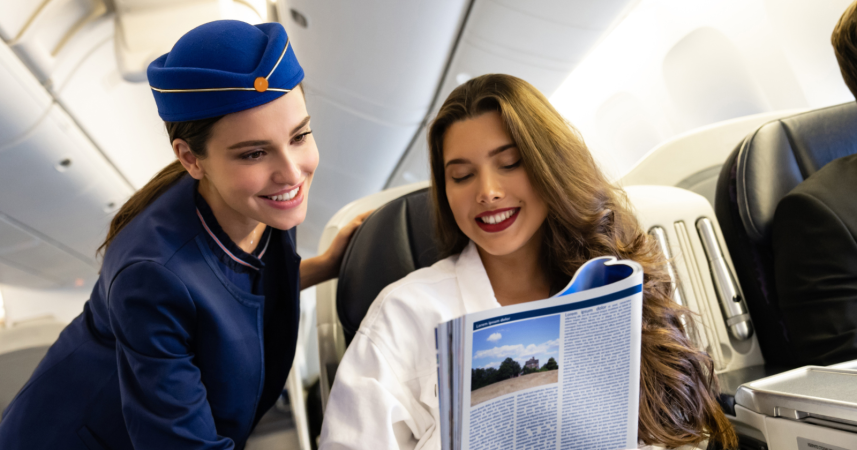
Your automatic reach for that aisle seat is about revealing deep-seated control patterns that show up everywhere from your restaurant seating choices to how you handle relationships.

Add VegOut to your Google News feed. 
Ever caught yourself making a beeline for the aisle seat on a plane, even when there's a perfectly good window seat available?
I'll confess something: I used to think my preference for aisle seats was purely practical.
Easy bathroom access, quick exit strategy, no climbing over strangers; after diving deep into the psychology of seating preferences, I've realized there's so much more to it.
If you're an aisle seat devotee like me, you might be displaying some fascinating control patterns in your personality.
Before you get defensive (trust me, I did too), these are just worth understanding.
Think about it: When you choose an aisle seat, you're choosing freedom of movement over the view, and you're prioritizing your ability to leave when you want over the comfort of leaning against the window.
That choice reveals more about you than you might think.
1) You need an escape route
Let me ask you something: Do you always sit facing the door in restaurants? Do you feel uncomfortable when your back is to the room?
If you're nodding along, welcome to the club.
Aisle seat lovers often have what psychologists call a "high need for environmental control."
We like knowing we can leave whenever we want.
Being trapped between a window and two strangers? That's our personal nightmare.
This tendency often shows up in other areas too.
You might find yourself avoiding commitments that feel too binding or getting anxious when plans are set in stone without flexibility.
The need for an escape route is about maintaining a sense of personal autonomy.
I discovered that my own need for this kind of control actually stemmed from childhood anxiety about my parents' approval.
When situations felt overwhelming as a kid, I'd retreat to my room.
As an adult, that translated into always needing a way out, whether physical or metaphorical.
2) You prioritize function over comfort
Window seats are objectively more comfortable for sleeping.
You get a wall to lean on, nobody climbing over you, your own little cocoon of space.
Yet here we are, choosing the aisle anyway.
This reveals a personality trait that extends far beyond airplane seating.
You likely value practicality and efficiency over pure comfort in many areas of your life.
Maybe you choose sensible shoes over stylish ones, or you'd rather have a functional bag than a fashionable one that barely holds your phone.
There's nothing wrong with being practical, but sometimes this tendency can rob us of simple pleasures.
When was the last time you chose the scenic route instead of the fastest one? Or picked a restaurant for ambiance rather than convenience?
3) You struggle with vulnerability
Picture yourself in a window seat: You're literally cornered, dependent on others to move if you need anything.
For many aisle seat preferrers, this physical vulnerability mirrors an emotional pattern.
Do you find it hard to ask for help? Would you rather struggle alone than admit you need support? The same independence that makes you choose the aisle might be keeping you from deeper connections.
I learned this the hard way when I had to overcome some compulsive exercise tendencies.
Part of my recovery involved learning that rest is productive, that needing downtime doesn't make me weak.
Similarly, being "trapped" in a window seat doesn't make you helpless.
Sometimes surrendering control can actually be freeing.
4) You're always preparing for worst-case scenarios
Quick question: When you board a plane, do you mentally note where the emergency exits are? Do you think through what you'd do if something went wrong?
Aisle seat lovers tend to be contingency planners; we're the ones with backup plans for our backup plans.
While this can be a strength (we're rarely caught completely off guard), it can also be exhausting.
This hypervigilance often extends beyond travel.
You might find yourself constantly anticipating problems at work, in relationships, or in daily life.
The mental energy spent preparing for disasters that rarely happen could be used for actually enjoying the present moment.
5) You have trouble being still
Here's something I noticed about myself: Even when I don't need the bathroom, even when I have nowhere to go, I feel better knowing I could get up if I wanted to.
Sound familiar?
This restlessness isn't just physical as people who prefer aisle seats often struggle with mental stillness too.
Meditation might feel torturous, and sitting through a long movie without checking your phone might seem impossible.
I had to learn to sit with discomfort instead of immediately problem-solving it away.
Now, I schedule my writing time in focused 90-minute blocks with breaks between, honoring both my need for movement and my need for deep focus.
6) You value independence above connection
Choosing an aisle seat means choosing independence over the shared experience of looking out the window with your travel companion.
It's choosing your own needs over the potential for connection.
This pattern might show up in how you approach relationships too.
Do you maintain strict boundaries even with close friends? Do you pride yourself on never being a burden to anyone?
Independence is valuable, but taken to an extreme, it can become isolation.
Sometimes choosing the middle seat next to someone you love, even if it's less comfortable, is worth more than all the freedom in the world.
7) You need to feel in charge of your environment
The aisle seat is the captain's seat of economy class.
You control when people in your row can get up (they need to wake you or ask you to move), you have easier access to the overhead bins, and you interact with the flight attendants more directly.
This need for environmental control often reflects a deeper pattern.
You might be someone who rearranges hotel room furniture, who has strong opinions about restaurant seating, who feels unsettled in spaces you can't modify.
Understanding this about yourself can be powerful.
My analytical skills from my finance days translated perfectly into breaking down psychological concepts like this one.
Once you recognize your patterns, you can choose when to lean into them and when to challenge them.
Final thoughts
So, what does all this mean if you're an aisle seat person?
Are you doomed to a life of control issues and emotional distance? Absolutely not!
These patterns are simply aspects of your personality to understand and work with.
Maybe you'll still choose the aisle seat, but now you'll know why, or maybe you'll occasionally pick that window seat and practice letting go.
Next time you're booking a flight, pause before automatically selecting that aisle seat.
Ask yourself: What would happen if I chose differently this time? The answer might surprise you.
After all, the view from the window can be pretty spectacular when you allow yourself to enjoy it.