
None of these details make you a good or bad person; they are simply clues that show how your history, beliefs, and current habits are being translated into physical reality.
We learn a lot about money and social class in boardrooms and spreadsheets.
But honestly, some of the clearest clues are hiding in plain sight at home, in the space where we flop on the couch, binge shows, and host friends.
Social class is more about habits, expectations, and what feels “normal” to you.
Your living room quietly reflects that; it shows how you treat yourself, what you prioritize, and the stories you carry from childhood about money, comfort, and “people like us.”
So as you read, try this question on: If a stranger walked into my living room today, what story would they tell about my life?
Let’s go through six details that give surprisingly strong signals, and, more importantly, how you can reshape them so your space reflects the class identity you are growing into, not just the one you came from.
1) The sofa tells a story
If your living room were a novel, the sofa would be the main character.
Think about yours for a second: Is it sagging in the middle? Covered in laundry? Stained from takeout and red wine? Or is it reasonably clean, with cushions that still have some structure and a throw blanket that looks like it was placed there on purpose?
When I worked as a financial analyst, I noticed a funny pattern whenever I visited clients at home.
People could have wildly different incomes, but the sofa nearly always matched their mindset.
Some high earners had expensive couches they treated like a dining chair at a fast-food place, and some middle-income families had modest but beautifully cared-for seating that said, “We respect ourselves here.”
The sofa reveals things like:
- Do you believe you deserve comfort, or are you used to “making do”?
- Do you see your home as temporary chaos or as something worth curating, even on a budget?
- Do you plan for the long term, or replace things only when they totally fall apart?
You do not need a designer piece to send a “higher class” signal.
Wash the covers, fix the legs, rotate the cushions, or add one good-quality pillow in a solid color.
Even a thrifted sofa can look elevated if it is clean, cared for, and positioned so people can talk to each other instead of only staring at a screen.
Your sofa should say, “People are welcome here, including me.”
2) Clutter versus systems
Let’s talk about surfaces: What is on your coffee table, TV console, and side tables right now?
The big class reveal here is about whether there are systems or just piles.
Growing up, our living room often doubled as an overflow storage unit.
The coffee table was a graveyard for mail, school forms, and things my parents were “dealing with later.”
There was nothing morally wrong with that, life was busy and money was tight, but when I started visiting homes where people had more education and more generational stability, I noticed something.
They had just as much “stuff” to handle, yet surfaces were clearer; there were drawers, labeled boxes, baskets, and routines.
Higher social class often shows up as: “Everything has a place, even the ugly, boring things.”
Here is the shift you can make, even if your space is small:
- Create one “intake zone” for mail and papers, not five.
- Use a tray or shallow basket on the coffee table for remotes and chargers.
- Decide a weekly reset time for your living room, even fifteen minutes.
That energy reads as higher class, no matter the size of your home.
3) What lives on your walls
Bare walls can signal “I just moved in” or “I am not sure I deserve to root myself here.”
On the other hand, every inch covered with cheap mass prints or random word art can feel more chaotic than curated.
The content matters too. Is it mostly generic quotes from big-box stores, or is there some mix of:
- Personal photos printed nicely
- Art from local creators
- Travel memories
- Pieces that reflect your values or interests
Social class is also about cultural capital, the idea of what you have been exposed to and how you express that.
People who grew up around art, books, and museums tend to treat wall space as something to compose, not just fill.
You can absolutely build that, even if you did not grow up with it.
Ask yourself: If someone looked only at my walls, what would they guess I care about?
Adjust until the answer feels true and slightly aspirational, not borrowed from a catalog.
4) Lighting and how you treat your space after dark
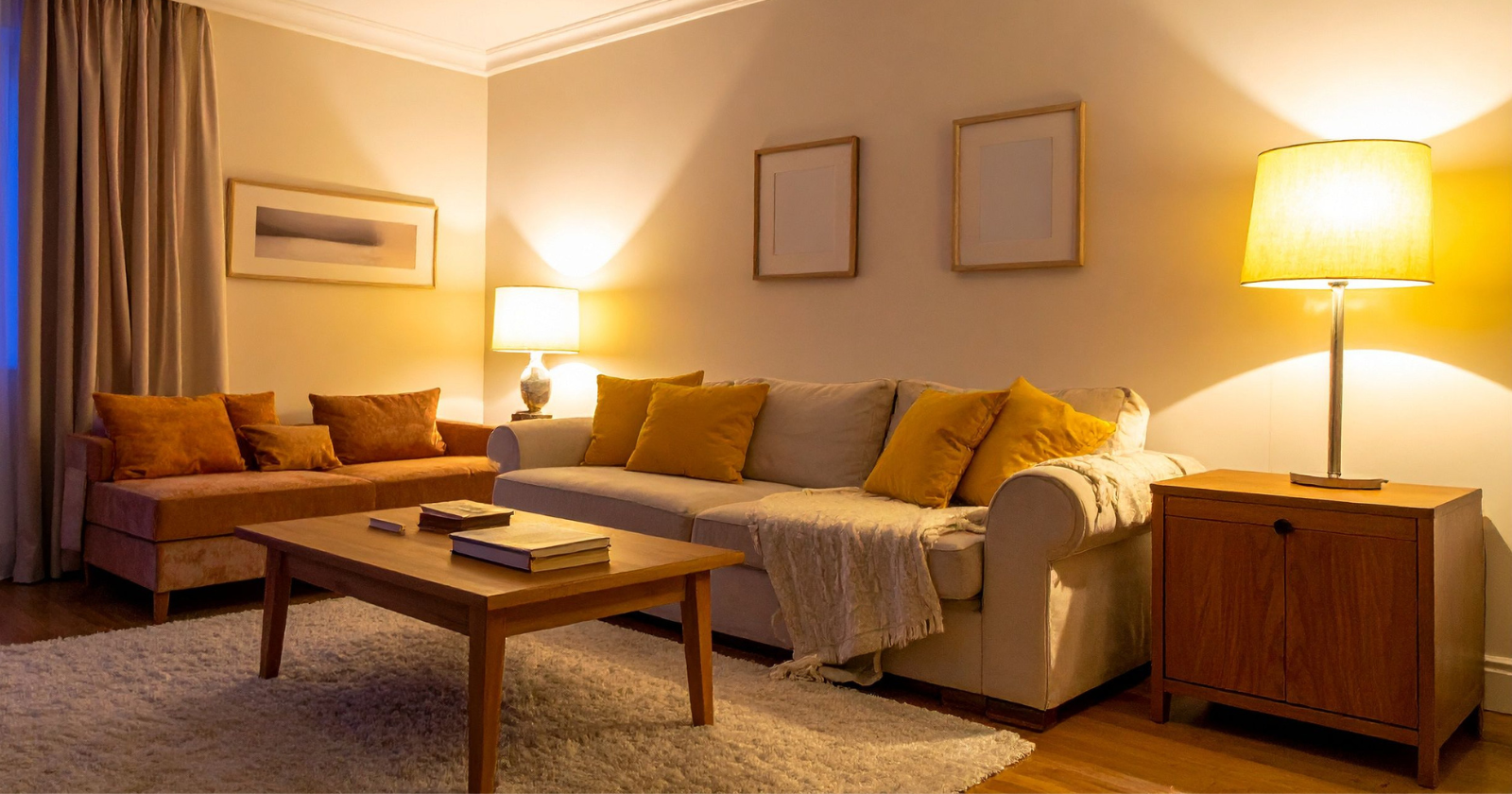
Lighting is one of those quiet details that separates “I live here because I have to” from “I live here because I choose to.”
Many people rely on a single harsh overhead light.
It is functional, but it makes the room feel like a waiting room or a warehouse.
That tends to signal survival mode, not intentional living.
Rooms that feel higher class usually have layered lighting:
- A floor lamp or two
- A table lamp by the couch
- Warmer bulbs instead of the brightest cold white option
- Maybe a candle or two in the evenings
None of this has to be expensive.
Thrift stores and online marketplaces are full of lamps that just need a new bulb, but the message layered lighting sends is powerful.
It says, “I care how I experience my own life. I am not just getting through the day.”
Soft, warm light also changes how people behave.
We relax more, speak more softly, stay a little longer.
It feels like a space designed for connection and conversation, not just tasks.
If you want one quick upgrade that instantly shifts how “classy” your living room feels, I would start here.
5) The relationship between screens, books, and conversation
I have nothing against a big TV.
I watch shows, I love movies, and I absolutely have evenings where I just want to zone out on the couch, but it is worth noticing the role screens play in your living room hierarchy.
Is the TV the altar of the room, with all furniture pointed nervously toward it like worship? Are there any other focal points, like a plant, a bookcase, or a piece of art? Do people sit where they can see each other, or only where they can see the screen?
Higher social class is often associated with spaces that support multiple types of attention: watching, reading, talking, playing games, doing nothing.
Here are some revealing questions:
- If the TV broke for a week, would your living room still invite you in?
- Can someone sit comfortably and chat without feeling they are interrupting the show?
- Are there any visible books or magazines that reflect your interests and growth?
A single small shelf or stack of books you actually read changes the energy of a room.
It sends a signal of curiosity and ongoing learning, which is a hallmark of upward mobility and self-development.
6) How you host yourself and others
Finally, let’s look at hospitality, even the tiny everyday version.
I am vegan and spend a lot of time around farmers’ markets, so my living room usually has a bowl of fruit or some seasonal veggies on the table.
It reminds me that nourishment is central, not an afterthought.
You do not need a perfectly styled fruit bowl, of course.
But ask yourself:
- If a friend dropped by, could you comfortably offer them a drink without scrambling?
- Do you have at least two or three matching mugs or glasses that feel decent in your hand?
- Are you sitting on chairs that wobble or smell faintly of last week’s leftovers?
I have seen plastic chairs in small homes that were spotless, with a folded blanket on top to make them comfortable; I have also seen luxury sofas with crumbs, pet hair, and mysterious stains that clearly no one had tried to tackle in months.
Class signals here are about care, not cost.
Think of it as hosting yourself too: When you walk into your own living room at the end of a long day, does it feel like a place that is happy you are home?
Final thoughts
None of these details make you a good or bad person as they do not define your worth, your potential, or your intelligence.
They are simply clues; they show how your history, beliefs, and current habits are being translated into physical reality.
The beautiful part is that they are also levers and you can shift them.
You do not have to tackle everything at once: Pick one area from this list and make a tiny upgrade this week.
Clean, rearrange, swap one item, or add one thing that feels like the future version of you.
Social class is also practiced; every choice you make in your living room is a quiet rehearsal for the life you are building next.
Just launched: Laughing in the Face of Chaos by Rudá Iandê
Exhausted from trying to hold it all together?
You show up. You smile. You say the right things. But under the surface, something’s tightening. Maybe you don’t want to “stay positive” anymore. Maybe you’re done pretending everything’s fine.
This book is your permission slip to stop performing. To understand chaos at its root and all of your emotional layers.
In Laughing in the Face of Chaos, Brazilian shaman Rudá Iandê brings over 30 years of deep, one-on-one work helping people untangle from the roles they’ve been stuck in—so they can return to something real. He exposes the quiet pressure to be good, be successful, be spiritual—and shows how freedom often lives on the other side of that pressure.
This isn’t a book about becoming your best self. It’s about becoming your real self.