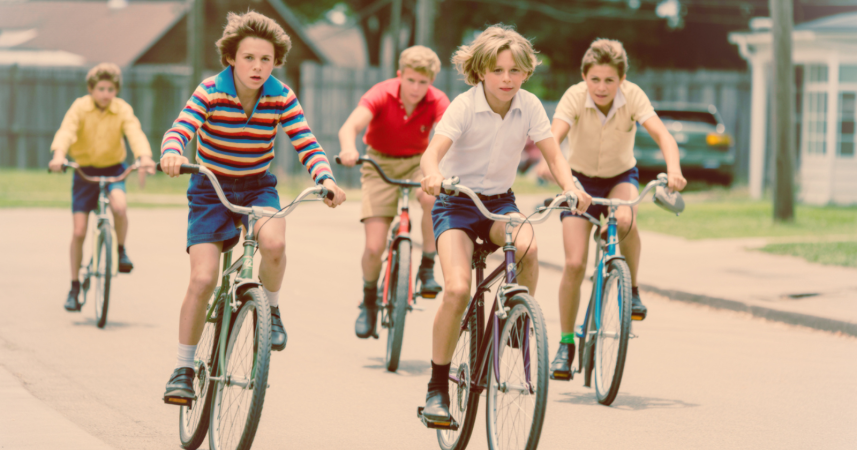
Growing up unsupervised taught us to survive anything except our own emotions — and forty years later, we're still learning the difference between being tough and being numb.
Here's the seventies toughness story we love to tell ourselves: the lack of seatbelts and supervision and emotional check-ins forged a sturdier generation. I'm not sure that's true anymore. I think a lot of what we call resilience was just a high tolerance for things no one should have had to tolerate, dressed up in a leather jacket and called character.
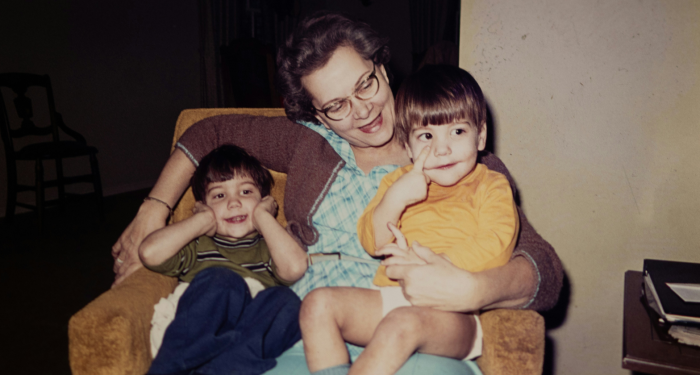
I started thinking about this last Thursday, when my granddaughter asked me why old photos show kids bouncing around in the backs of station wagons like loose groceries. I told her that's just how things were. She looked at me like I'd survived a war, which in a way, maybe I had. A war against common sense that somehow we all lived through, more or less intact. Or at least that's what we tell ourselves.
The truth is more complicated. Those of us who grew up in the seventies learned a particular brand of toughness that I'm still trying to untangle from genuine resilience. We learned to walk it off, rub some dirt on it, stop crying or I'll give you something to cry about. We learned that feelings were luxury items we couldn't afford.
The gift and curse of benign neglect
My childhood was supervised by physics and luck. Parents didn't hover. They existed somewhere in the peripheral vision of our adventures, usually holding a cigarette and a cup of coffee that had gone cold hours ago. We left the house after breakfast and returned when the streetlights came on, our days punctuated only by hunger and the setting sun.
This freedom taught us self-reliance. When I crashed my bike trying to jump four garbage cans, there was no parent rushing over with band-aids and sympathy. I walked the bike home, blood running down my shin, and cleaned it myself with hydrogen peroxide that bubbled like a science experiment. The scar is still there, a small white line that reminds me I learned to be my own first responder at age nine.
But here's what else I learned: that pain was private, that needing comfort was weakness, that the appropriate response to injury was to minimize it. "I'm fine" became my automatic response to everything from scraped knees to my parents' divorce. Fine was the only acceptable answer, so fine was what I became, even when I wasn't.
The mythology of natural consequences
We love to romanticize the hands-off parenting of the seventies. No participation trophies meant we learned to lose, we say. No helmets meant we learned to be careful. No constant supervision meant we learned independence. There's truth in this, but it's mostly a flattering story we tell to make sense of what happened to us.
Yes, I learned to lose. I also learned that losing meant disappearing, that second place was first loser, that if you weren't exceptional, you were invisible. Without participation trophies, some kids didn't learn resilience at all. They learned they weren't worth celebrating unless they won, and that lesson has followed many of them into careers, marriages, and parenting styles that still mistake achievement for worth.
The natural consequences we faced weren't always educational. Sometimes they were just consequences. My friend broke his arm falling from a tree we had no business climbing. He learned nothing except that his parents couldn't afford the emergency room visit, so his arm healed crooked. Natural? Yes. Character-building? That's harder to argue.
The emotional archaeology of growing up unseen
Nobody asked how I was feeling because feelings weren't part of the curriculum. You had them, presumably, but discussing them was like discussing your digestive system: unnecessary and vaguely embarrassing. Men especially lived in emotional prohibition, where anything beyond anger or humor was contraband.
I became fluent in the language of doing rather than feeling. Bad day at school? Mow the lawn. Parents fighting? Shoot baskets until dark. Confused about girls, grades, or the general chaos of adolescence? Build something, break something, fix something. Action was always the answer because action didn't require the vocabulary I'd never learned.
This created a peculiar kind of person. Highly functional, impressively productive, and emotionally illiterate. We could build a deck, fix a car, work through pneumonia, but ask us to identify what we were feeling beyond "good" or "fine," and we'd look at you like you'd asked us to explain quantum physics.
When tough becomes brittle
The problem with being raised to be tough is that tough things tend to break rather than bend. I discovered this in my thirties when my marriage ended, when life threw punches I couldn't walk off or rub dirt on. The coping mechanisms that had served me through childhood (denial, distraction, and doubling down on work) suddenly weren't enough.
What nobody tells you about growing up without emotional support is that eventually, you have to become your own emotional support, and you have no model for what that looks like. It's like being asked to speak a language you've never heard. You know other people do it, you see their mouths moving, but the sounds mean nothing to you.
I spent years thinking therapy was for people who couldn't handle life, not realizing that handling life and processing life are different things. I was handling everything beautifully on the surface: successful restaurant, nice house, kids who looked well-adjusted. Underneath, I was held together with workaholism and the kind of determination that looks like strength until it collapses.
Relearning what strength means
Real toughness, I've learned, isn't about endurance. It's about honesty. It's harder to say "I'm struggling" than to say "I'm fine." It takes more courage to ask for help than to go it alone. The kid who learned to set his own broken finger would be impressed by the adult who learned to admit when he was broken in ways that didn't show.
My generation confused numbness with resilience. We thought if we couldn't feel it, it couldn't hurt us. But those unfelt feelings didn't disappear. They calcified, creating an entire generation of adults who could survive anything except their own inner lives.
The participation trophy debate misses the point. It's not about whether kids should get trophies for showing up. It's about whether they should feel seen, valued, and worth celebrating regardless of their achievements. We can teach resilience without teaching neglect. We can raise tough kids without raising kids who are tough to reach emotionally.
Finding the balance between then and now
I don't want to return to the seventies, and I'm done pretending it gave me some secret superpower. There was something to be said for boredom, for figuring things out ourselves, for learning that our parents had lives beyond our needs. But the assumption that children didn't need emotional tending, that they'd grow straight like trees without any cultivation, did real damage that I'm still paying for in my sixties.
The answer isn't helicopter parenting or total neglect. It's presence without hovering, support without solving everything, teaching resilience while also teaching that needing help is human. It's asking kids how they're feeling and actually listening to the answer, even when the answer is complicated or inconvenient.
My grandchildren are growing up with seatbelts and helmets and adults who check in on their emotional wellbeing. They also climb trees, fail at things, and learn that not everyone gets a trophy. They're developing both toughness and emotional intelligence, learning that strength includes vulnerability, that independence doesn't mean isolation.
Final words
Recently, I taught my granddaughter to ride a bike. She wore a helmet, knee pads, and elbow pads, gear that would have marked me as the neighborhood weakling in 1975. When she fell, I didn't tell her to walk it off. I asked if she was hurt, if she was scared, if she wanted to keep trying. She thought about it, really thought about it, then said she wanted to try again.
That's the difference. She got to choose her response rather than having it chosen for her. She's learning to be tough, but she's also learning when toughness isn't the answer. She's developing resilience without developing scar tissue over her emotional life.
Here is what I've come to believe, after sixty-some years of carrying around the seventies in my body: we weren't tougher. We were trained not to flinch, which is a very different thing. The flinch was still there. It just went underground, and it found its way out later in marriages that ended badly, in bodies that broke down on schedule, in children who told us we were impossible to talk to. I don't think we should romanticize any of it. We endured what we shouldn't have had to endure, and calling that strength has cost us more than it ever gave us.